https://zenblis.com/glossary/elder-law-attorney
Elder-Law Attorney
Elder-law attorneys specialize in the legal issues that arise as families age — Medicaid and long-term care planning, advance directives, special needs trusts, guardianship, and more. The CELA designation is the gold-standard credential, recognized by the American Bar Association.
By Derek Belfield - 2026-04-28

Definition
An Elder-Law Attorney is a lawyer who specializes in the legal issues that affect aging adults and their families — including Medicaid and long-term care planning, estate planning, powers of attorney and advance directives, guardianship, special needs trusts, and elder abuse — with the most rigorously credentialed attorneys carrying the Certified Elder Law Attorney (CELA) designation from the National Elder Law Foundation.
Expanded definition
An Elder-Law Attorney is a specialist who organizes their practice around a population — older adults and people with disabilities — rather than around a single legal subject. Most areas of law are defined by what they cover (tax law, criminal law, and real estate). Elder law is defined by who it serves, which is why a single elder-law attorney often handles matters that would normally span three or four different legal specialties: Medicaid eligibility analysis, estate and trust planning, powers of attorney and advance directives, guardianship and conservatorship petitions, special needs trusts for adult children with disabilities, elder abuse and exploitation cases, age discrimination matters, and Social Security and veterans' benefits work. The practice exists because aging triggers a cluster of overlapping legal issues that few generalist attorneys handle competently.
CELA credential
The most consequential credential families should know about is the Certified Elder Law Attorney designation, abbreviated CELA. Created in 1994 by the National Elder Law Foundation and recognized by the American Bar Association, CELA was the first legal specialization the ABA ever accredited. Earning the credential requires demonstrating substantial recent experience in elder law, completing significant continuing legal education, providing peer references, and passing a full-day written examination with a famously low pass rate. As of recent years, only a few hundred to a few thousand CELAs practice nationwide — the credential is genuinely rare. Any attorney who has passed a state bar exam can call themselves an "elder law attorney." Only an attorney who has met the National Elder Law Foundation's standards and passed the supplemental exam can use the CELA designation. The National Academy of Elder Law Attorneys (NAELA), founded in 1988 with approximately 5,000 members, is the membership organization most elder-law attorneys belong to; it operates alongside but separately from the certification program.
What elder-law attorneys do
The work elder-law attorneys do most often for senior care families falls into a few common patterns. Medicaid asset-protection planning helps families preserve resources for the community spouse or for inheritance while qualifying a senior for nursing home or HCBS Waiver coverage — a process that is heavily regulated and can trigger serious penalties if done incorrectly within the 60-month look-back period. Crisis Medicaid planning helps families when a senior needs Medicaid benefits within 30-60 days, often after an unexpected hospitalization, using tools like Medicaid Compliant Annuities, Qualified Income Trusts (in income-cap states), and the Modern Half-a-Loaf strategy. Drafting and updating powers of attorney, healthcare proxies, advance directives, living wills, and HIPAA authorizations creates the legal foundation that senior care decisions depend on. Special needs planning establishes trusts for adult children with disabilities so they can inherit without losing means-tested government benefits. Guardianship and conservatorship petitions become necessary when a senior loses decision-making capacity without having executed POA documents in advance — a more expensive, public, and emotionally taxing process than planning would have been.
CMP v. CELA
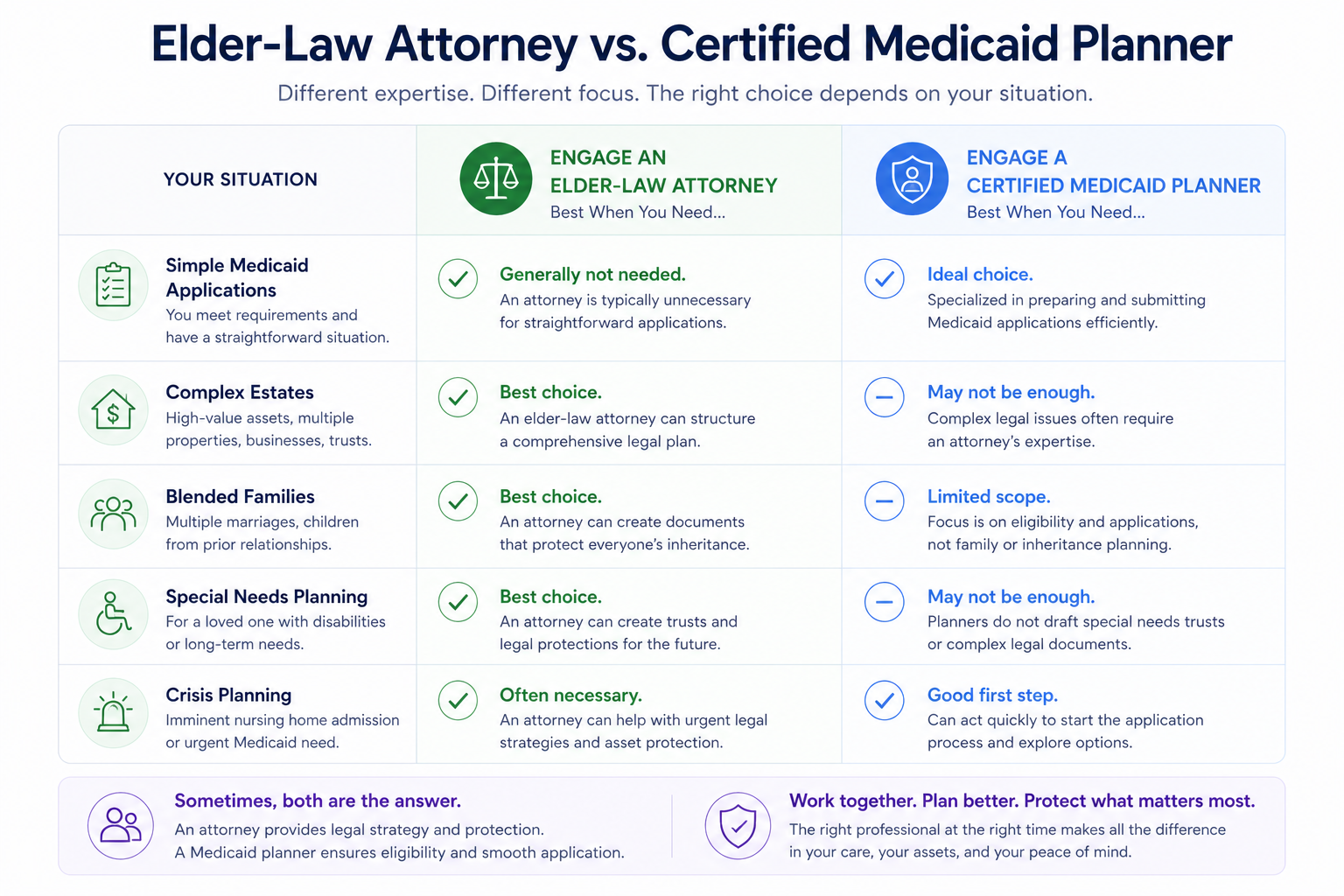
A practical distinction matters for families. Certified Medicaid Planners (CMPs) are non-attorney professionals who specialize in the administrative and procedural side of Medicaid applications — gathering documentation, calculating spousal allowances, completing forms, working with caseworkers, and navigating the bureaucratic process. CMPs are often faster and less expensive than elder-law attorneys for straightforward applications, particularly when a senior needs benefits quickly. Elder-law attorneys are typically the better choice when the family situation is complex — multiple business or real estate holdings, blended family dynamics, anticipated litigation, divorce or guardianship issues, special needs trusts, or coordination with broader estate planning. Many families benefit from working with both an attorney for the legal strategy and a CMP for application execution.
How to find an attorney
How to find an elder-law attorney is itself a question with state-by-state variation. NAELA's online directory at NAELA.org lets families search by state and zip code. The National Elder Law Foundation maintains a separate directory of CELAs at NELF.org. State bar associations sometimes maintain their own elder law sections with referral lists. Local Area Agencies on Aging often keep informal lists of attorneys who have worked well with their seniors. Cost varies widely — initial consultations are sometimes free, sometimes flat-fee, and sometimes billed hourly at rates ranging from a few hundred dollars to several hundred dollars per hour, depending on the market. For long-term care planning specifically, many elder-law attorneys offer flat-fee packages for common scenarios such as Medicaid asset-protection planning or comprehensive estate document preparation. Engaging early — before a crisis — is consistently the most-cited recommendation from elder-law attorneys themselves, because the most powerful planning tools require time to work within the look-back period rules.
Frequently Asked Questions
- What does an elder-law attorney do?
- Elder-law attorneys handle the legal issues that arise as people age — Medicaid and long-term care planning, asset-protection strategies, drafting powers of attorney and advance directives, guardianship and conservatorship petitions, special needs trusts for adult children with disabilities, estate and trust planning, elder abuse and exploitation cases, and Social Security and veterans' benefits work. The practice is defined by the population served (older adults and their families) rather than a single legal topic, which is why elder-law attorneys often handle matters that would normally cross several specialties.
- What is a CELA, and does my attorney need one?
- CELA stands for Certified Elder Law Attorney — a credential issued by the National Elder Law Foundation since 1994 and recognized by the American Bar Association as a legal specialization. CELAs must demonstrate substantial elder-law experience, complete significant continuing education, provide peer references, and pass a difficult full-day examination. Any lawyer can call themselves an "elder law attorney"; only those who have met the foundation's requirements can use the CELA designation. For complex matters — Medicaid asset-protection planning, special needs trusts, contested guardianships — a CELA is generally the strongest choice. For simpler matters, a non-CELA attorney with substantial elder-law practice experience can be equally effective.
- When should I hire an elder-law attorney?
- The most-cited recommendation from elder-law attorneys themselves is to engage early — well before a crisis — because Medicaid's 60-month look-back period and other planning tools require time to work effectively. Common triggers for hiring an elder-law attorney include: anticipating long-term care needs in the next several years, reviewing or updating powers of attorney and advance directives, planning for a spouse or parent who may need Medicaid coverage, navigating a recent hospitalization or new diagnosis with care implications, addressing a special needs adult child's long-term financial security, and responding to suspected elder abuse or exploitation.
- What's the difference between an elder-law attorney and a Certified Medicaid Planner?
- An Elder-Law Attorney is a lawyer who handles the full range of legal issues affecting aging adults — Medicaid planning is one practice area among many, and the attorney can also draft documents, file court petitions, and represent clients in litigation. A Certified Medicaid Planner (CMP) is a non-attorney professional who specializes specifically in the administrative side of Medicaid applications — documentation, calculations, form completion, and working with caseworkers. CMPs are often faster and less expensive for straightforward Medicaid applications. Elder-law attorneys are usually the better choice when the family situation is complex or when broader legal documents are needed. Many families benefit from working with both.
- How much does an elder-law attorney cost?
- Cost varies widely by region and complexity. Initial consultations are sometimes free, sometimes flat-fee. Hourly rates range from a few hundred dollars to several hundred dollars per hour depending on the market. Many elder-law attorneys offer flat-fee packages for common scenarios — Medicaid asset-protection planning, comprehensive estate document preparation, or guardianship petitions — which can be more predictable than hourly billing. Crisis Medicaid planning and complex matters typically cost more than advance planning. The cost is usually small compared to the assets and benefits at stake; an elder-law attorney's strategies routinely protect tens or hundreds of thousands of dollars that would otherwise be spent on long-term care.
- How do I find a qualified elder-law attorney?
- The most direct sources are the National Academy of Elder Law Attorneys (NAELA) directory at NAELA.org, which lets families search by state and zip code, and the National Elder Law Foundation's CELA directory at NELF.org. State bar associations sometimes maintain their own elder law sections with referral lists. Local Area Agencies on Aging often keep informal lists of attorneys who have worked well with their seniors. Trusted referrals from geriatric care managers, social workers, or other families who have gone through similar planning are also valuable.
- What questions should I ask before hiring an elder-law attorney?
- Useful questions include: What percentage of your practice is elder law? Are you a Certified Elder Law Attorney, and if not, what is your experience with elder-law matters? How many Medicaid applications have you handled in this state in the past year? How do you charge — hourly, flat fee, or a combination? Do you offer a free initial consultation? What is your approach to coordinating with my parent's primary care physician, geriatric care manager, financial advisor, or accountant? How quickly can you respond when an urgent situation arises? Asking for references from other client families is also reasonable.