https://zenblis.com/glossary/advance-directive
Advance Directive
An Advance Directive is the umbrella legal document recording your medical wishes if you can't make decisions yourself — typically a Living Will plus a Healthcare Power of Attorney. Most state forms are free; most families don't need a lawyer.
By Derek Belfield - 2026-04-27
Definition
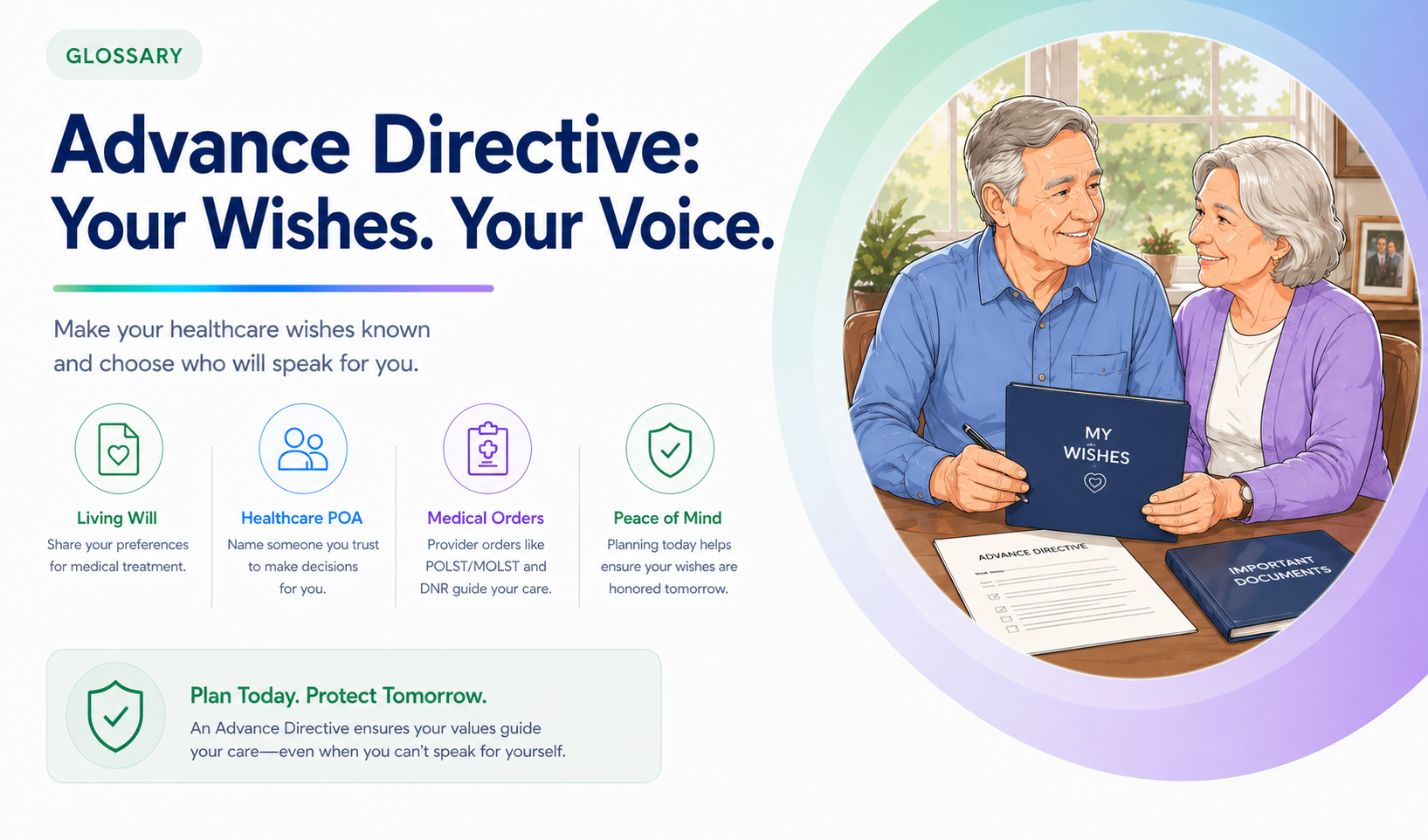
An Advance Directive is a legal document — or set of documents — that records a person's wishes for medical care if they later become unable to make or communicate those decisions, typically combining a Living Will (treatment preferences) and a Healthcare Power of Attorney (the agent authorized to decide).
Expanded definition
The Advance Directive is the umbrella term for the legal documents that speak for a person when they can no longer speak for themselves. Most senior care families encounter the term during a hospital admission, a hospice referral, or a memory care transition — usually the worst possible moment to first discover the documents they wish they had. Research from the National Institute on Aging found that even close family members guess nearly one in three end-of-life decisions incorrectly when no advance directive exists, which is why advance care planning is consistently one of the most-recommended preparations clinicians, attorneys, and geriatric care managers urge families to complete early.
Components of the Advance Directive
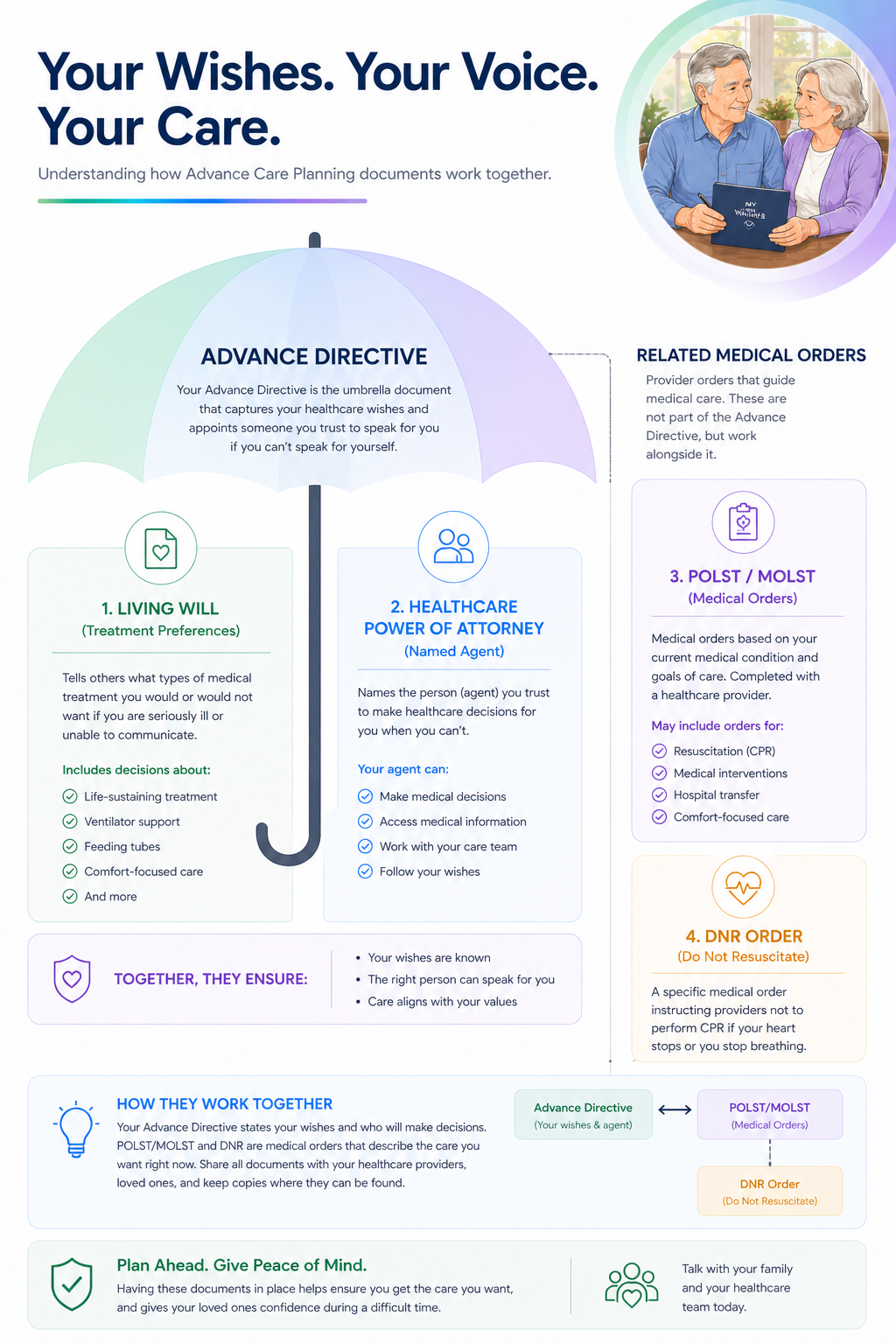
In the United States, the Advance Directive is generally a container for two distinct components. The Living Will is a written statement of treatment preferences — what the person wants and does not want if they are terminally ill, permanently unconscious, or otherwise unable to make decisions. Common Living Will provisions cover the use of mechanical ventilation, feeding tubes, dialysis, antibiotics, CPR, and pain management, along with options around organ donation and how the body should be handled. The Healthcare Power of Attorney (also called a Healthcare Proxy, Medical Power of Attorney, or Healthcare Agent designation depending on state) names a trusted person to make medical decisions when the principal cannot. Living Wills cover the predictable end-of-life decisions; Healthcare POAs cover everything else — and most senior care families need both, because real-world medical decisions rarely match the precise scenarios a Living Will anticipates.
Advance Directive by state
State variation is significant. Forty-nine states and the District of Columbia provide statutory advance directive forms, with terminology and execution requirements that differ at the state line. Some states accept verbal advance directives in limited circumstances; others require written, witnessed, and notarized documents. New York calls the healthcare agent appointment a "Healthcare Proxy," California uses "Advance Health Care Directive" as the umbrella term that combines both components, Texas has separate "Directive to Physicians" and "Medical Power of Attorney" documents. CaringInfo, Five Wishes, and the Conversation Project all publish state-specific forms families can complete at no cost without an attorney, and most hospitals provide forms during admission. POLST or MOLST forms — Physician/Medical Orders for Life-Sustaining Treatment — are a separate document type that translates an advance directive into actionable medical orders for emergency personnel and are typically completed when a person is already seriously ill.
Legal implications
The legal effect of an Advance Directive is real but conditional. The document is recognized but not strictly binding — physicians and proxies are obligated to follow the principal's known wishes but may not be able to follow them exactly in every circumstance. Living Wills only activate when two physicians confirm the principal cannot make decisions, which means the document does not control routine care or temporary incapacity. The Healthcare POA only activates when the physician (or the document's specific trigger) confirms incapacity. Notably, advance directives are not effective outside the medical environment — emergency medical services responding to a 911 call cannot honor a Living Will alone and will provide full resuscitation by default unless a DNR or POLST is present. Families navigating a parent who is medically stable but cognitively declining often discover that the Living Will sits unused while the Healthcare POA does the heavy lifting through years of incremental decisions.
Practical Realities
The practical realities most families want to know: any adult can create an Advance Directive without a lawyer, though attorney involvement is helpful when the family situation is complex. Free state-specific forms are widely available. Documents must be signed and witnessed (or notarized, depending on the state) while the principal still has decision-making capacity. Once executed, copies should go to the named healthcare agent, the primary care physician, the local hospital, close family members, and any specialists involved in ongoing care — not to a safety deposit box, where it cannot be retrieved in an emergency. Documents should be reviewed every 5 to 10 years, after major life events (marriage, divorce, death of the named agent, major diagnosis), and when moving across state lines. And although the conversation is hard, the National Institute on Aging is clear: the most valuable part of advance care planning is not the document itself but the conversations with family that the document records.
Frequently Asked Questions
- What's the difference between an Advance Directive and a Living Will?
- An Advance Directive is the umbrella term for legal documents that record medical wishes; a Living Will is one specific component inside it. The Living Will spells out treatment preferences for end-of-life situations — what the person wants or does not want if terminally ill or permanently unconscious. The other main component is a Healthcare Power of Attorney that names someone to make decisions in any situation requiring medical judgment. The two are commonly confused because state forms sometimes combine them into a single document and use the terms interchangeably.
- Do I need an attorney to create an Advance Directive?
- No. Any adult with decision-making capacity can complete an Advance Directive without legal counsel. Most states publish free statutory forms, and organizations like CaringInfo, Five Wishes, and the Conversation Project offer state-specific templates at no cost. Hospitals are required to ask about Advance Directives at admission and can provide forms. Attorney involvement is helpful when the family situation is complex — blended families, estranged relatives, business interests, or coordination with broader estate planning — but is not legally required.
- When does an Advance Directive take effect?
- The Living Will portion typically activates only when two physicians confirm the principal cannot make their own medical decisions and is in a terminal condition or persistent vegetative state, depending on state law. The Healthcare Power of Attorney portion typically activates when the attending physician confirms the principal lacks decision-making capacity, but the specific trigger varies by document and state. As long as the principal can make decisions, they direct their own care — the Advance Directive is a safety net, not a substitute for current consent.
- Will my Advance Directive be honored in a different state?
- Generally yes — most states honor Advance Directives validly executed in another state, though state-specific forms are usually preferred because they remove ambiguity for local providers. When a senior moves across state lines or spends significant time in another state, updating the Advance Directive to that state's statutory form is the standard recommendation. Snowbirds with homes in two states should consider executing valid documents in both.
- What's the difference between an Advance Directive and a POLST?
- An Advance Directive is the broad legal document recording wishes for future medical care across many possible scenarios. A POLST (Physician Orders for Life-Sustaining Treatment, sometimes called MOLST or POST) is a medical order, signed by a physician, that translates a person's wishes into immediately actionable instructions for emergency responders and treating clinicians. Advance Directives are appropriate for any adult; POLSTs are typically completed only when a person is seriously ill or near the end of life. Emergency medical personnel can act on a POLST but cannot act on an Advance Directive alone.
- Can I change my Advance Directive after I've signed it?
- Yes, at any time, as long as decision-making capacity remains intact. Updating the document requires creating and signing a new Advance Directive that explicitly revokes the prior version. All copies of the previous document should be destroyed and replaced. Notify the named healthcare agent, primary care physician, and any institutions holding the document of the change. Reviewing the directive every five to ten years, and after major life events, is the standard recommendation.
- How is an Advance Directive different from a Healthcare Power of Attorney?
- A Healthcare Power of Attorney is one component of a complete Advance Directive — the part that names the agent authorized to make medical decisions. The full Advance Directive typically also includes a Living Will recording specific treatment preferences. Some state forms combine the two into a single document, while others keep them separate. Most senior care families need both: the Living Will guides the named agent on predictable end-of-life decisions, and the Healthcare POA empowers that agent to handle the unpredictable rest.