https://zenblis.com/glossary/living-will
Living Will
A Living Will records your wishes about life-sustaining treatment — CPR, ventilation, feeding tubes — for when you're terminally ill or permanently unconscious. Different document from a Last Will and Testament, despite the similar name.
By Derek Belfield - 2026-04-27
Definition
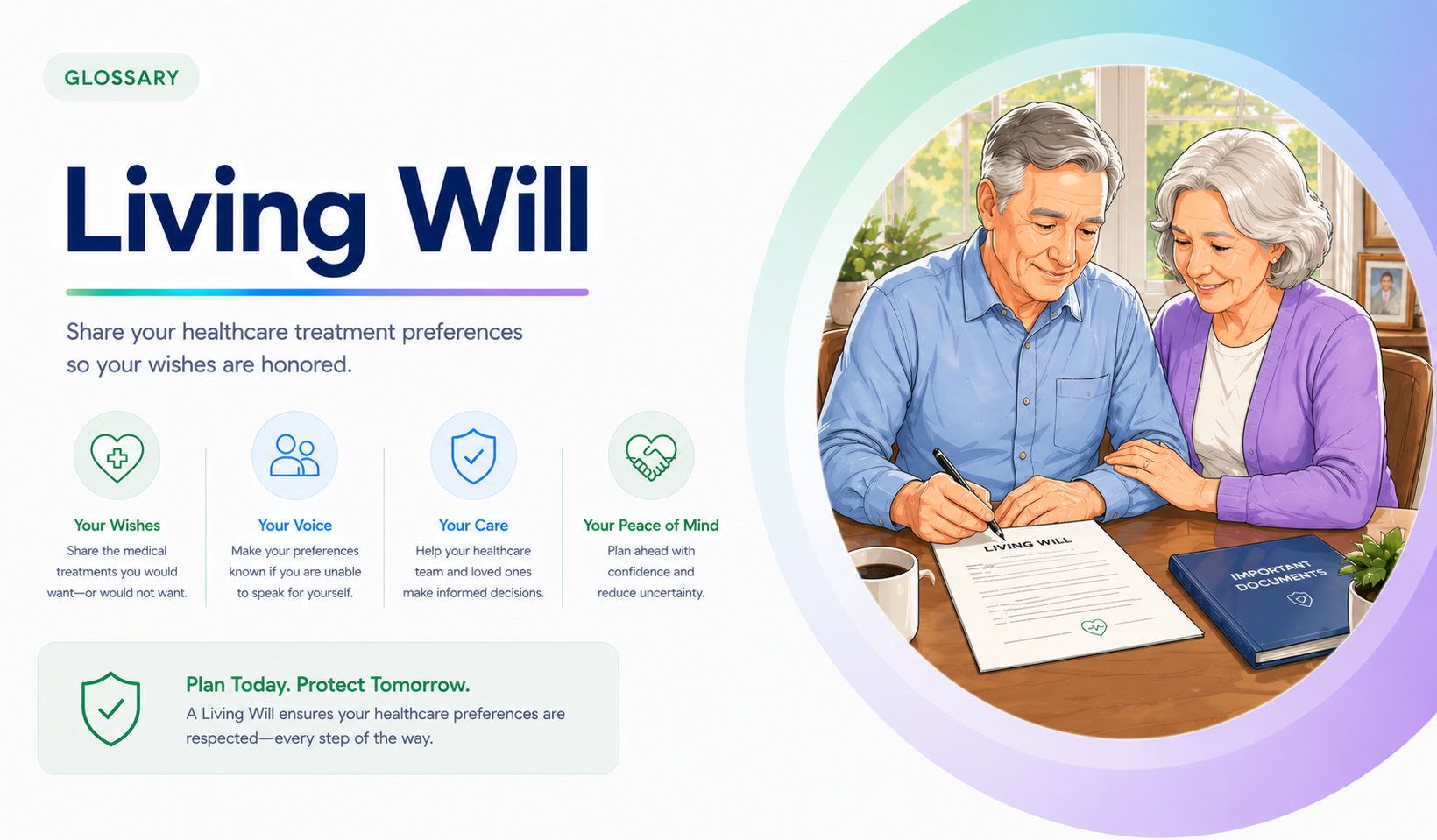
A Living Will is a legal document that records a person's preferences for life-sustaining medical treatment — such as CPR, mechanical ventilation, feeding tubes, and dialysis — that should be used or withheld if they are terminally ill or permanently unconscious and cannot make decisions themselves.
Expanded definition
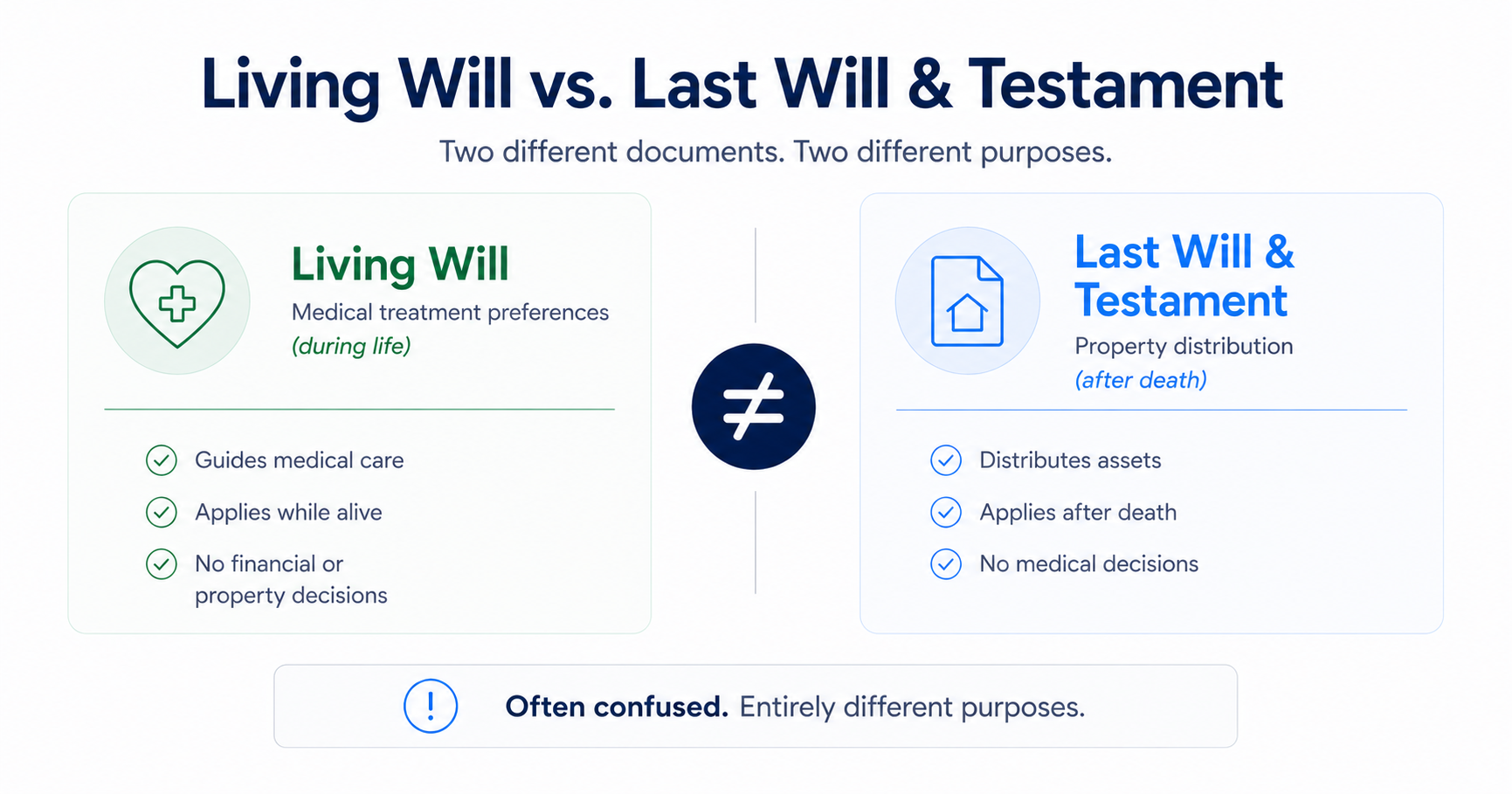
A Living Will is the document that speaks for a person when they are at the end of life and cannot speak for themselves. The name causes confusion: a Living Will has nothing to do with a Last Will and Testament, the document that distributes property after death. A Living Will operates while the person is still alive, addressing only medical treatment decisions during a terminal or end-of-life condition. It is one of the two main components inside an Advance Directive, the other being a Healthcare Power of Attorney.
Treatment preferences
The treatment preferences a Living Will commonly addresses are concrete and consequential: cardiopulmonary resuscitation (CPR), mechanical ventilation, artificial nutrition and hydration through feeding tubes, dialysis, antibiotics, and aggressive pain management even if it might shorten life. Most Living Wills also include sections for organ and tissue donation, instructions about disposition of the body, and personal values that family and clinicians should consider. The document only takes effect under specific clinical conditions — typically when two physicians confirm the person is in a terminal condition or persistent vegetative state, and that the person cannot make decisions for themselves. Until those conditions are met, the Living Will sits unused.
Recognition of Living Wills
Living Wills are recognized in every state but their legal status is conditional. The document is legally recognized but not strictly binding — physicians and healthcare proxies are obligated to honor known wishes in good faith, but real medical situations are often more complex than any document can anticipate. Research published in clinical journals has documented a meaningful gap between Living Will language and real end-of-life scenarios: the standard "terminal condition" or "permanent unconsciousness" framing covers a narrower set of situations than most families expect. Many actual end-of-life decisions involve gradual decline, partial recovery, or treatment that might prolong life with significant burden — situations the Living Will did not specifically anticipate. This is why the Healthcare Power of Attorney is the practical companion: where the Living Will speaks to predictable scenarios, the Healthcare POA empowers a trusted agent to handle the unpredictable rest.
Living Wills by state
State variation in Living Will execution is significant. Some states require two adult witnesses; others require notarization. Some states exclude family members or the named healthcare agent from witnessing. Some states require specific statutory language; others accept any clear written statement. Forms are widely available without an attorney through state-specific resources at CaringInfo, Five Wishes, the Conversation Project, and most state bar associations and Area Agencies on Aging. Hospitals are required by federal law (the Patient Self-Determination Act of 1990) to ask all patients at admission whether they have an Advance Directive and to provide forms if they do not.
Practical guidance
The most important practical guidance for families is also the simplest: the document records the conversation, it does not replace it. A Living Will written in isolation, then never discussed with family or the named healthcare agent, is significantly less useful than a thinner document accompanied by years of clear conversation about values and preferences. The National Institute on Aging's research is consistent on this point — even close family members guess approximately one in three end-of-life decisions incorrectly, and the gap closes substantially when families have actually talked. For senior care families navigating dementia, frailty, terminal illness, or hospice referrals, the Living Will is most useful when it is executed early, while the principal can speak clearly about their own wishes, and shared openly with everyone who might be in the room when the document matters.
Frequently Asked Questions
- Is a Living Will the same as a Last Will and Testament?
- No — they are completely different documents that share an unfortunate name. A Living Will records wishes about medical treatment while the person is still alive but cannot make decisions due to terminal illness or permanent unconsciousness. A Last Will and Testament distributes property and assets after death. The two documents serve unrelated purposes, are governed by different laws, and require separate preparation. A complete estate plan typically includes both, alongside a Healthcare Power of Attorney and a Financial Power of Attorney.
- What does a Living Will typically address?
- Most Living Wills address life-sustaining medical interventions: CPR (cardiopulmonary resuscitation), mechanical ventilation, artificial nutrition and hydration through feeding tubes, dialysis, antibiotics, and pain management even if it might shorten life. Many forms also include sections for organ and tissue donation, body disposition, and personal values that should guide care. The document specifies which treatments the person wants and which they do not want under defined clinical conditions, typically terminal illness or permanent unconsciousness.
- When does a Living Will take effect?
- Most Living Wills only activate when two physicians confirm the principal is in a terminal condition or persistent vegetative state, and that the principal cannot make medical decisions for themselves. The specific trigger varies by state — some require only one physician, some require additional clinical findings. Until those conditions are met, the principal continues to direct their own care, even if their preferences differ from what the Living Will states. The document is a safety net for end-of-life scenarios, not a control on routine treatment.
- Do I need a lawyer to create a Living Will?
- No. Most states publish free statutory Living Will forms, and organizations like CaringInfo, Five Wishes, and the Conversation Project provide state-specific templates at no cost. Hospitals are required by federal law to ask about Advance Directives at admission and provide forms. An attorney is helpful when the family situation is complex — blended families, disagreements among children, broader estate planning — but is not legally required to create a valid Living Will.
- Why isn't a Living Will enough on its own?
- Real end-of-life situations are often more complicated than any Living Will can anticipate. The standard "terminal condition" or "permanent unconsciousness" framing covers a narrower set of scenarios than most families expect — many actual decisions involve gradual decline, partial recovery, or treatments that might prolong life with significant burden. A Healthcare Power of Attorney is the practical companion: it empowers a trusted person to make decisions in situations the Living Will did not specifically anticipate. Most senior care families need both documents.
- How often should a Living Will be updated?
- Most clinicians and elder-law attorneys recommend reviewing the Living Will every five to ten years and after any major life event — a new diagnosis, the death of a spouse or named healthcare agent, divorce or remarriage, or a move across state lines. Personal values about end-of-life treatment often change with age and health changes, and an outdated document is worse than no document because it can mislead the people trying to honor your wishes. Updates require creating a new document that explicitly revokes the prior one.
- What happens if a Living Will conflicts with what family members want?
- The Living Will reflects the principal's own wishes, and physicians are obligated to follow it when its conditions are met — not the family's preferences. This is one of the strongest reasons to have a Living Will: it gives clinicians clear authority to follow the patient's known wishes even when family members disagree. The Healthcare Power of Attorney named alongside the Living Will is also obligated to follow the principal's known wishes, regardless of personal feelings. Having difficult conversations with family while the principal is healthy reduces the chance of conflict at the bedside.