https://zenblis.com/glossary/nursing-home
Nursing Home
A nursing home provides 24-hour skilled care for seniors who can't live at home safely. Medicaid is the primary payer; CMS Care Compare rates every facility.
By Derek Belfield - 2026-04-26
Definition
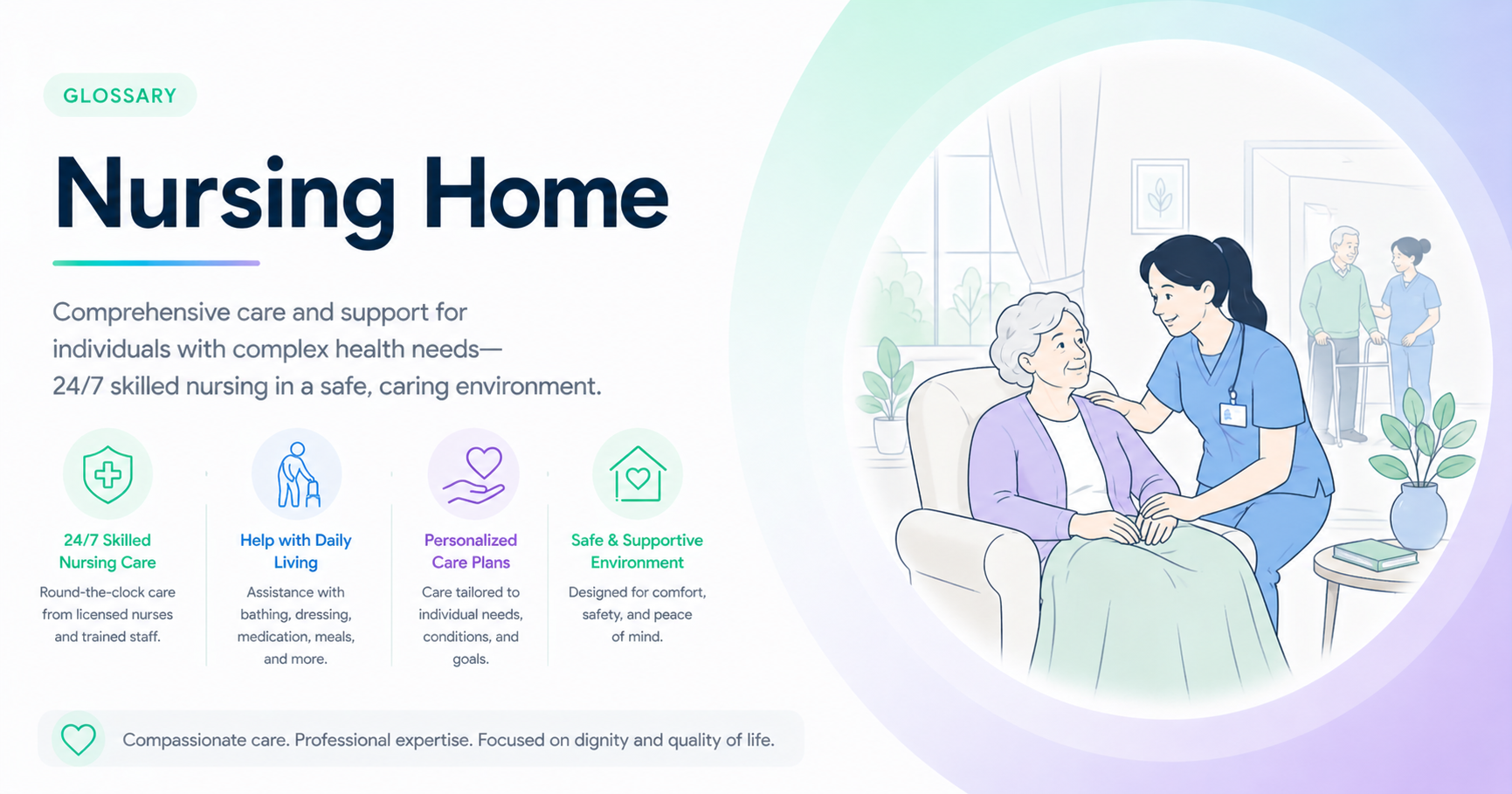
A nursing home is a state-certified residential facility that provides 24-hour skilled nursing care, personal care, and rehabilitation services for people who cannot safely live at home — most commonly used for long-term custodial care for seniors with significant medical or functional needs.
Expanded definition
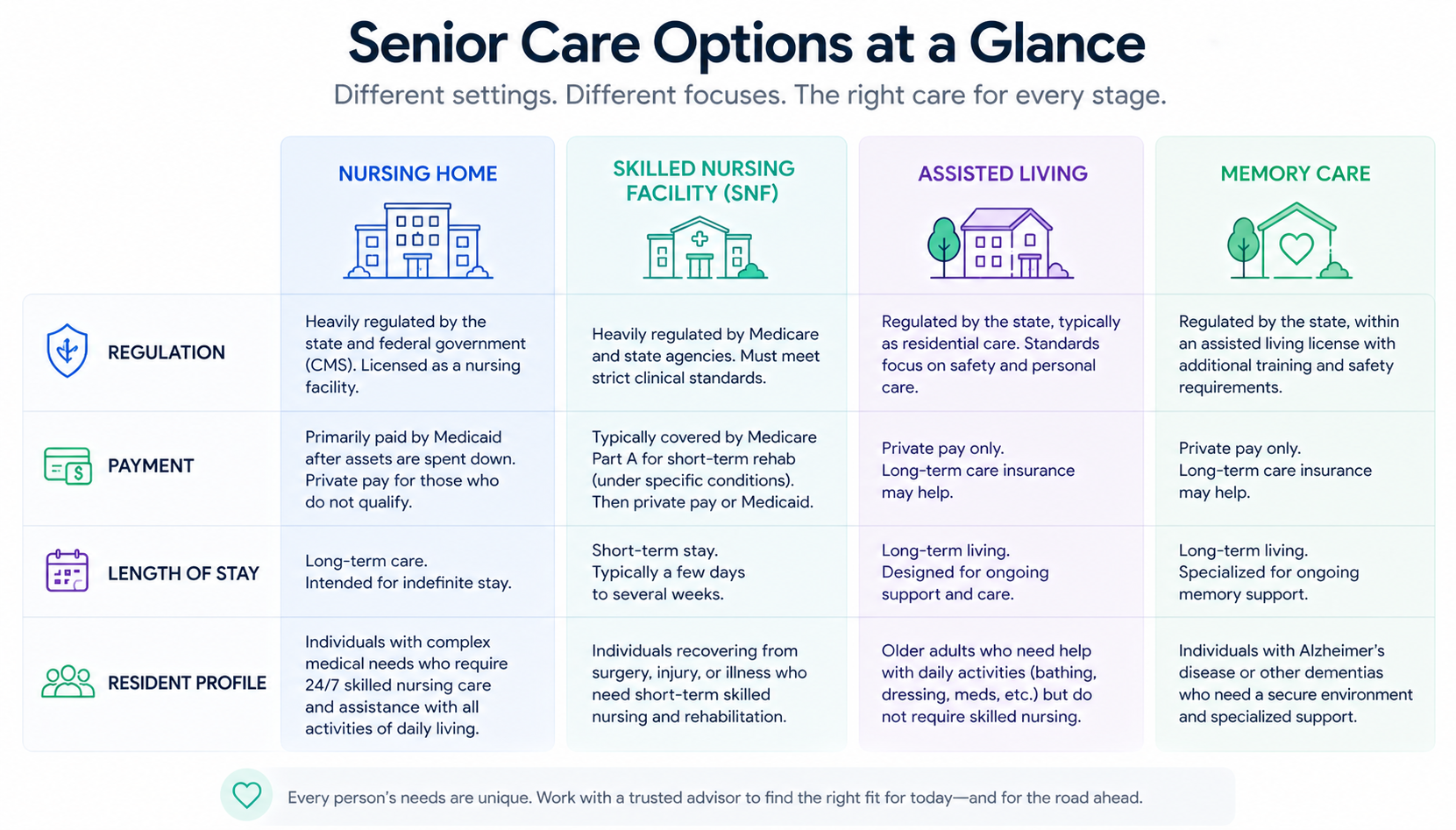
About 16,000 nursing homes operate across the United States, regulated jointly by federal Medicare and Medicaid standards under 42 CFR Part 483 and inspected regularly by state survey agencies on behalf of the Centers for Medicare and Medicaid Services. The vast majority of nursing homes are dual-certified, meaning the same building serves both short-term Medicare patients recovering from a hospital stay and long-term Medicaid residents who live there for the rest of their lives. This is why the line between a nursing home and a skilled nursing facility (SNF) is more about which Medicare or Medicaid program is paying than about a different physical setting.
Needs of the residents
Long-term nursing home residents typically need help with most activities of daily living, have complex medical needs, or live with advanced cognitive decline that exceeds what assisted living or memory care can support. Unlike assisted living, which is regulated state-by-state and is mostly private-pay, nursing homes are heavily federally regulated and Medicaid is the primary payer — covering roughly 62 percent of residents nationally. Medicare does not pay for long-term nursing home care; it only covers short-term skilled stays through the SNF benefit (up to 100 days per benefit period after a qualifying hospital admission).
CMS and nursing homes
CMS publishes a Five-Star Quality Rating System for every Medicare- or Medicaid-certified nursing home, available at Care Compare. The overall rating combines three weighted factors: results from health inspections, staffing levels (registered nurse hours and total nursing hours per resident day), and quality measures derived from clinical resident assessments. Families researching nursing homes should always pull the Care Compare report — but treat the star rating as one signal among many, not a final answer. Inspection history, staff turnover, and conversations with current residents and families give a more complete picture than the headline rating alone.
Choosing nursing homes
Choosing a nursing home is one of the highest-stakes decisions in senior care. Most family members visit several facilities, ask about staffing ratios across day, evening, and overnight shifts, review the most recent inspection report, and — if Medicaid will eventually pay — confirm whether the facility accepts Medicaid for a resident already in private-pay residence. Many nursing homes legally require an initial period of private-pay before transitioning a resident to Medicaid coverage, and these "spend-down" rules are a common source of family financial stress that an elder-law attorney can help navigate.
Frequently Asked Questions
- What's the difference between a nursing home and a skilled nursing facility (SNF)?
- The same physical building can be both. Most nursing homes are dual-certified by Medicare and Medicaid, meaning they serve short-term SNF patients (under Medicare, after a hospital stay) and long-term nursing home residents (mostly under Medicaid). The terms refer to which payer is covering the stay and the level of care being provided, not to two different types of buildings.
- Who pays for nursing home care?
- Medicaid is the primary payer for long-term nursing home care nationally, covering about 62 percent of residents. Other payment sources include private savings, long-term care insurance, and the VA Aid and Attendance benefit for eligible veterans. Medicare does not pay for long-term nursing home care — it only covers short-term skilled nursing through the SNF benefit, up to 100 days per benefit period.
- How is nursing home quality measured?
- The Centers for Medicare and Medicaid Services publishes a Five-Star Quality Rating System on Care Compare. The overall rating combines three weighted factors: health inspection results from the most recent surveys, staffing levels (registered nurse and total nursing hours per resident day), and quality measures derived from clinical assessments of residents. Families can search any Medicare- or Medicaid-certified nursing home at Medicare.gov/Care-Compare.
- When is a nursing home the right level of care?
- A nursing home is generally the right setting when a senior needs 24-hour skilled nursing care, has complex medical needs that require licensed nurses on-site, has cognitive or physical decline beyond what assisted living or memory care can safely support, or has been discharged from a hospital and is unable to return home. Many seniors enter a nursing home through a short-term SNF stay that becomes long-term when recovery is incomplete.
- Will a nursing home accept a resident on Medicaid?
- Most Medicaid-certified nursing homes accept Medicaid, but not all beds are designated as Medicaid beds, and some facilities require an initial period of private-pay before transitioning a resident to Medicaid coverage. Always confirm a facility's specific Medicaid policy in writing before admission. An elder-law attorney can help families understand spend-down rules and Medicaid eligibility timing.
- Are nursing homes federally regulated?
- Yes. Medicare- and Medicaid-certified nursing homes must meet federal requirements under 42 CFR Part 483 and are inspected regularly by state survey agencies acting on behalf of the Centers for Medicare and Medicaid Services. Federal oversight covers staffing, resident rights, infection control, medication management, and dozens of other clinical and operational standards. Nursing homes that fail inspections face fines and, in serious cases, can be terminated from Medicare and Medicaid participation.