https://zenblis.com/glossary/healthcare-proxy
Healthcare Proxy
A Healthcare Proxy is the New York and Massachusetts term for what most states call a Healthcare Power of Attorney — a document appointing someone to make medical decisions if you lose capacity. Same purpose, different name.
By Derek Belfield - 2026-04-27

Definition
A Healthcare Proxy is a legal document — most commonly used as the statutory term in New York and a handful of other states — in which a person appoints a trusted agent to make medical decisions on their behalf if they lose decision-making capacity, functionally equivalent to a Healthcare Power of Attorney in most other states.
Expanded definition
A Healthcare Proxy is one of the most state-specific and confusing terms in senior care planning, because the same legal concept appears under different names in different states. New York's statutory document is called the Healthcare Proxy, established in 1990 and governed by Article 29-C of the New York Public Health Law. Massachusetts, Vermont, and Maine also use the term as the formal name for their healthcare-decision-making documents. Most other states use Healthcare Power of Attorney, Medical Power of Attorney, Durable Power of Attorney for Healthcare, or Advance Healthcare Directive for documents that do essentially the same thing. The differences between these forms are largely about state-specific execution requirements, witness rules, and statutory language — not about the underlying purpose.
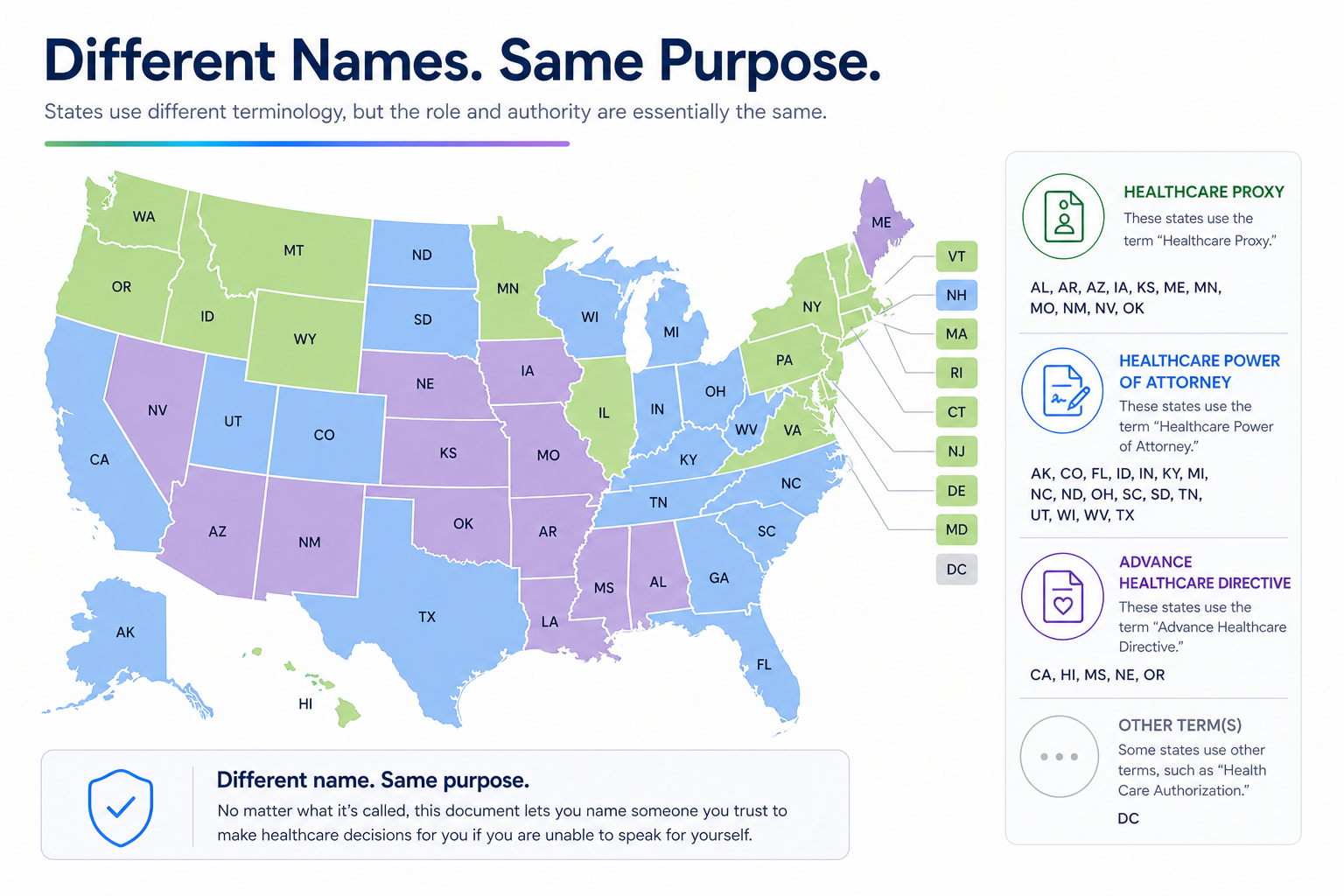
Proxies by state
The core function is consistent across states. The principal — the person creating the document — appoints a trusted adult, called the healthcare agent, healthcare proxy, or healthcare attorney-in-fact, to make medical decisions if the principal becomes unable to make or communicate those decisions themselves. The document is a safety net, not an active control. As long as the principal can make their own medical decisions, they continue to do so directly, regardless of what the proxy document says. The agent's authority activates only when the attending physician determines the principal lacks decision-making capacity, and ends if the principal regains capacity, even temporarily. In New York specifically, the physician must inform the principal both orally and in writing of any incapacity determination, and the principal can challenge that determination simply by stating they are still competent — at which point the presumption flips back to capacity until a court determines otherwise.
Agent responsibilities
What the agent can do is generally broad. Unless the document specifies limits, the agent can consent to or refuse treatment, choose physicians and hospitals, authorize surgery, decide about life-sustaining interventions, access medical records under HIPAA, and even arrange transfers between care settings — including admissions to nursing homes, hospitals, hospice, or other facilities. Some specific decisions require explicit written instruction from the principal: in New York, an agent cannot make decisions about artificial nutrition and hydration unless the principal has put their wishes in writing or otherwise made them clearly known. The agent must follow the principal's known wishes, and when those wishes are not clear, must act in the principal's best interest.
State variations
State variation matters most when a senior moves or has homes in multiple states. A Healthcare Proxy validly executed in New York is generally honored across state lines, but local providers may prefer or even require state-specific forms, and execution requirements vary — New York requires two adult witnesses but no notary, Florida requires two witnesses or a notary, California requires either two witnesses or notarization, Texas requires two witnesses with specific exclusions. For families with parents who split time between states, executing a healthcare-decision document in each primary state is the standard recommendation. The terminology variation also creates real confusion when families compare notes: a daughter in New York who has her parent's "Healthcare Proxy" and a son in Texas who has his parent's "Medical Power of Attorney" may not realize they are describing essentially the same legal authority under different state names.
The most important practical point for senior care families is the same one that applies to all healthcare-decision documents: the document is the legal foundation, but the conversation between the principal and the agent is the actual safeguard. The National Institute on Aging's research consistently shows that even close family members guess about one in three end-of-life decisions incorrectly when they have not had explicit conversations about wishes. A Healthcare Proxy handed to an agent without context — without conversations about values, religious beliefs, end-of-life preferences, or quality-of-life thresholds — gives that agent legal authority but very little guidance. Most elder-law attorneys and geriatric care managers recommend the proxy form be completed alongside a Living Will or written instructions, and that the principal walk the agent through their wishes in detail at least once. When that combination exists, the document does the legal work; the conversation does the moral work.
Frequently Asked Questions
- Is a Healthcare Proxy the same as a Healthcare Power of Attorney?
- Functionally, yes — though the formal name differs by state. New York, Massachusetts, Vermont, and Maine use Healthcare Proxy as the statutory term. Most other states call the same kind of document a Healthcare Power of Attorney, Medical Power of Attorney, Durable Power of Attorney for Healthcare, or Advance Healthcare Directive. The underlying purpose is identical: appointing a trusted person to make medical decisions if you cannot. The differences are state-specific execution rules, witness requirements, and language — not the document's core legal function.
- Who can serve as my Healthcare Proxy?
- In most states, any competent adult age 18 or older can serve as a healthcare agent — typically a spouse, adult child, sibling, close friend, or other trusted person. Most states exclude the principal's healthcare provider and employees of facilities where the principal is receiving care, to avoid conflicts of interest. The agent should be someone who knows the principal's values, can be reached in an emergency, can be calm under pressure, and is willing to advocate for the principal's wishes even when family members disagree. Many states also recommend naming an alternate agent in case the primary agent is unavailable.
- When does a Healthcare Proxy take effect?
- A Healthcare Proxy activates only when the attending physician formally determines that the principal lacks decision-making capacity — meaning the inability to understand and appreciate the nature and consequences of healthcare decisions. As long as the principal can make their own decisions, the principal directs their own care, even when their preferences differ from what the agent or family thinks is best. If the principal regains capacity (after recovering from a temporary illness, for example), the agent's authority pauses until any future incapacity. Most states require the physician to document the determination in writing.
- Do I need a lawyer to create a Healthcare Proxy?
- No. Most states publish free statutory Healthcare Proxy forms that any competent adult can complete. New York requires only two adult witnesses; other states have similar low-friction execution rules. Hospitals are required by federal law to provide forms at admission, and organizations like CaringInfo and the Conversation Project offer state-specific templates at no cost. An attorney is helpful when family situations are complex — blended families, estranged relatives, broader estate planning — but is not legally required for a valid document.
- Can my Healthcare Proxy make any medical decision for me?
- Generally yes, unless the document specifies limits. Once activated, the healthcare agent can consent to or refuse treatment, choose physicians and care settings, authorize procedures, access medical records, and approve transfers between facilities including admission to nursing homes or hospice. Some specific decisions require explicit written instruction — in New York, for example, an agent cannot make decisions about artificial nutrition and hydration unless the principal's wishes are clearly known. Many states also require explicit authorization for organ donation decisions.
- Will my Healthcare Proxy be honored in a different state?
- Generally yes, but state-specific forms are usually preferred by local providers because they remove ambiguity. A Healthcare Proxy valid in one state must generally be honored in another, but execution requirements vary — what is valid in New York may not match the witness or notary rules expected in Florida, Texas, or California. For seniors who split time between states, executing a healthcare-decision document in each primary state is the standard recommendation. When in doubt, ask the local hospital or healthcare provider what form they prefer.
- What's the difference between a Healthcare Proxy and a Living Will?
- A Healthcare Proxy appoints a person to make decisions; a Living Will records specific treatment preferences. The two work together — the proxy interprets the Living Will when its scenarios apply and makes decisions in situations the Living Will did not anticipate. A Living Will alone covers narrow end-of-life conditions; a Healthcare Proxy alone gives the agent authority but limited guidance. Most senior care families benefit from both documents, often combined into a single Advance Directive, alongside conversations that translate written words into shared understanding.