https://zenblis.com/glossary/dnr
DNR (Do Not Resuscitate)
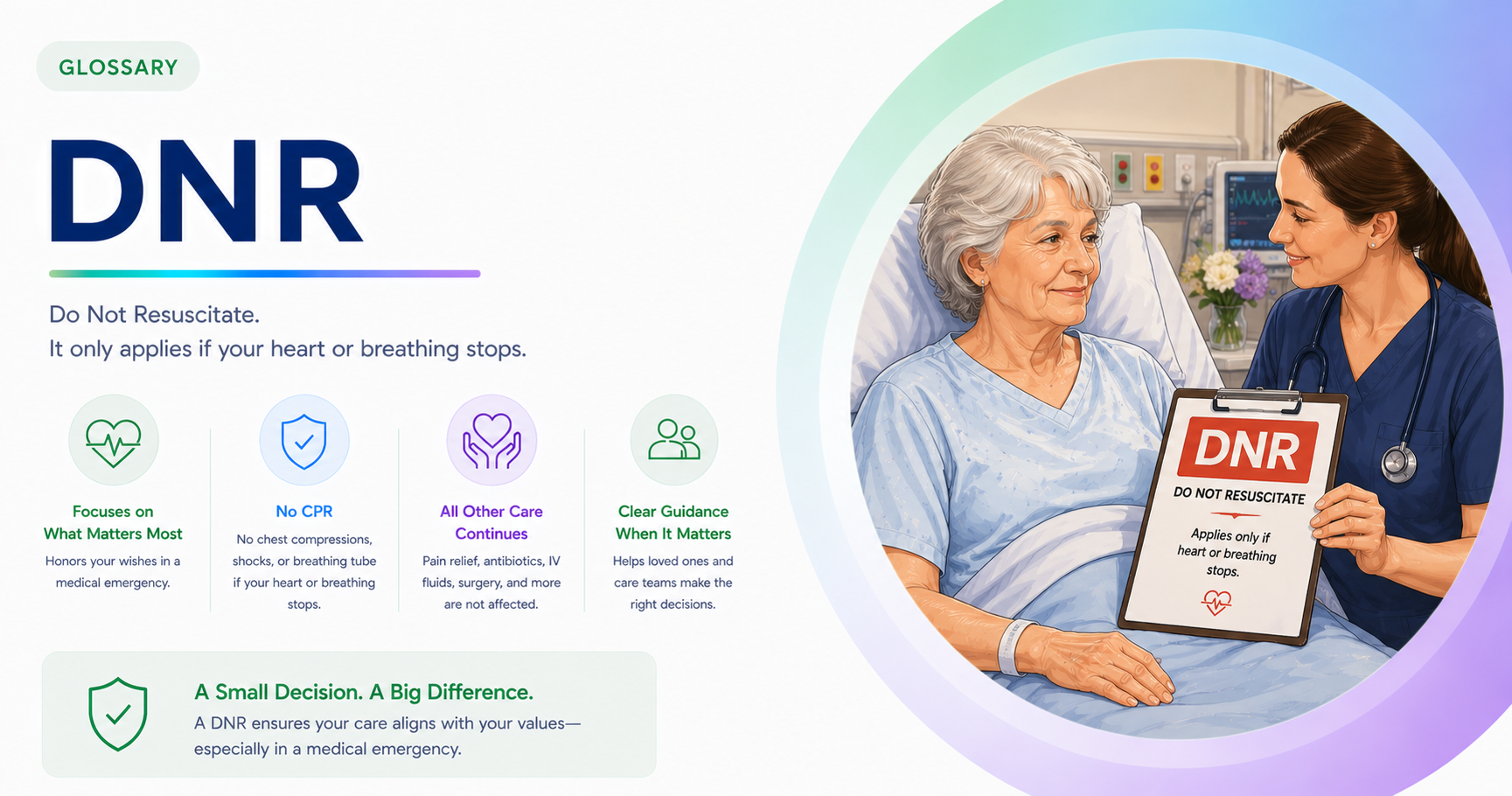
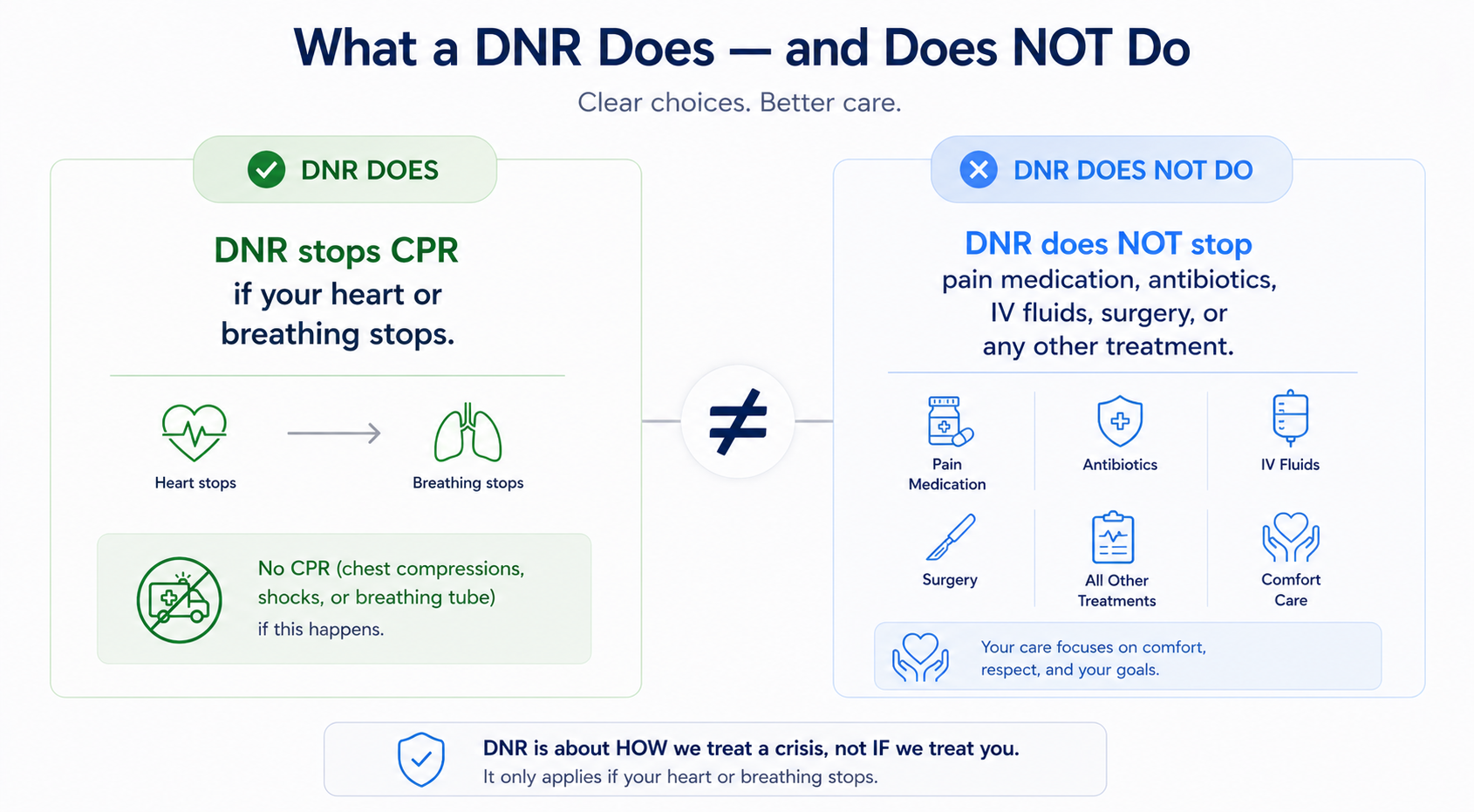
A Do Not Resuscitate order addresses only one specific situation — cardiac or respiratory arrest. It does not stop pain medication, antibiotics, surgery, or any other treatment. The most common misconception in end-of-life planning.
By Derek Belfield - 2026-05-07
Definition
A DNR — Do Not Resuscitate — is a specific medical order, signed by a physician, that instructs healthcare providers not to perform cardiopulmonary resuscitation (CPR) if the patient's heart or breathing stops, while still authorizing all other appropriate medical care, including pain management, antibiotics, and treatment of the underlying condition.
Expanded definition
A DNR is the most narrowly targeted medical order in end-of-life planning, and also the most commonly misunderstood. Research consistently shows that only about a third of patients with a DNR order accurately understand what it does and does not authorize. The order applies only to one specific clinical event: cardiac arrest or respiratory arrest, when the patient's heart stops, or breathing stops. Outside of that moment, a DNR has no effect. Patients with a DNR continue to receive every other appropriate treatment — pain medications, antibiotics for infections, IV fluids, oxygen, surgery for non-cardiac conditions, even chemotherapy or dialysis if those are part of the care plan. The DNR simply tells clinicians, "If my heart stops or I stop breathing, do not attempt resuscitation."
CPR and DNR
CPR is the treatment that a DNR refuses. CPR involves chest compressions, often combined with electric shocks (defibrillation), insertion of breathing tubes (intubation), mechanical ventilation, and emergency cardiac medications. The procedures are physically invasive — broken ribs are common in older adults — and the success rate near the end of life is genuinely low. For seriously ill patients, particularly those over 80 or with advanced illness, peer-reviewed research consistently shows that CPR survival rates to hospital discharge are below 10 percent, and survivors often have significant new neurological impairment. For healthy adults experiencing unexpected cardiac arrest, CPR success rates are higher, which is why DNRs are inappropriate for adults who are not seriously ill.
Two forms of DNRs
DNR orders exist in two distinct forms that families consistently confuse:
In-hospital DNR
An in-hospital DNR applies only inside the hospital, where it is written, recorded in the patient's medical chart, and stops working when the patient is discharged.
Out-of-hospital DNR
An out-of-hospital DNR — sometimes called a Comfort Care order, No CPR order, or by other names depending on the state — applies in the patient's home, in a nursing home or assisted living community, in an ambulance, and anywhere else outside a hospital. Without an out-of-hospital DNR, emergency responders called by a 911 dispatcher are legally required to perform full CPR by default.
Execution requirements by state
The execution requirements vary substantially by state. Most states require a written form signed by both the attending physician and the patient (or the patient's healthcare agent if the patient lacks capacity), and many states also offer DNR identification bracelets or necklaces — distinctively engraved metal items that emergency responders are trained to recognize and honor. Texas, New Jersey, Pennsylvania, and most other states have specific statutory forms. Out-of-hospital DNR orders only apply in the state where they are issued; a senior who splits time between two states should have a valid order in each state. In the hospital, staff can place a DNR order in the chart at the request of the patient or healthcare agent without requiring a state-specific form.
The bottom line
Two practical realities matter most for families. First, a DNR is not the same as a POLST. A DNR addresses only CPR; a POLST is a broader portable medical order that includes the CPR decision plus additional sections on medical interventions, antibiotics, and artificial nutrition. In states that use POLST, the POLST often supersedes a separate DNR or includes the DNR within it. Second, a DNR can be revoked or revised at any time. The patient (if competent) or healthcare agent can change the order by talking to the attending physician and signing a new form. Many seniors complete a DNR only to revoke it later when they begin a new treatment, recover from an acute illness, or change their thinking about end-of-life care. The decision is always reversible while the patient is alive, and the conversation should be revisited periodically as the patient's condition changes.
Frequently Asked Questions
- Does a DNR mean no medical treatment at all?
- No — and this is the most common misconception about DNR orders. A DNR addresses only one specific situation: cardiac arrest or respiratory arrest, when the heart or breathing stops. In every other circumstance, the patient continues to receive all other appropriate care, including pain medications, antibiotics for infections, IV fluids, oxygen, surgery, and treatment of the underlying condition. The DNR simply means: if my heart or breathing stops, do not attempt CPR. Research has shown that only about a third of patients with DNR orders accurately understand this distinction, which is why open conversation with the physician matters.
- What's the difference between an in-hospital DNR and an out-of-hospital DNR?
- An in-hospital DNR is written into the patient's medical chart at a hospital and applies only within that hospital — it stops working when the patient is discharged. An out-of-hospital DNR (also called a Comfort Care order, No CPR order, or other names depending on the state) is a state-specific written form that applies in the patient's home, nursing home, ambulance, or anywhere else outside a hospital. The two protections do not transfer between settings. Without a valid out-of-hospital DNR, emergency responders called to a 911 dispatch are legally required to perform full CPR — even if the patient has an in-hospital DNR from a previous admission.
- What's the difference between a DNR and a POLST?
- A DNR addresses only one decision: CPR or no CPR if the heart or breathing stops. A POLST is a broader portable medical order that includes the CPR decision plus additional sections on medical interventions if the patient has a pulse, antibiotics for infections, and artificial nutrition. In states that use POLST, the POLST often supersedes a separate DNR or includes the DNR section within it. Some patients have only a DNR; others have a POLST that includes a DNR; some have both as separate documents. The right combination depends on the patient's condition and the state's documentation requirements.
- Who should consider a DNR?
- A DNR is generally appropriate for patients who are seriously ill, terminally ill, very frail, or near the end of life — and who, after conversation with their physician about CPR's likely outcomes for their specific condition, decide they would not want resuscitation attempted. CPR success rates near the end of life are low, and survivors often have significant new impairment. A DNR is generally not appropriate for healthy adults who are not seriously ill, where CPR success rates are higher. The decision should be made together with the attending physician based on the patient's specific medical situation.
- How is a DNR created?
- A DNR is a medical order, which means it must be signed by a physician — not by the patient or family alone. The patient (or healthcare agent if the patient lacks capacity) discusses the decision with the attending physician, and the physician writes the order in the medical chart for an in-hospital DNR or completes the state-specific form for an out-of-hospital DNR. Most states also offer DNR identification bracelets or necklaces that emergency responders are trained to recognize. The form must be readily visible — often kept on the refrigerator at home or with the patient at all times in long-term care settings.
- Can a DNR be changed or revoked?
- Yes, at any time. A patient with decision-making capacity can revoke a DNR by telling the attending physician verbally, destroying the written form, or removing the identification bracelet. The healthcare agent can also revoke a DNR following the patient's known wishes. Revocation takes effect immediately. Many seniors revoke and re-establish DNR orders multiple times as their conditions change — recovering from an acute illness, starting a new treatment, or rethinking end-of-life decisions. The DNR is a living decision, not a permanent one.
- Will a DNR be honored in a different state?
- An in-hospital DNR applies only inside the specific hospital where it was written, so state boundaries are not the issue — discharge is. An out-of-hospital DNR generally only works in the state where it was issued, because each state has its own statutory forms and identification systems. For seniors who split time between two states or who travel frequently, the standard recommendation is to have a valid out-of-hospital DNR in each primary state. When traveling, carrying a copy of the original DNR document and discussing the situation with local healthcare providers is the safest approach.