https://zenblis.com/glossary/va-long-term-care-programs
VA Long-Term Care Programs
The VA's long-term care system is broader than most families realize. Beyond Aid and Attendance, it includes 100+ Community Living Centers, 175 State Veterans Homes, contracted nursing homes, in-home care, adult day services, and hospice.
By Derek Belfield - 2026-04-26
Definition
VA Long-Term Care Programs are the collection of services through which the Department of Veterans Affairs supports eligible veterans needing extended care — including nursing home, assisted living, in-home, adult day, and end-of-life care — delivered through VA-operated facilities, state-owned veterans homes, contracted community providers, and direct in-home services.
Expanded definition
The VA's long-term care system is one of the largest in the country and one of the least understood. Most families who hear "VA benefits for senior care" think only of the Aid and Attendance pension — the cash benefit that helps pay for care families arrange themselves. But the VA also operates and contracts an extensive network of long-term care services delivered directly to enrolled veterans, with eligibility rules and cost-sharing that work very differently from the pension program.
Requirements
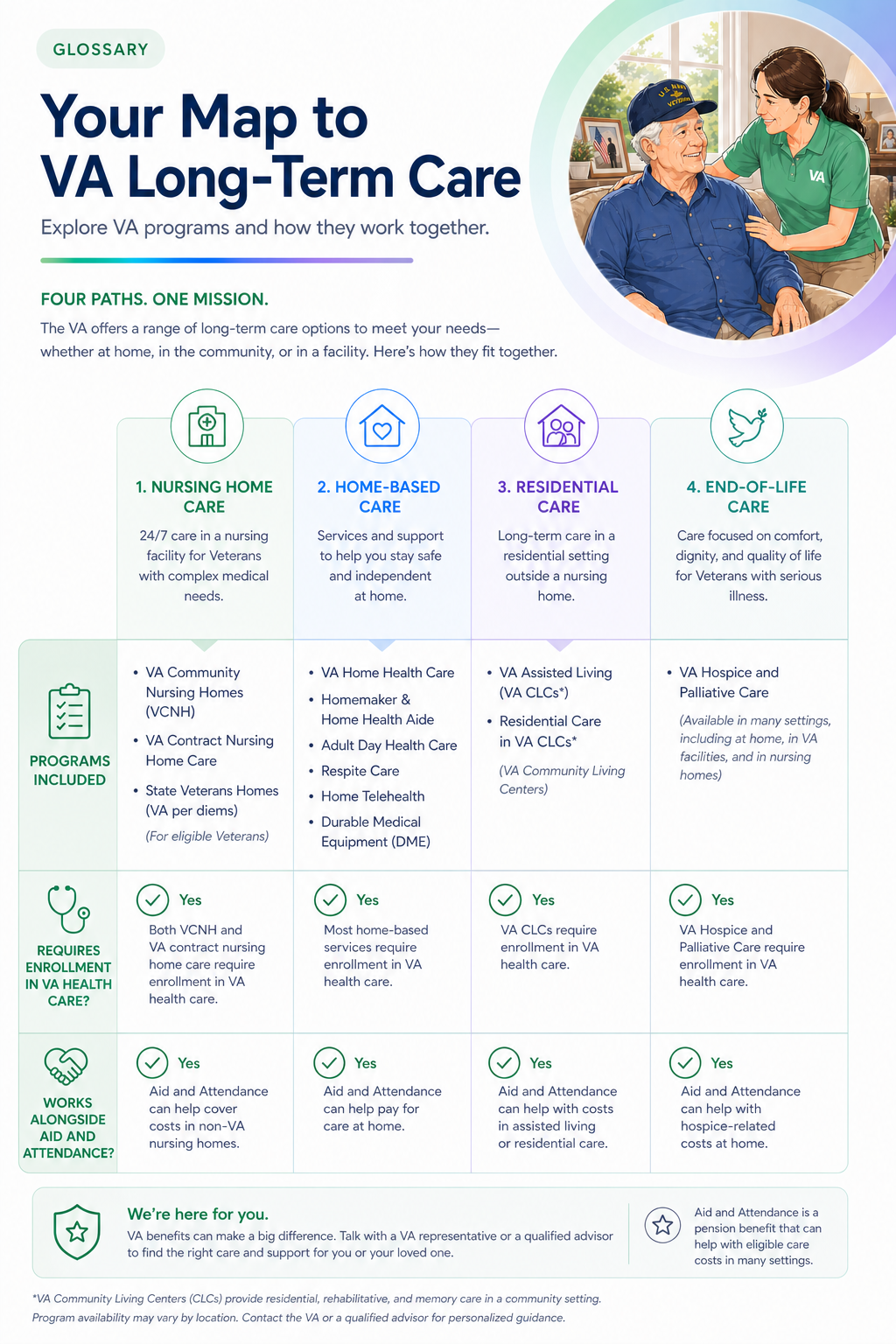
Three core requirements gate access to most VA long-term care services:
First, the veteran must be enrolled in VA health care, which is separate from receiving disability compensation — being rated for a disability does not automatically enroll a veteran in VA health care.
Second, the veteran must have a clinical need for the specific service, established by a VA care team or social worker.
Third, the service must be available in the veteran's geographic area, which varies significantly by region.
Categories of services
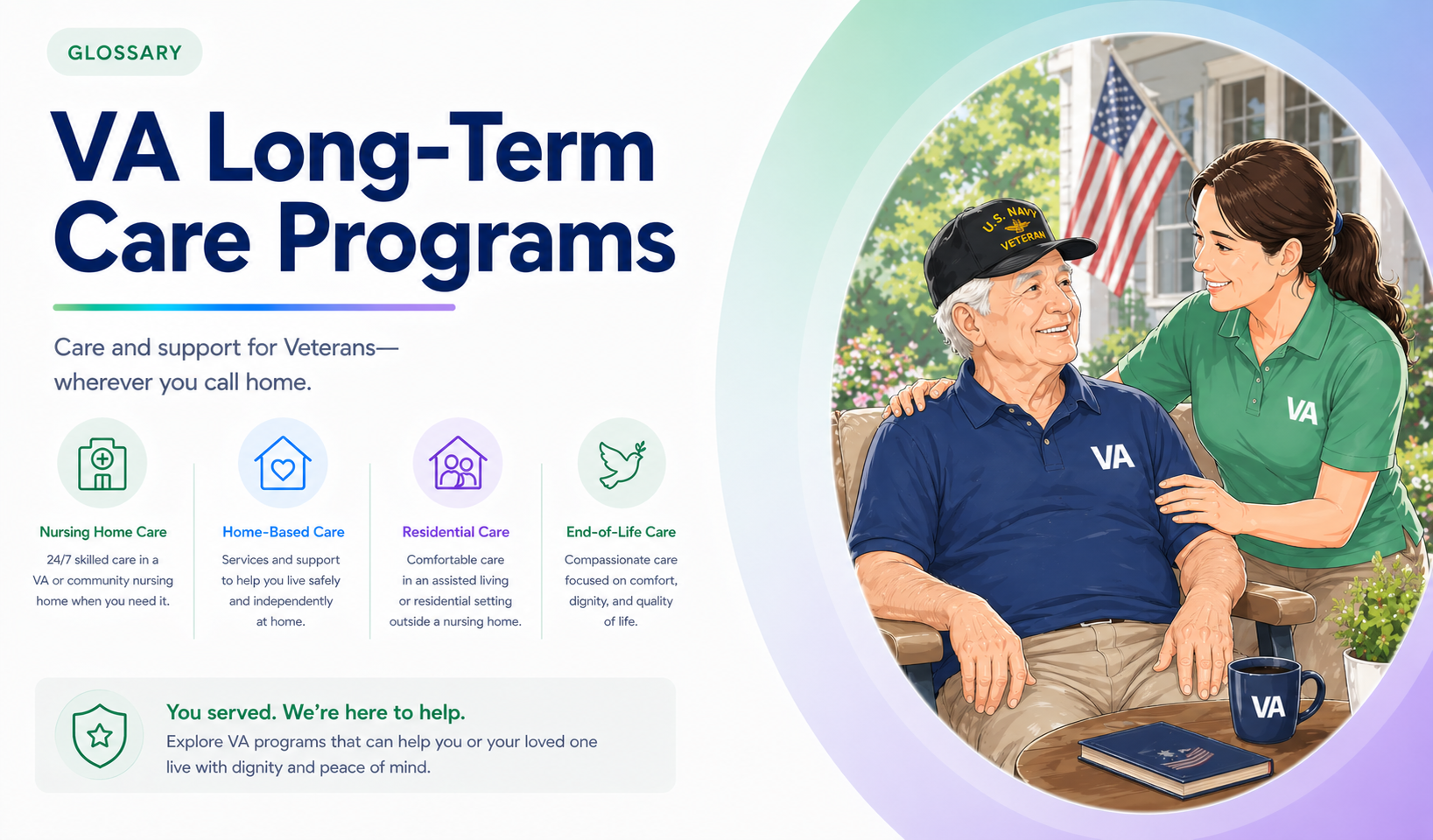
The VA's long-term care services fall into four broad categories:
Nursing home care
Nursing home care is delivered through three settings:
VA-operated Community Living Centers (CLCs), 100-plus VA-run nursing homes that emphasize home-like environments and serve veterans across short-stay rehabilitation, hospice, and long-term care;
State Veterans Homes, 175 facilities owned and operated by state governments and certified by the VA, which sometimes admit non-veteran spouses and Gold Star parents and receive VA per-diem support for eligible veterans; and
Community Nursing Homes, non-VA nursing homes the VA contracts with so that veterans can receive care closer to family. Each setting has different eligibility and cost-sharing rules.
Home and community-based services
Home and community-based services are the second category and the most actively expanding. These include Home-Based Primary Care (a VA-led care team that provides medical care in the veteran's home), Homemaker/Home Health Aide services (a trained caregiver who assists with daily tasks), Adult Day Health Care, Skilled Home Care (episodic professional services through Medicare-eligible community agencies under VA consult), Home Respite for caregivers, and Veteran-Directed Care, a participant-directed program that gives veterans who would otherwise need nursing home care a flexible budget to hire their own caregivers, including family members. Veteran-Directed Care now operates at 95 VA Medical Centers in partnership with state Aging and Disability Network Agencies.
Residential care
The third category is residential care, primarily through the Community Residential Care program — the VA does not pay room and board, but provides case management, medical oversight, and quality monitoring for veterans living in over 550 approved board-and-care, assisted living, and psychiatric residential facilities nationwide.
End-of-life care
The fourth category is end-of-life care, including hospice and palliative care delivered in the veteran's home, in a CLC, or through community partnerships. The Housebound Benefit (a smaller pension enhancement than Aid and Attendance) and the Aid and Attendance pension are separate cash benefits that can be used alongside or in place of these services. For families navigating any of these options, the VA social worker assigned to the veteran's care team is the most useful starting point. They can clarify eligibility, complete the Application for Extended Care Benefits (VA Form 10-10EC), and connect families to the specific programs available in their region.
Frequently Asked Questions
- What is the difference between VA Aid and Attendance and other VA long-term care programs?
- Aid and Attendance is a tax-free cash pension benefit paid monthly to qualifying wartime veterans and surviving spouses, used to help pay for care the family arranges. Other VA long-term care programs are services the VA delivers directly or contracts on the veteran's behalf — Community Living Centers, State Veterans Homes, contracted Community Nursing Homes, in-home services, and adult day care. The two work differently: Aid and Attendance is money in the veteran's pocket, while the other programs are care services delivered by VA-managed or VA-contracted providers. Some veterans use both at once.
- Do I need to be enrolled in VA health care to use VA long-term care?
- Yes, for most VA-delivered long-term care services. Receiving VA disability compensation does not automatically enroll a veteran in VA health care — these are separate enrollments. To access Community Living Centers, contracted Community Nursing Homes, Home-Based Primary Care, Homemaker/Home Health Aide services, Adult Day Health Care, and most other VA-operated programs, the veteran must apply for and be enrolled in VA health care first. Aid and Attendance, by contrast, does not require VA health care enrollment.
- What is a VA Community Living Center?
- A Community Living Center (CLC) is a VA-operated nursing home. The VA runs more than 100 CLCs across the country, most located on or near VA medical center campuses. CLCs provide nursing home level care including help with activities of daily living, skilled nursing, rehabilitation, hospice, and end-of-life care. They are designed to feel as home-like as possible — veterans can decorate their rooms, and pets are sometimes allowed to visit or live there. Stays can range from short rehabilitation stints to long-term residency. Eligibility is based on enrollment in VA health care, service-connected status, level of disability, and income, with copays applying in some cases.
- What are State Veterans Homes?
- State Veterans Homes are nursing homes, domiciliaries, and adult day health care programs owned and operated by state governments — 175 facilities nationwide as of late 2025. The VA does not manage them but does formally certify each one and surveys them annually to confirm they meet VA standards. The VA provides per-diem payments to states for eligible veterans, helping defray the cost of care. Each state sets its own eligibility and admission rules; some State Veterans Homes admit non-veteran spouses and Gold Star parents, while others serve only veterans. The National Association of State Veterans Homes maintains a directory of facilities at nasvh.org.
- What is Veteran-Directed Care?
- Veteran-Directed Care (VDC) is a participant-directed VA program that gives veterans who would otherwise need nursing home level care a flexible monthly budget to hire and manage their own caregivers — including, in many cases, family members. The veteran works with a counselor to develop a care plan and stays in their own home or community setting. VDC operates through partnerships between VA Medical Centers and state Aging and Disability Network Agencies, with 95 VA Medical Centers actively making referrals as of recent reporting. The program is one of the most flexible options in the VA system and is especially valuable for veterans whose families want to provide care directly.
- Does the VA pay for assisted living?
- The VA does not pay for room and board in assisted living, but it does pay for related services in two ways. Through the Community Residential Care program, the VA provides case management, medical oversight, and quality monitoring for veterans living in over 550 approved residential facilities including some assisted living communities — the veteran is responsible for housing costs. Separately, Aid and Attendance pension benefits can be used to offset the cost of assisted living, since the cash benefit is unrestricted. Some veterans qualify for both at once.
- How do I apply for VA long-term care services?
- Start by applying for VA health care if not already enrolled — this can be done online or at any VA medical center. Once enrolled, ask to speak with a VA social worker assigned to the veteran's care team. The social worker will assess the veteran's care needs, complete the Application for Extended Care Benefits (VA Form 10-10EC) if applicable, and identify which long-term care services are available in the veteran's geographic area. The Aid and Attendance pension benefit has a separate application path through VA Form 21-2680 and the relevant pension application forms — that benefit does not require VA health care enrollment.