https://zenblis.com/glossary/long-term-care-insurance
Long-Term Care Insurance (LTCI)
Long-term care insurance pays for nursing home, assisted living, memory care, and in-home care that Medicare doesn't cover. Triggered by ADL or cognitive impairment.
By Derek Belfield - 2026-04-26

Definition
Long-Term Care Insurance is private insurance designed to pay for the personal care services Medicare does not cover — including nursing home, assisted living, memory care, and in-home care — with benefits typically triggered when a policyholder cannot perform two or more activities of daily living or has significant cognitive impairment.
Expanded definition
Long-Term Care Insurance fills the most expensive gap in senior care planning: the cost of long-term custodial care that Medicare does not cover.
The coverage gap is the single largest unfunded liability in most family financial plans, and LTCI is one of the four main ways families can prepare for it — alongside Medicaid spend-down, the VA Aid and Attendance benefit, and self-funding from savings.
Types of policies
Two main types of policies dominate the current market:
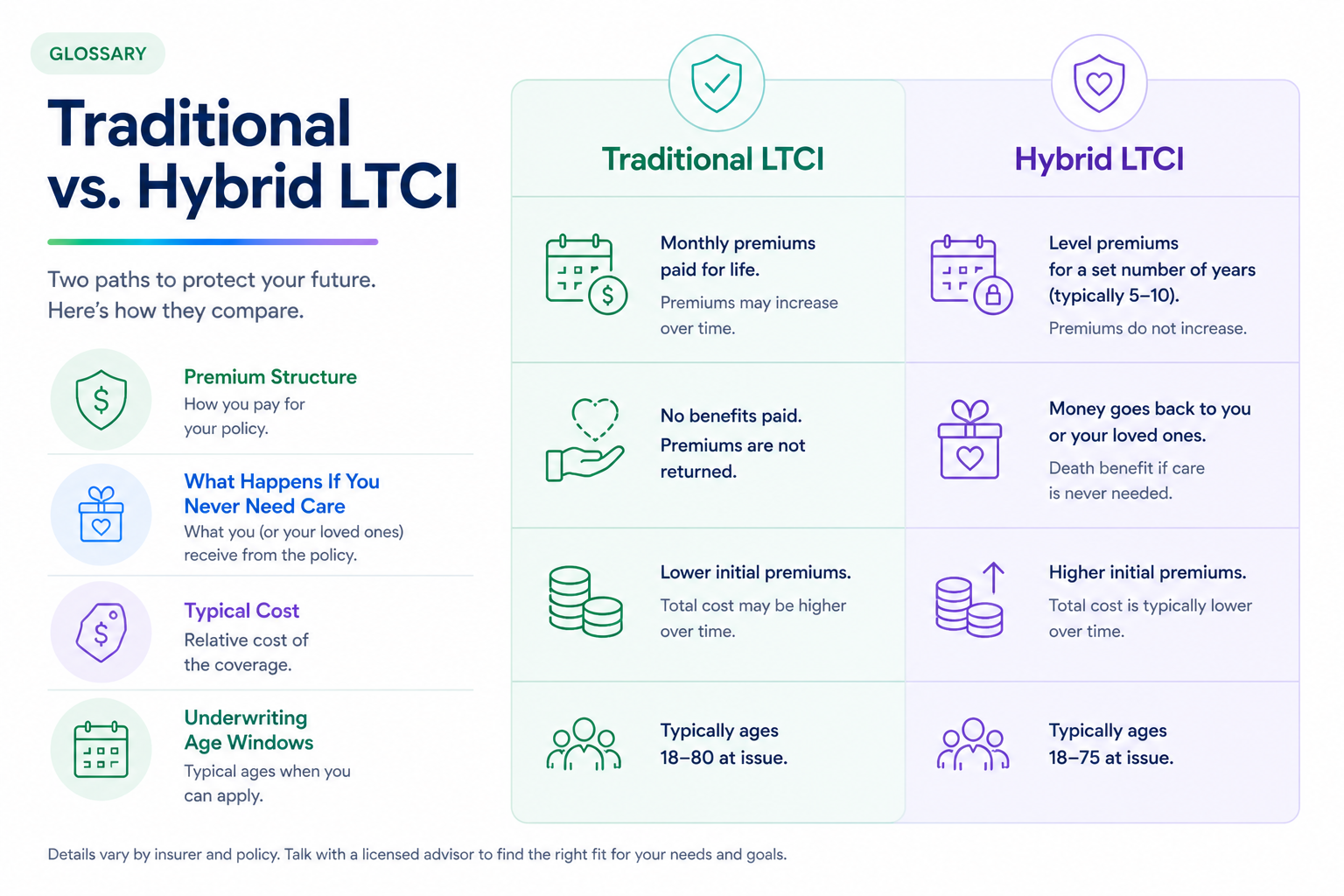
Traditional long-term care insurance is the older "use-it-or-lose-it" model: policyholders pay annual premiums for years or decades, and receive benefits only if they qualify under the policy's triggers. Premiums are typically lower than hybrid policies, but if the insured never needs care, the money is gone.
Hybrid policies — also called asset-based or linked-benefit policies — combine LTCI with life insurance or an annuity. Premiums are typically paid as a single large payment or over 10 to 20 years, and if the policyholder never needs long-term care, beneficiaries receive a death benefit or cash value. Hybrid policies have grown significantly because they solve the use-it-or-lose-it concern, though they cost more for equivalent long-term care coverage.
What these policies actually pay for
Several policy features determine what a policy actually pays. The benefit trigger is the qualifying event — federal "tax-qualified" policies require a licensed health practitioner to certify that the insured cannot perform at least two of six ADLs without substantial assistance for at least 90 days, or has severe cognitive impairment requiring substantial supervision.
The elimination period is the deductible-like waiting time between qualifying for benefits and when the policy starts paying — typically 30, 60, or 90 days.
The benefit period is how long the policy pays — common options are 2 years, 5 years, or lifetime. The daily or monthly benefit amount is the maximum the policy pays per day or per month for covered care. Inflation protection — usually a 3 to 5 percent annual compound rider — keeps the benefit amount growing alongside rising care costs over decades.
Tax implications
Tax treatment is meaningful. Tax-qualified LTCI premiums are deductible as a medical expense up to age-based IRS limits.
The IRS also caps tax-free benefits from indemnity-style policies at $430 per day in 2026, with payments above this amount potentially taxable. Many states also operate Long-Term Care Partnership Programs, in which an approved LTCI policy provides Medicaid asset-protection: every dollar paid out by the policy protects an equivalent dollar of personal assets from Medicaid's spend-down requirements when the policyholder later qualifies for Medicaid. Partnership programs are a meaningful planning option in many states.
Coverage cautions
The American Association for Long-Term Care Insurance recommends evaluating coverage in the mid-50s to balance affordability with eligibility. For families considering LTCI, working with an independent insurance professional who can compare carriers and structures, ideally alongside an elder-law attorney, is the standard recommendation.
Frequently Asked Questions
- What does long-term care insurance cover?
- Most LTCI policies cover the costs of nursing home care, assisted living, memory care, adult day services, and in-home care — the personal care services Medicare does not pay for. Coverage details vary by policy and may include skilled nursing, custodial care, respite care for family caregivers, and in some cases home modifications or care coordination services. The policy specifies a daily or monthly benefit amount, an elimination period before benefits begin, and a maximum benefit period.
- When does long-term care insurance start paying benefits?
- Federal tax-qualified policies require a licensed health practitioner to certify that the insured cannot perform at least two of six activities of daily living — bathing, dressing, eating, toileting, transferring, or continence — without substantial assistance for at least 90 days, or has severe cognitive impairment requiring substantial supervision. After the trigger is met, the elimination period (typically 30, 60, or 90 days) must pass before benefits begin paying. Some policies require the insured to receive paid care during the elimination period to satisfy it.
- How much does long-term care insurance cost?
- Premiums vary widely based on age at purchase, health, the daily benefit amount, the benefit period, the elimination period, and whether the policy includes inflation protection. Traditional policies are typically less expensive annually than hybrid policies for equivalent long-term care coverage, but offer no return of premium if care is never needed. Hybrid policies cost more upfront — often $50,000 or more in single-premium structures, or higher annual payments over 10 to 20 years — but include a death benefit or cash value if long-term care is never used. The American Association for Long-Term Care Insurance recommends evaluating coverage in the mid-50s for the best balance of affordability and underwriting acceptance.
- What's the difference between traditional and hybrid LTC insurance?
- Traditional LTCI is "use-it-or-lose-it" — the policyholder pays premiums for life, and if they never need care, the premium money is gone. Hybrid policies combine LTCI with life insurance or an annuity, so if the insured never needs long-term care, beneficiaries receive a death benefit or cash value. Traditional policies typically buy more long-term care coverage per dollar; hybrid policies are more expensive but eliminate the use-it-or-lose-it concern. The market has shifted significantly toward hybrid structures over the past decade.
- Are long-term care insurance premiums tax-deductible?
- Yes, for tax-qualified policies, with limits. For 2026, the IRS allows annual deductions per individual of $500 (age 40 or under), $930 (41–50), $1,860 (51–60), $4,960 (61–70), and $6,200 (71+). Premiums count as a medical expense and are deductible only to the extent that total medical expenses exceed 7.5 percent of adjusted gross income. Self-employed individuals and business owners may have additional deduction options. Tax-free benefits from indemnity-style policies are capped at $430 per day in 2026.
- What is a Long-Term Care Partnership Program?
- Long-Term Care Partnership Programs are state programs that link an approved LTCI policy with Medicaid asset protection. Every dollar the LTCI policy pays in benefits protects an equivalent dollar of the policyholder's assets from Medicaid's spend-down requirements when the policyholder later applies for Medicaid. So a partnership policy that pays out $200,000 in benefits would let the policyholder keep $200,000 in additional assets above the standard Medicaid asset limit. Most states operate partnership programs; eligibility and policy requirements vary by state.
- What are the risks of buying long-term care insurance?
- The main risks are premium increases, market consolidation, and underwriting denial. Insurers can raise premiums on entire classes of policyholders if their loss experience justifies it — historically, many traditional LTCI policies have seen significant rate increases. The traditional LTCI market has shrunk as carriers have exited, leaving fewer choices. Underwriting tightens with age and health conditions, so applying after 70 is often expensive or unsuccessful. Hybrid policies reduce some of these risks but cost more upfront. Working with an independent insurance professional who can compare multiple carriers is the standard recommendation.