https://zenblis.com/resources/zenblis-vs-a-place-for-mom
Zenblis vs. A Place for Mom: Which Actually Pays Off for Operators?
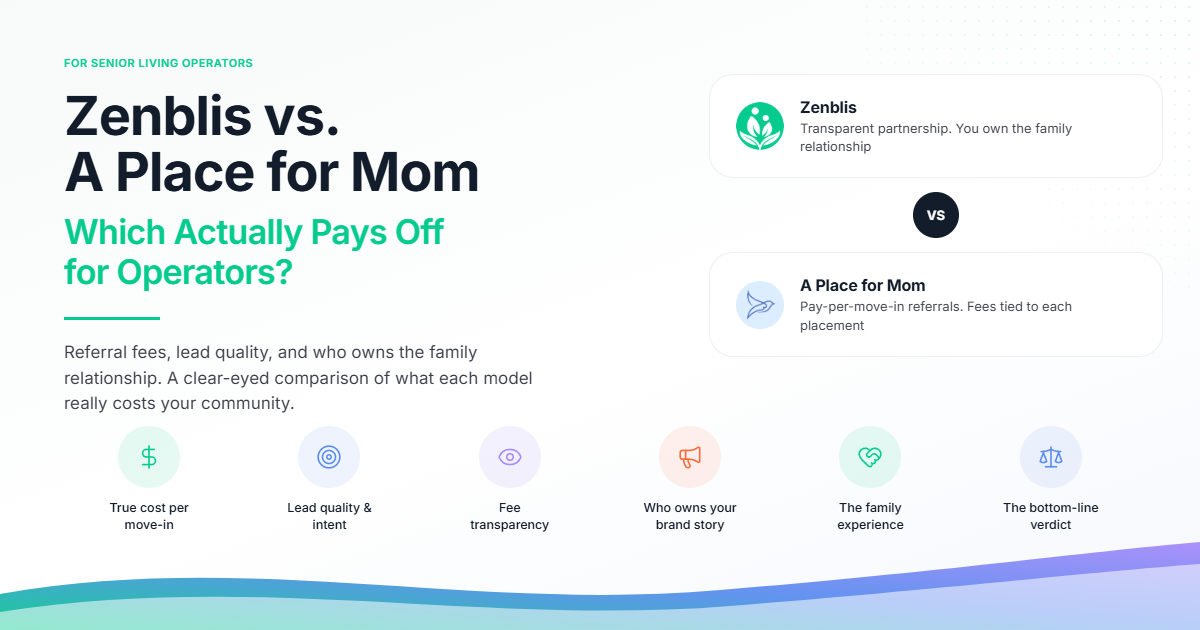
The core difference is simple. A Place for Mom (APFM) charges your community a placement fee, typically around 100% of a new resident's first month's rent, every single time a referred family moves in. Zenblis charges a flat $299/month per community to maintain your profile, no matter how many residents you fill.
By Derek Belfield - 2026-07-26
60-second summary
How the two models actually work
A Place for Mom is a referral (lead-generation) agency. It markets to families, captures their contact information, and distributes each family's inquiry to communities in its paid partner network. When a referred family moves in, the community pays APFM a commission. Industry sources put that commission at roughly 80% to 100% of the resident's first month's rent, and by some accounts as high as 100% to 150%. A 2010 Seattle Times investigation found average commissions of about $3,500 per placement in one Washington county, and rents have climbed substantially since.
Zenblis is a subscription directory and education platform. Families research care options and find your community's profile directly. You pay a flat $299/month per community to maintain that profile, and the inquiry comes straight to you. There is no per-move-in commission, no revenue share, and no penalty for filling faster.
Side-by-side comparison
| Criteria | A Place for Mom | Zenblis |
|---|---|---|
| Pricing model | Per-placement commission (roughly 100% of first month's rent; some accounts 100% to 150%) | Flat $299/month per community |
| Annual cost example | $60,000 to $90,000+ at one $5,000 move-in per month | $3,588 per year, fixed |
| Cost when you fill more | Goes up with every move-in | Stays the same |
| Who owns the lead | APFM; the family reaches them first | You; the inquiry comes directly to your team |
| Lead exclusivity | Same family often sent to many communities at once | Your profile, your inquiry, no shotgun blast |
| Brand building | Transactional; builds APFM's brand, not yours | Builds your community's visibility and reputation |
| Budget predictability | Variable, hard to forecast | Fixed line item, $299/month |
| Cost passed to residents | Commission effectively folds into resident fees | No per-resident acquisition cost to pass on |
The real math for operators
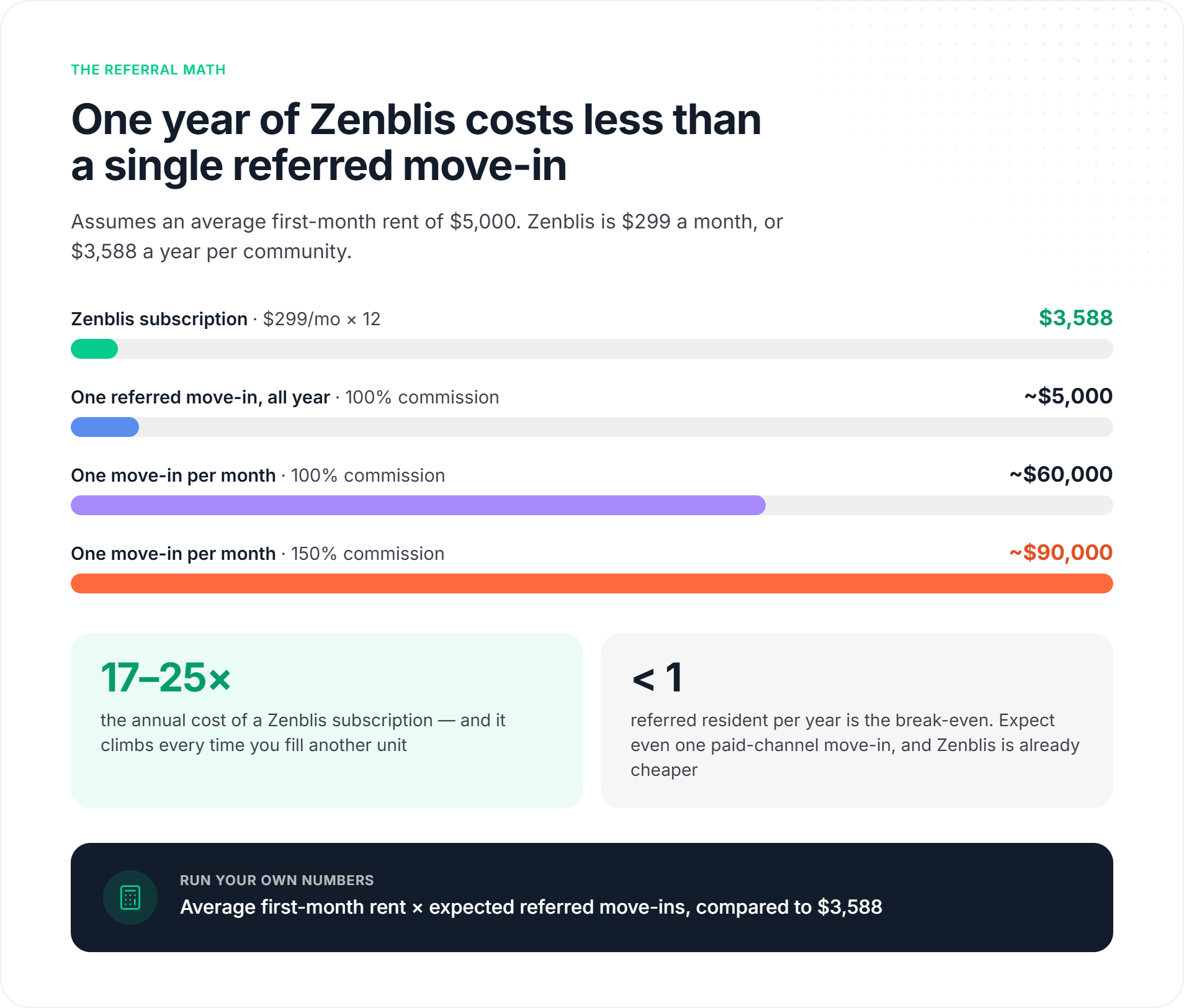
A full year of Zenblis costs $3,588 per community ($299 times 12). Here is what the referral model costs against that. With an average first-month rent of $5,000:
Just one referred move-in all year costs about $5,000 in commission (at 100%), already more than a full year of Zenblis.
One referred move-in per month costs about $60,000 per year at 100%, or about $90,000 per year at 150%.
That is 17 to 25 times the annual cost of a Zenblis subscription, and it climbs every time you fill another unit.
Put plainly, the break-even is less than a single referred resident per year. If you expect to fill even one move-in through a paid channel in the next twelve months, a $299/month subscription is already the cheaper way to get in front of families. Run your own numbers. Multiply your average first-month rent by your expected referred move-ins, and compare it to $3,588.
You paid for the lead, but do you own the relationship?
One of the least-discussed costs of the referral model is disintermediation. Referral platforms sit between your community and the family. Industry analyses note that families searching for a specific community by name are often intercepted and routed through a referral site first, which means you can end up paying a commission for a resident who was already looking for you. You also do not build a direct relationship or a returning-customer pipeline; the platform does. With a subscription directory, the inquiry lands with your team and the relationship, and the brand equity, stays yours.
Lead quality: your profile vs. the shotgun blast
Referral agencies typically distribute a single family's contact information to a wide set of communities at once, by some accounts 20 or more across a broad geography. Families describe being hit with a "tidal wave" of calls and emails, which trains them to price-shop and slows your sales cycle. When a family finds and contacts your community through its own profile, the intent is higher and the conversation starts on your terms.
The trust factor families are starting to notice
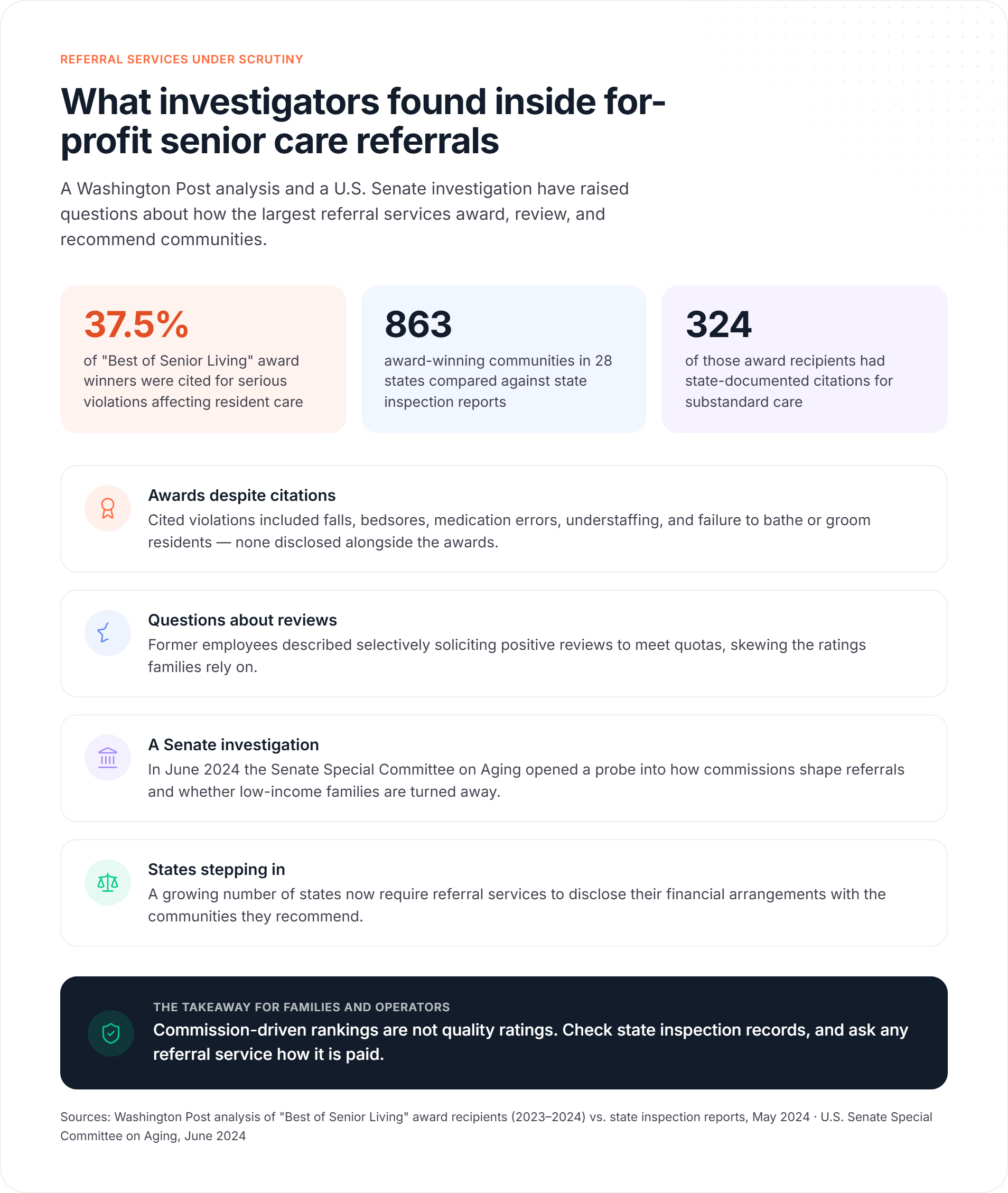
The referral model has also drawn growing public scrutiny. In 2024, a U.S. Senate committee announced a probe into for-profit senior living referral services, and a Washington Post analysis raised questions about the relationship between referral-site awards and reviews and care-quality citations. Families are increasingly wary of "free" referral services once they learn communities pay for placements. A transparent, subscription-based directory, where profiles are not ranked by who paid the biggest commission, is easier to trust, and that trust reflects well on the communities listed on it.
Where A Place for Mom still makes sense
To be fair, APFM has enormous reach, a large advisor workforce, and decades of brand recognition, and for a community with empty units and no marketing engine, "pay only when someone moves in" can feel low-risk. If you have deep vacancy and no other lead flow, referral agencies can put heads in beds quickly. The trade-off is that you pay richly for every one of those move-ins, you do not own the relationship, and the cost scales with your success. Many operators use referral agencies as a stopgap while they build lower-cost, owned channels, which is exactly the role a $299/month directory profile is built to fill.
The bottom line for operators
If your community rarely fills units and wants pure pay-per-result, a referral agency can work, at a premium. If you fill units regularly and want predictable costs, direct family relationships, and brand equity you keep, a flat $299/month profile on Zenblis is the better long-term economics. The break-even is strikingly low. One referred move-in a year already costs more than twelve months of Zenblis.
Claim your community on Zenblis
Zenblis gives your community a verified profile in front of families actively researching senior care, for a flat $299/month per community, with no per-move-in fees and every inquiry sent straight to your team. Claim your community's profile or see provider pricing to compare $3,588 a year against what you are paying in referral commissions today.
Frequently Asked Questions
- How much does A Place for Mom charge senior living communities?
- A Place for Mom charges communities a placement fee when a referred family moves in, typically around 100% of the resident's first month's rent, and by some industry accounts as much as 100% to 150%. There is generally no upfront cost; the community pays per successful move-in.
- How much does Zenblis cost for operators?
- Zenblis is a flat $299/month per community ($3,588 per year). There are no per-move-in fees and no revenue share. Every inquiry from your profile goes directly to your team, and your cost stays the same no matter how many units you fill.
- Is a subscription cheaper than paying referral commissions?
- For almost any community that fills units, yes. A single referred move-in at $5,000 first-month rent costs about $5,000 to $7,500 in commission, already more than a full year of Zenblis at $3,588. Fill one referred resident per month and you would pay $60,000 to $90,000 a year versus $3,588.
- Do I lose the family relationship with a referral agency?
- Often, yes. Referral platforms sit between your community and the family, capturing the relationship and sometimes intercepting families who were already searching for you by name. A subscription directory sends the inquiry directly to you, so you own the relationship and the brand equity.
- Can I use both A Place for Mom and Zenblis?
- Yes. Many operators run referral agencies as a stopgap for vacancy while building lower-cost owned channels like a $299/month directory profile. Over time, shifting move-ins from commission-based to flat-fee channels improves your cost of acquisition.