https://zenblis.com/resources/is-memory-care-safe-warning-signs
Is Memory Care Safe? 7 Warning Signs for Families
Most memory care communities keep residents safe but safety depends almost entirely on staffing levels, supervision, and how well a community manages dementia-related behavior.
By Derek Belfield - 2026-07-22
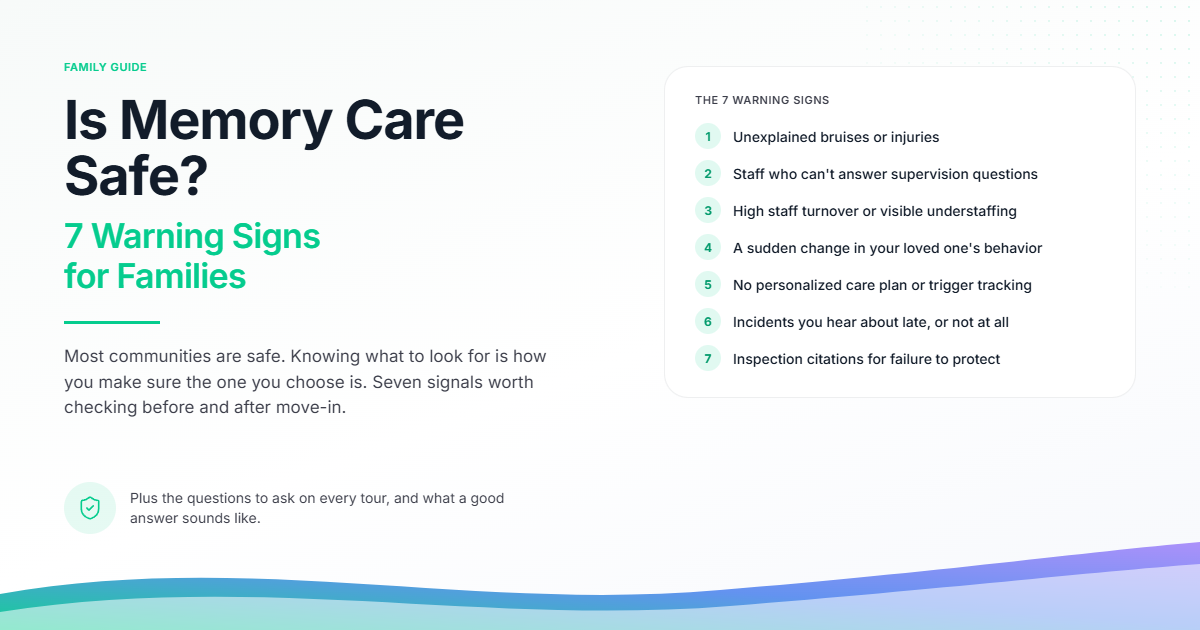
A July 2026 national investigation found that resident-on-resident aggression is more common than many families realize, and that the worst incidents were usually preceded by clear, ignored warning signs. The good news: those same warning signs are things you can check for before you ever sign a contract.
Why safety is a real question in dementia care
Dementia changes the brain regions that govern judgment and threat response. As the disease progresses, residents may be unable to say they're in pain, frightened, or overstimulated; and some express that distress physically. Environmental triggers like unfamiliar staff, loud noise, crowding, and rushed personal care can escalate a situation quickly.
Victims of aggression per month
- 1 in 7 assisted living residents
- 1 in 5 nursing home residents
The scale is significant. Cornell University research has found that roughly 1 in 7 assisted living residents and 1 in 5 nursing home residents experience some form of resident-to-resident aggression in a given month, and a CDC analysis found nearly 8% of assisted living residents engaged in physical aggression toward others. Since January 2024, Medicare has cited nursing homes at least 700 times for failing to protect residents from peer abuse. A problem far more prevalent than staff abuse. As one dementia expert put it, "in the vast majority of incidents, there are warning signs in the months, weeks, days, hours, and sometimes minutes" beforehand.
That's the key insight for families: safe communities are the ones that see the warning signs and act on them.
7 warning signs to check before you choose a memory care community
- Thin or inconsistent staffing, especially at night. Ask for the staff-to-resident ratio on every shift. Aggression and wandering often spike in the evening ("sundowning"), when staffing is frequently lowest.
- Slow response to call buttons and alert pendants. In one 2026 case, a fatal injury followed a 13-minute delay after an alert was pressed. Ask how response times are tracked and what the average is.
- No clear plan for residents with a history of aggression. A safe community assesses behavioral triggers and has a written plan; an unsafe one simply reassigns rooms and hopes for the best.
- Staff who can't describe de-escalation training. Front-line aides should be able to tell you, in plain terms, how they're trained to redirect and calm an agitated resident.
- High staff turnover. Unfamiliar caregivers are themselves a trigger for people with dementia. Ask how long the typical aide has worked there.
- Vague answers about incident reporting. Ask directly: "How do you document and report resident-to-resident incidents, and can families see them?" Transparency here is a strong safety signal.
- A tense or overstimulating environment. Visit at a busy time. Is it loud and chaotic, or calm and structured? Rigid routines and sensory overload are known escalators.
Questions to ask on tour
- What is your staffing ratio on nights and weekends?
- What is your average call-response time?
- How are staff trained in dementia behavior and de-escalation?
- How do you handle a resident who becomes aggressive?
- Can I see your most recent state inspection report?
The bottom line
Memory care can be a safe, even life-improving choice. However, "safe" is not a given; it's a set of practices you can verify. Check staffing, supervision, response times, de-escalation training, and inspection history before you commit, and trust what you see and hear on an unannounced second visit.
How Zenblis helps
Zenblis exists to help families evaluate senior care options on the things that actually matter — including safety and supervision — and to connect you with memory care communities that meet those standards. Explore verified memory care communities and safety questions to ask from our knowledge hub.
Frequently Asked Questions
- How common is violence in memory care?
- Research suggests roughly 1 in 7 assisted living residents and 1 in 5 nursing home residents experience resident-to-resident aggression in a typical month. Most incidents are preventable when staff recognize and respond to warning signs.
- What's the single most important safety factor in memory care?
- Adequate, well-trained, consistent staffing — particularly on nights and weekends. Most serious incidents trace back to supervision gaps rather than a single "bad" resident.
- How can I check a community's safety record?
- Ask for the most recent state inspection (survey) report, search Medicare's Care Compare for nursing homes, and ask directly how the community documents and shares resident-to-resident incidents.
- Is memory care safer than keeping a loved one at home?
- It depends on the person's needs. A well-staffed memory care community offers 24/7 supervision and dementia-trained caregivers that are hard to replicate at home, but quality varies widely — which is why vetting the specific community matters more than the care type alone.