https://zenblis.com/resources/senior-care-fraud-three-states-family-guide
Three States, Billions in Fraud: What Families Should Know When Choosing Senior Care
A grounded look at recent home health and hospice fraud cases in California, Ohio, and Minnesota; and what they should change about how families choose a provider.
By Derek Belfield - 2026-05-06
Key takeaways
- Three states, billions alleged. California, Ohio, and Minnesota have unsealed major home- and community-based care fraud cases in the past year.
- It's almost always billing fraud. Providers billed Medicare or Medicaid for care that wasn't delivered. Patients were used as billing currency, not the primary target.
- Lighter-license services took the worst hits. Hospice, home health aide, and autism services — all newer categories where oversight is still maturing.
- The patterns are detectable. Billing-data analytics is how investigators cracked all three states.
- Families have more tools than they realize. Medicare's Care Compare is the most underused.
- Fifteen minutes of homework matters. Five basic questions can separate a credible provider from a suspect one.
Lede
Three different states. Three different schemes. One unsettling pattern for families trying to do right by an aging parent.
Over the past year, federal and state prosecutors in California, Ohio, and Minnesota have unsealed indictments alleging billions of dollars in fraud across home health, hospice, and community-based care — the same services families turn to during the most exhausting and emotional decisions of their lives. The cases don't mean every provider is suspect. They do mean families are right to ask harder questions before they pick one.
Here's what's been alleged in each state, what the cases have in common, and what to look for when you're standing in a hallway choosing a hospice agency, a home health aide, or a memory care community for someone you love.
California: A $267 million hospice scheme
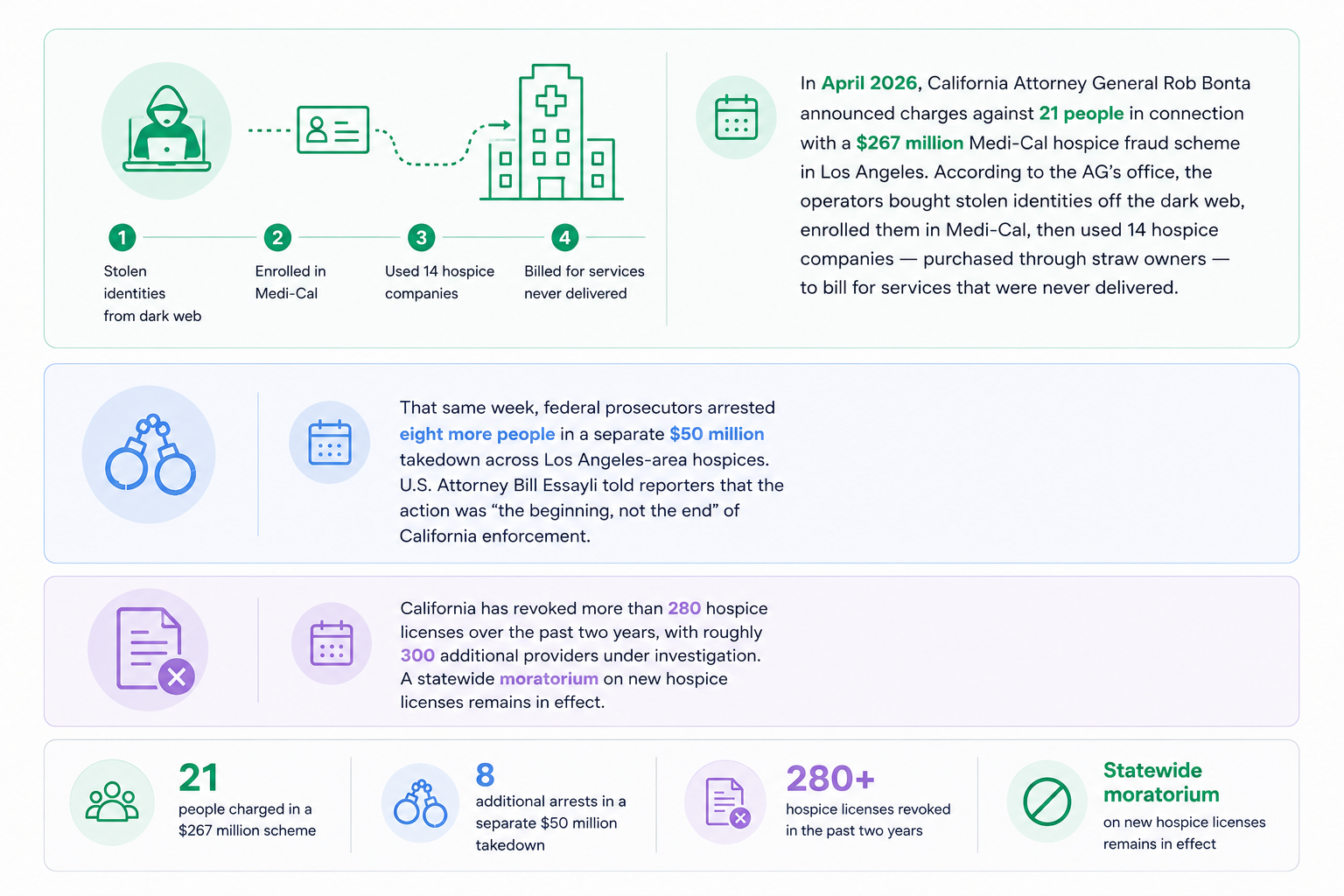
In April 2026, California Attorney General Rob Bonta announced charges against 21 people in connection with a $267 million Medi-Cal hospice fraud scheme in Los Angeles. According to the AG's office, the operators bought stolen identities off the dark web, enrolled them in Medi-Cal, then used 14 hospice companies — purchased through straw owners — to bill for services that were never delivered.
That same week, federal prosecutors arrested eight more people in a separate $50 million takedown across Los Angeles-area hospices. U.S. Attorney Bill Essayli told reporters that the action was "the beginning, not the end" of California enforcement.
California has revoked more than 280 hospice licenses over the past two years, with roughly 300 additional providers under investigation. A statewide moratorium on new hospice licenses remains in effect.
Ohio: A steady drumbeat of home health cases
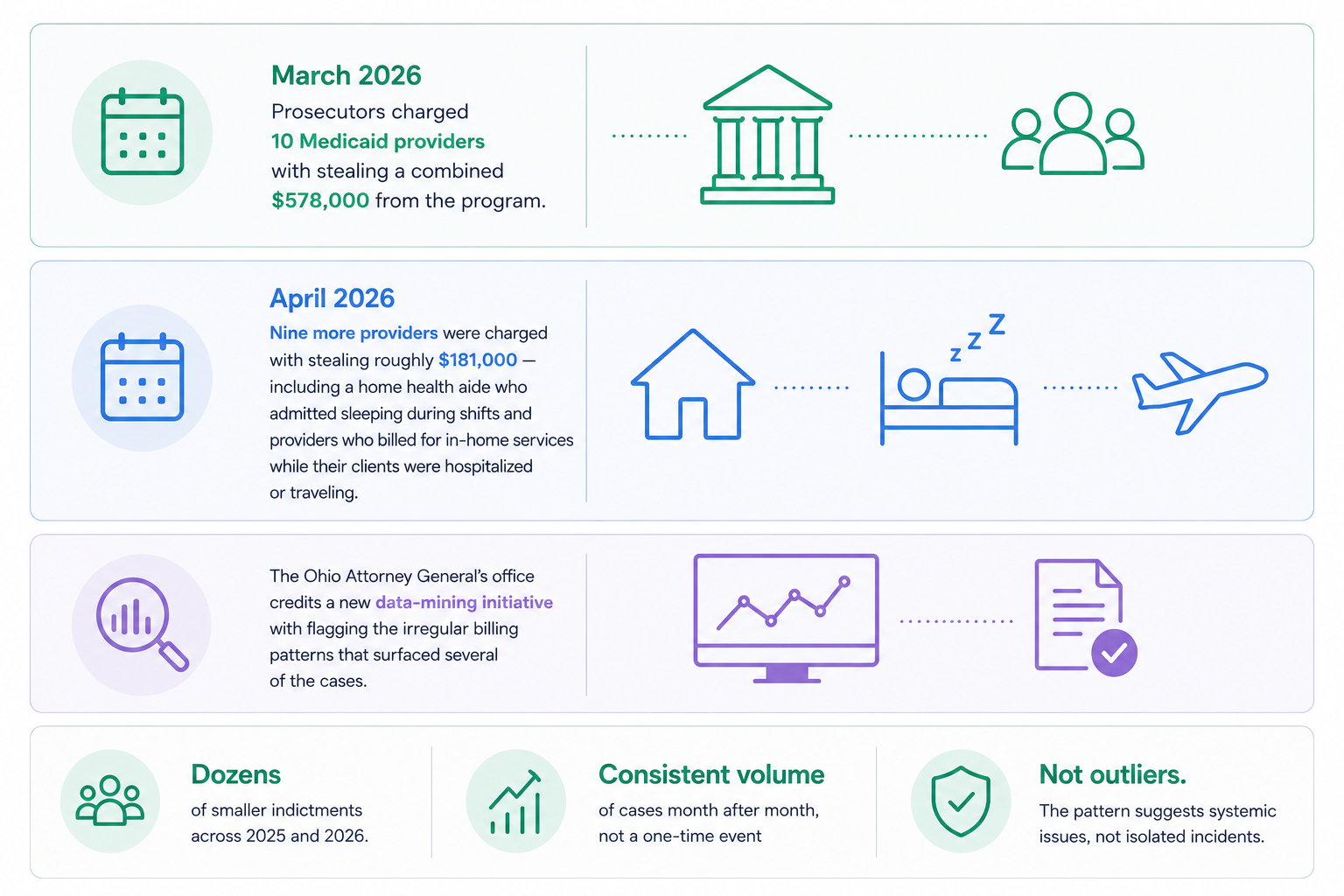
Ohio's pattern looks different. Rather than a single massive scheme, Attorney General Dave Yost's office has been indicting home health providers in monthly batches.
In March 2026, prosecutors charged 10 Medicaid providers with stealing a combined $578,000 from the program. In April, nine more providers were charged with stealing roughly $181,000 — including a home health aide who admitted sleeping during shifts and providers who billed for in-home services while their clients were hospitalized or traveling.
The Ohio Attorney General's office credits a new data-mining initiative with flagging the irregular billing patterns that surfaced several of the cases. The volume — dozens of smaller indictments across 2025 and 2026 — suggests these aren't outliers.
Minnesota: A multi-billion-dollar federal investigation
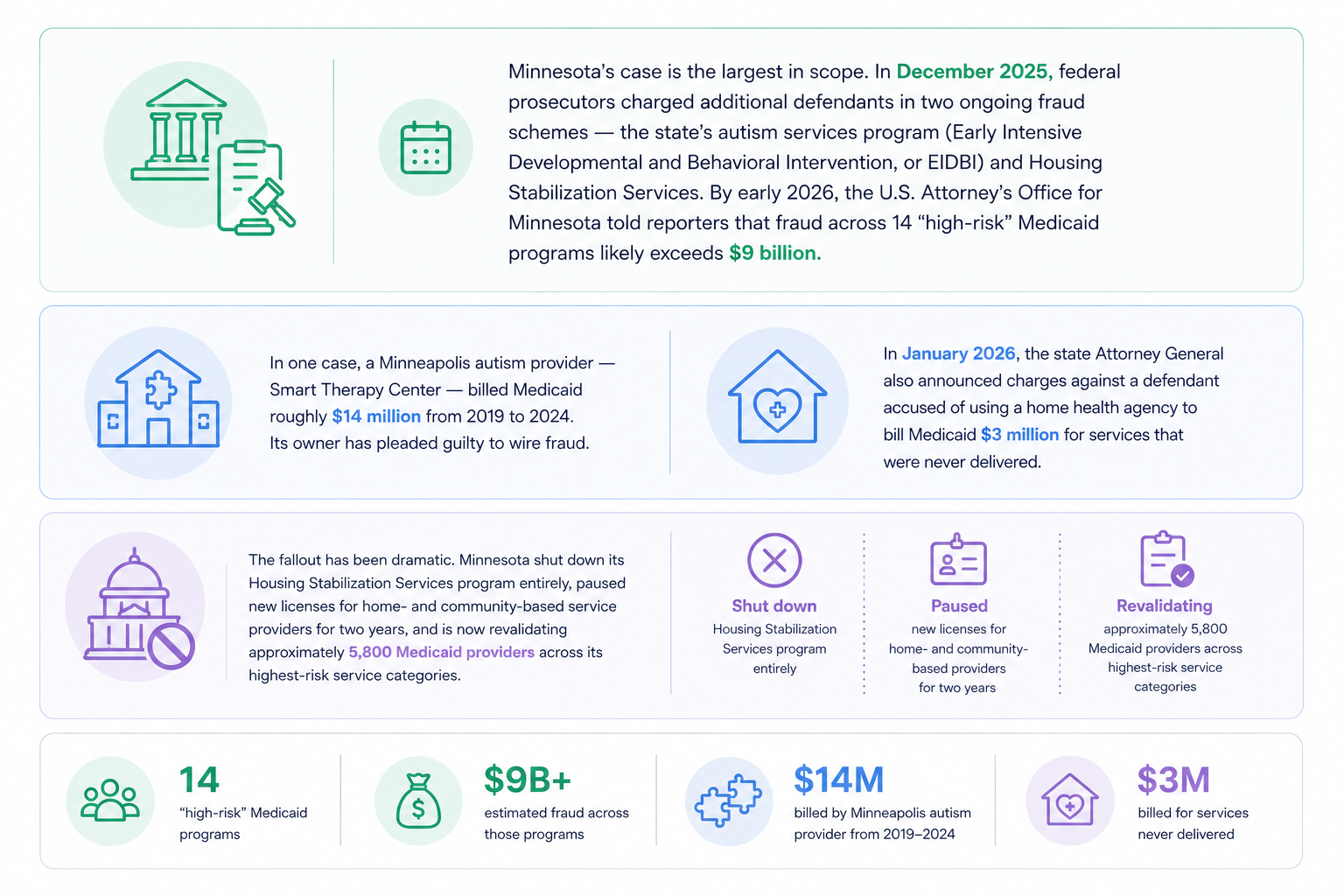
Minnesota's case is the largest in scope. In December 2025, federal prosecutors charged additional defendants in two ongoing fraud schemes — the state's autism services program (Early Intensive Developmental and Behavioral Intervention, or EIDBI) and Housing Stabilization Services. By early 2026, the U.S. Attorney's Office for Minnesota told reporters that fraud across 14 "high-risk" Medicaid programs likely exceeds $9 billion.
In one case, a Minneapolis autism provider — Smart Therapy Center — billed Medicaid roughly $14 million from 2019 to 2024. Its owner has pleaded guilty to wire fraud. In January 2026, the state Attorney General also announced charges against a defendant accused of using a home health agency to bill Medicaid $3 million for services that were never delivered.
The fallout has been dramatic. Minnesota shut down its Housing Stabilization Services program entirely, paused new licenses for home- and community-based service providers for two years, and is now revalidating approximately 5,800 Medicaid providers across its highest-risk service categories.
What the three states have in common
Different geographies, different schemes — but a few themes run through all of them.
The fraud was largely against payers, not patients directly. Most of these cases involve providers billing Medicare or Medicaid for services that were never delivered, exaggerated, or delivered to people who didn't qualify. Patients were often used as billing currency — sometimes recruited with cash kickbacks, sometimes through stolen identities they never knew were being used.
Data analytics is what cracked the cases. All three states leaned on billing-pattern analysis to flag providers whose claims looked unusual relative to their peers. Explosive growth in billing, repeat licenses held by straw owners, and unusually long service durations were common tells.
Lighter-touch license categories saw the worst abuse. Hospice in California, autism services in Minnesota, and home health aide services in Ohio are all fields where licensing requirements are lighter than skilled nursing, and where regulator oversight has been racing to catch up.
For families, none of this means home health, hospice, or community-based care should be avoided. These services are the difference between dignity and despair for millions of older Americans. It does mean a little homework matters more than it used to.
Five questions to ask before you choose a provider
- How long has the provider been licensed under its current ownership? Brand-new entities operating under recent licenses deserve more scrutiny. Ask for the original licensing date and any history of name changes or ownership transfers.
- Is the provider listed on Medicare's official Care Compare tool? Medicare.gov publishes ratings, inspection findings, and complaint records for skilled nursing, home health, and hospice. It is the single most underused resource families have.
- Can you visit unannounced? Reputable providers welcome it. Several of the operations in these indictments shared addresses with multiple unrelated companies, or had no functioning office at all.
- Who actually delivers the care, and are they employees or contractors? Ownership and staffing patterns — for example, recently hired relatives staffing visits — show up repeatedly in fraud cases.
- Does the billing match what you witnessed? Families should review the Medicare and Medicaid explanation-of-benefits statements that come in the mail. Bills for visits that didn't happen are often the first sign of fraud.
Where Zenblis fits
Zenblis is a senior care directory built on a simple idea: families making care decisions for someone they love deserve clear information, presented honestly.
Our provider profiles surface the things that take families hours to track down on their own — licensing details, services offered, ownership information where it's publicly available, and links to the official regulatory data sources families can use to verify what they're reading.
We're not a fraud-detection service. No directory is. What we are is a starting point — a calm, well-sourced view of the provider in front of you, with the public records that can confirm or complicate the picture you've been given.
If you're researching senior care for someone in your family, you can browse providers and the public data we publish about them at zenblis.com.
If you operate a senior care community or agency and want to make your facility's information easier for families to verify, we'd like to hear from you.
Frequently Asked Questions
- Does this mean home health and hospice care aren't safe?
- No. The vast majority of providers deliver legitimate care that meaningfully improves lives. The cases described here are a subset of bad actors — and most were caught precisely because the legitimate industry's billing patterns gave investigators a baseline to compare against.
- What's the single best way to verify a provider?
- Zenblis pulls data from Medicare's CMS Data. We pull their star ratings, inspection results, and complaint records. We're also pulling data from each state's licensing agency.
- How do I report suspected fraud?
- Federally, contact the HHS Office of Inspector General at 1-800-HHS-TIPS or oig.hhs.gov. At the state level, every state has a Medicaid Fraud Control Unit, typically housed under the state Attorney General. Tips can be submitted anonymously.
- Are these problems only in California, Ohio, and Minnesota?
- No. Those three states are simply where the most public enforcement actions surfaced this year. Medicaid Fraud Control Units operate in all 50 states and the District of Columbia, and federal Health Care Fraud Strike Forces are active in 27 federal districts.
- My parent's provider seems trustworthy. Should I still review their billing statements?
- es. Reviewing the Medicare and Medicaid explanation-of-benefits statements that arrive in the mail is one of the simplest ways to catch issues early. Look for visits, services, or supplies that don't match what your loved one actually received.
- Does Zenblis vet every provider in its directory?
- Zenblis publishes the public regulatory data available for providers in our directory and links families to the official sources where they can verify it themselves. We are not a fraud-detection service, and no directory should claim to be. Our role is to make verification easier — not to replace it.