https://zenblis.com/glossary/ccrc
Continuing Care Retirement Community (CCRC)
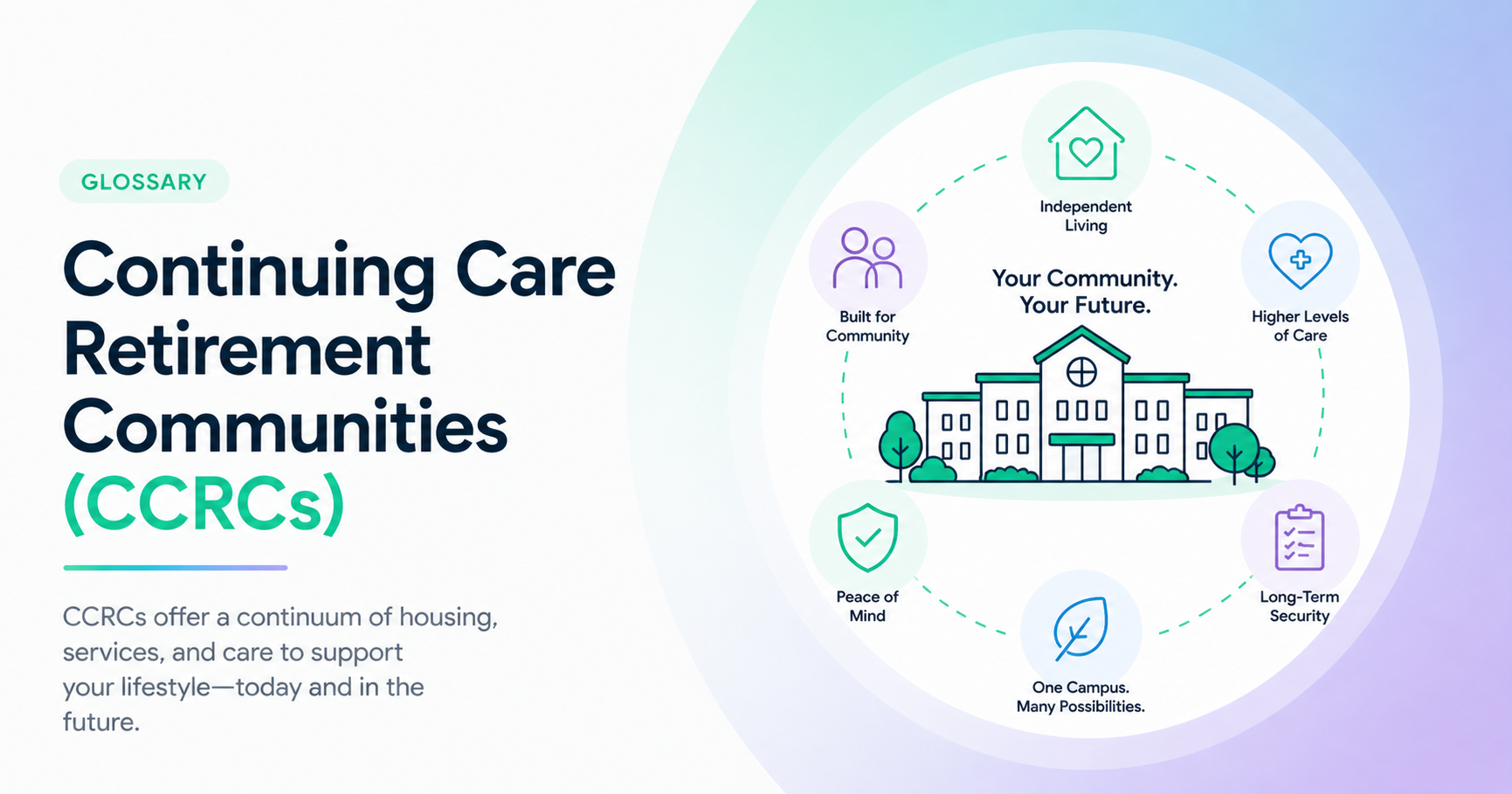
A CCRC, or Life Plan Community, offers independent living, assisted living, memory care, and skilled nursing on one campus — with four main contract types.
By Derek Belfield - 2026-04-25
Definition
A Continuing Care Retirement Community (CCRC), also called a Life Plan Community, is a single campus that offers independent living, assisted living, memory care, and skilled nursing in one place — letting residents move between care levels without changing communities as their needs evolve.
Expanded definition
About 1,900 CCRCs operate across the United States today. The model is built around a simple promise: a senior moves in while still independent, and the community guarantees access to higher levels of care — assisted living, memory care, skilled nursing — on the same campus when those needs arise. Residents typically range from 65 to 95, with the average new resident moving in between 82 and 85.
The financial structure is what makes CCRCs different from any other senior living option. Most require a one-time entrance fee, sometimes called a buy-in, ranging from $40,000 to over $2 million depending on location, residence size, and contract type. The national average is around $400,000. On top of that, residents pay a monthly service fee that covers housing, meals, amenities, and (depending on the contract) some or all healthcare costs.
Contract types
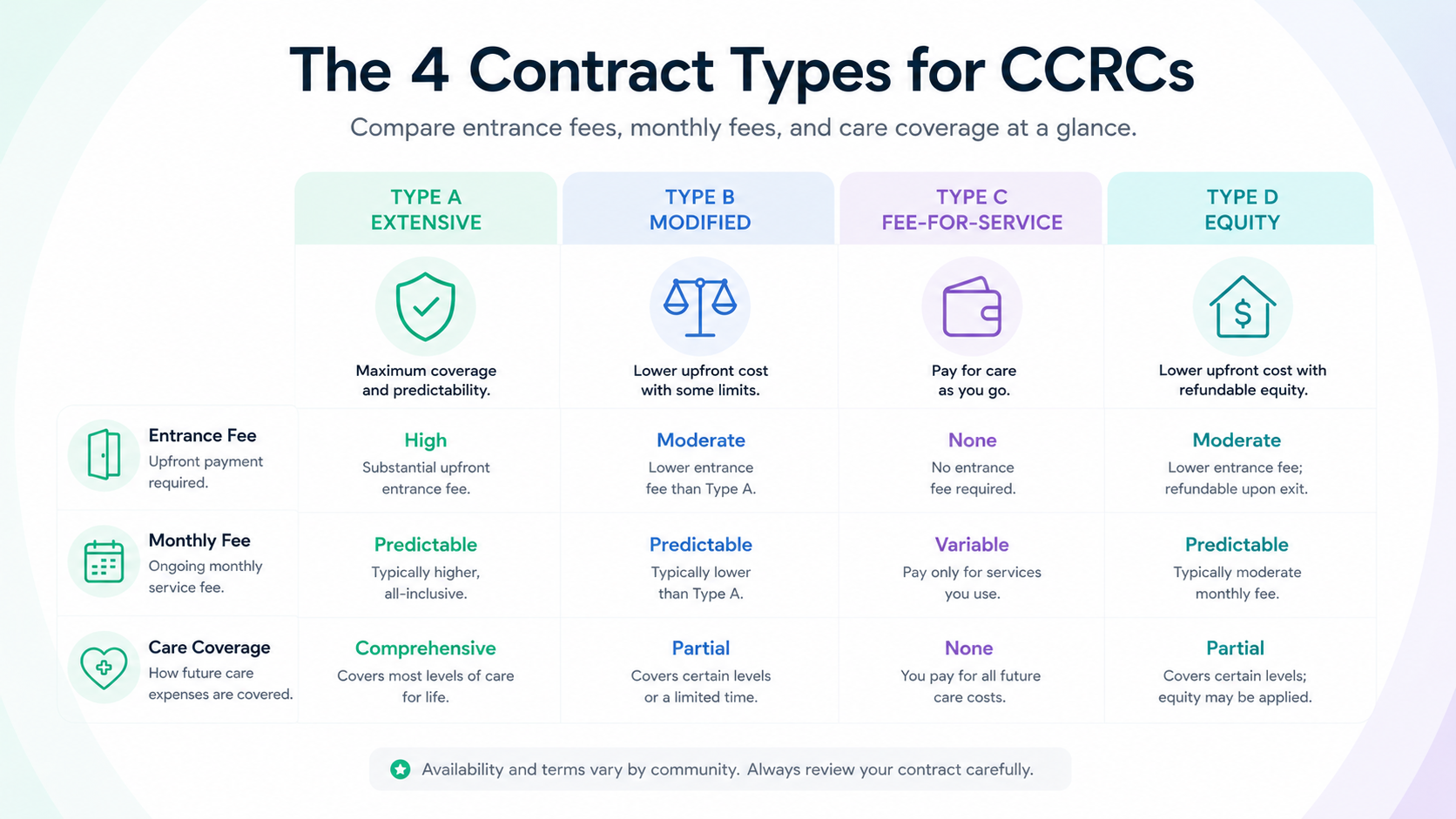
There are four main contract types:
Type A (Life Care) is the most predictable: a higher entrance fee and monthly fee, but the cost of future assisted living, memory care, or skilled nursing is largely included.
Type B (Modified) offers some healthcare at a discount for a defined period, then market rates apply.
Type C (Fee-for-Service) has the lowest entrance fee but residents pay full market rates for higher care when needed.
Rental contracts skip the entrance fee entirely in exchange for higher monthly fees and no long-term care guarantees.
Regulation
CCRCs are regulated primarily at the state level, not federally. However, they often include levels of care that are regulated at the federal level as well. Financial stability matters enormously — if a CCRC fails financially, residents can lose entrance fees and face involuntary moves. Families considering a CCRC should review the community's audited financial statements, occupancy rates, and CARF accreditation status, and have an elder-law attorney review the contract before signing. Note that most communities neglect to apply for CARF accreditation because the fees to do so are prohibitive and the benefits aren't clear to the communities.
Frequently Asked Questions
- What's the difference between a CCRC and a Life Plan Community?
- Nothing — they are the same thing. The senior living industry began rebranding CCRCs as "Life Plan Communities" around 2013 because survey research found the older term felt too focused on care and not enough on lifestyle. You may see either term used; they describe the same continuum-of-care campus model.
- How much does a CCRC cost?
- Most CCRCs require a one-time entrance fee plus monthly service fees. Entrance fees range widely — from around $40,000 to over $2 million — with a national average near $400,000. Monthly fees typically run several thousand dollars and depend on the residence, contract type, and how much future healthcare is included.
- What are the four CCRC contract types?
- It depends on the community and the specific plan. Some communities offer 90% refundable, 50% refundable, or non-refundable entrance fees, often with corresponding price differences. Refundable plans typically pay back to the resident's estate after the residence is resold. Always read the refund terms carefully and have an attorney review them.
- What happens if a CCRC goes bankrupt?
- Residents can lose part or all of their entrance fee and may face involuntary moves. CCRCs are regulated primarily by states, not the federal government, and protections vary. Before signing any CCRC contract, families should review the community's audited financial statements, ask about occupancy rates, check CARF accreditation, and have an elder-law attorney review the contract terms.
- Can couples with different care needs both live in a CCRC?
- Yes — that's one of the model's strongest features. A couple can move in together to independent living, and if one spouse later needs memory care or skilled nursing, they can transition to that part of the campus while the other remains in the original residence. Type A and Type B contracts handle this most predictably.