https://zenblis.com/resources/how-to-vet-in-home-care-agency-questions
How to Vet an In-Home Care Agency: 12 Questions
Compare an in-home care agency’s services, screening, supervision, missed-visit plan and written costs. Use these 12 questions and a comparison worksheet before signing.
By Derek Belfield - 2026-09-08
- Caregiving
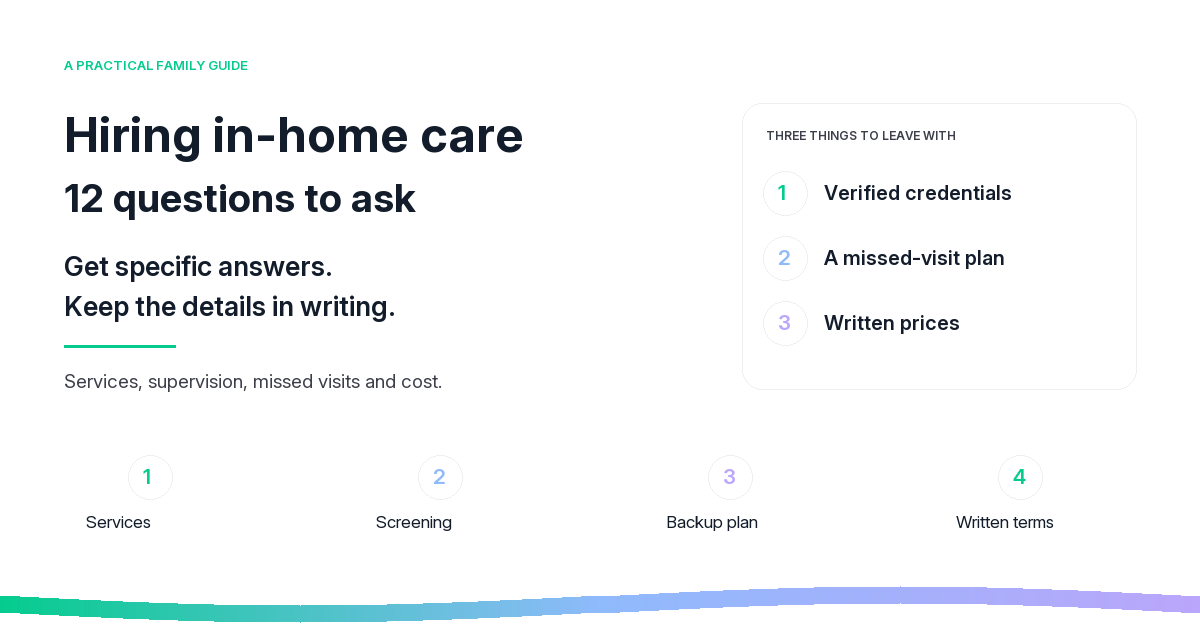
Before hiring an in-home care agency, compare the help it can provide, who employs and supervises caregivers, its plan for missed visits, and the full written cost. Verify any required license with the relevant state authority. A reassuring sales conversation is a starting point; specific answers and written terms give you something to check.
Start with the person who will receive care. What help do they want, which tasks need support, and when? Bring that list to each agency. Our weekly care-at-home planning guide can help you identify the hours you are trying to cover.
First, separate home care from home health
For this checklist, home care means help with daily life, such as dressing, meals or companionship. Ask each agency which tasks its staff can perform. Skilled home health involves clinical services such as nursing or therapy.
Medicare can cover eligible home health care when its requirements are met, including homebound status, a qualifying skilled need, a provider's assessment and order, and a Medicare-certified home health agency. Personal care alone is not covered under this benefit. Part-time or intermittent aide services may be covered alongside qualifying skilled services. Medicare does not cover round-the-clock care at home. Check your specific benefits with the agency and your plan. Medicare home health coverage
Certification for Medicare home health is a different question from whether an agency meets state requirements for the services you want. Do not use one as a substitute for checking the other.
Twelve questions to bring to an agency
1. Which services are you authorized to provide here?
Ask for the agency's legal business name, any required license number, the issuing authority and the services covered. Verify the record with that authority. Requirements vary by service and location; a national checklist cannot establish what a particular agency is required to hold.
2. Who employs the caregiver, and who handles each responsibility?
Ask whether caregivers are agency employees, contractors or workers introduced through a registry. Request written answers about payroll, taxes, insurance and supervision. Do not assume that using an agency removes every possible responsibility. If the arrangement leaves employment obligations unclear, get advice about the actual contract and your state's rules before signing.
3. What screening happens before someone comes into the home?
Ask which background checks, references and relevant credentials the agency verifies, and whether checks are repeated. Ask how it handles a concern raised after hiring. A broad statement such as “fully screened” needs an explanation of what was checked.
4. What insurance and bonding apply to our arrangement?
Request evidence of current coverage and an explanation of relevant limits, exclusions and the claims process. Ask specifically how worker injuries and property-loss concerns are handled. A policy or bond is not a promise that every incident will be covered.
5. Who assesses needs and supervises the work?
Ask who prepares the care plan, how that person is qualified for the services involved, how often it is reviewed and who checks whether the plan is being followed. Find out how changes in needs reach the supervisor and when another type of provider may be needed.
6. What happens when the caregiver cannot come?
Ask for the missed-visit plan in writing:
Who notifies you?
Who looks for a replacement?
When should you expect an update?
What happens if no suitable replacement is available?
Keep a family backup contact for uncovered hours. A contingency process should not be mistaken for guaranteed staffing.
7. Can we meet the caregiver and request a change?
Ask how introductions work and how the person receiving care can express preferences. Find out what happens if the match is uncomfortable, whether a change affects the schedule and whether any fees apply. Do not assume a trial visit or penalty-free replacement is included.
8. Can staff handle our specific tasks?
Describe the actual help needed rather than relying on labels such as “dementia trained.” Ask about relevant training, demonstrated skills, task limits and escalation procedures. Clarify the difference between medication reminders and other medication-related services. Clinical questions should go to the appropriate licensed professional.
9. What will our actual weekly schedule cost?
Request an itemized quote for the hours you need. Ask about minimum shifts, travel, weekends, holidays, overnight arrangements, rate changes and other charges. CareScout's 2025 survey reported a national median of $35 an hour for non-medical caregiver services, based on provider-reported prices. That is a benchmark, not a local quote or a promise about your bill. CareScout survey results
10. What happens if we cancel or end services?
Read notice periods, deposits, cancellation charges, refund terms and the process for ending the agreement. Ask what happens during a hospitalization or other unplanned absence. Keep a copy of the signed terms and any later changes.
11. How will we communicate?
Identify the daytime contact, after-hours contact and route for complaints. Agree on how visits and changes will be documented and who is authorized to receive updates. An app can be useful, but a named person and a clear response process matter too.
12. What can we verify beyond the sales conversation?
Ask for references that clients have agreed to provide and check relevant state records. Read reviews for specific patterns, while recognizing that reviews alone cannot establish quality. Compare what you hear with the written service plan and contract.
Compare answers, not just impressions
Use a separate comparison sheet for each agency. Record who answered, the date, the document supplied and what remains unresolved. These are practical discussion prompts, not a certification or a clinical assessment.
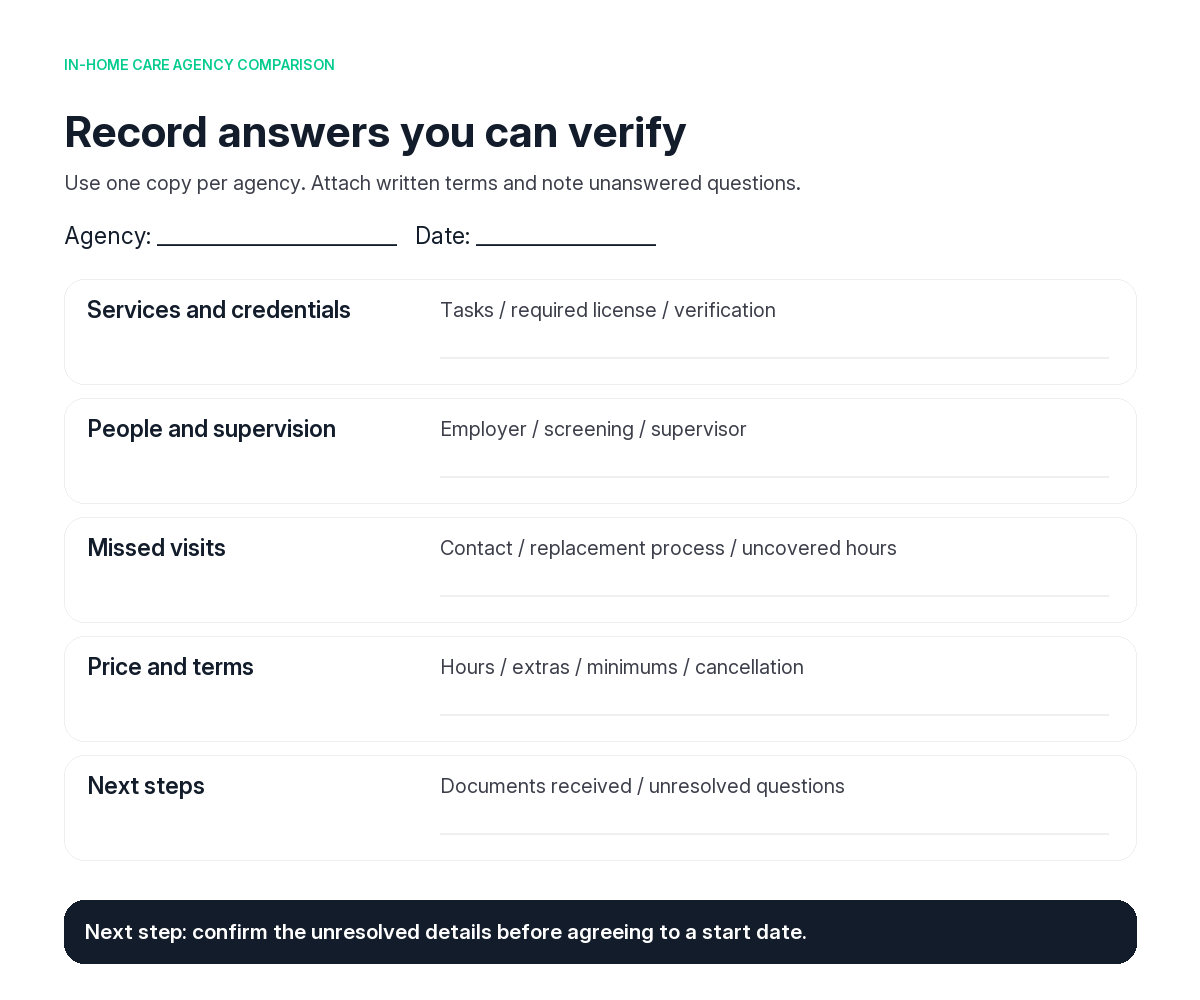
Open the agency comparison worksheet to save or print.
Pause if an agency will not identify the responsible business, explain its service limits or provide written prices. If a required credential cannot be verified, resolve that before starting. An unanswered question may need follow-up; it does not by itself prove misconduct.
Before agreeing to a start date, confirm the first visit, the tasks, the named contact and the backup plan with everyone involved. Include the person receiving care in that decision.
How Zenblis helps
Zenblis provides senior-care education and a directory families can browse for free. Community subscriptions support operator tools; Zenblis does not take referral fees or move-in commissions. Directory information does not replace your own checks. Use our at-home care overview to clarify the options before comparing providers.
Frequently Asked Questions
- Does Medicare pay for personal care at home?
- Personal care by itself is not covered under Medicare’s home health benefit. Eligible aide services can be covered alongside qualifying skilled care. Confirm the services, eligibility and plan requirements before assuming coverage.
- Does an agency guarantee a replacement caregiver?
- Do not assume so. Ask for its replacement process, notification timing and what happens when nobody suitable is available. Record your own backup arrangements for uncovered hours.
- Should we choose the lowest hourly rate?
- Compare the complete quote, minimum hours, task coverage and terms. A lower advertised rate does not establish the lowest bill or the best fit for the care needed.