https://zenblis.com/resources/free-isnt-neutral
When "Free" Isn't Neutral: What the Public Record Shows About America's Largest Senior Care Referral Service
The U.S. Senate, the Washington Post, and four state legislatures have spent two years documenting how the senior care referral model actually works. Here's what's on the record.
By Derek Belfield - 2026-04-30
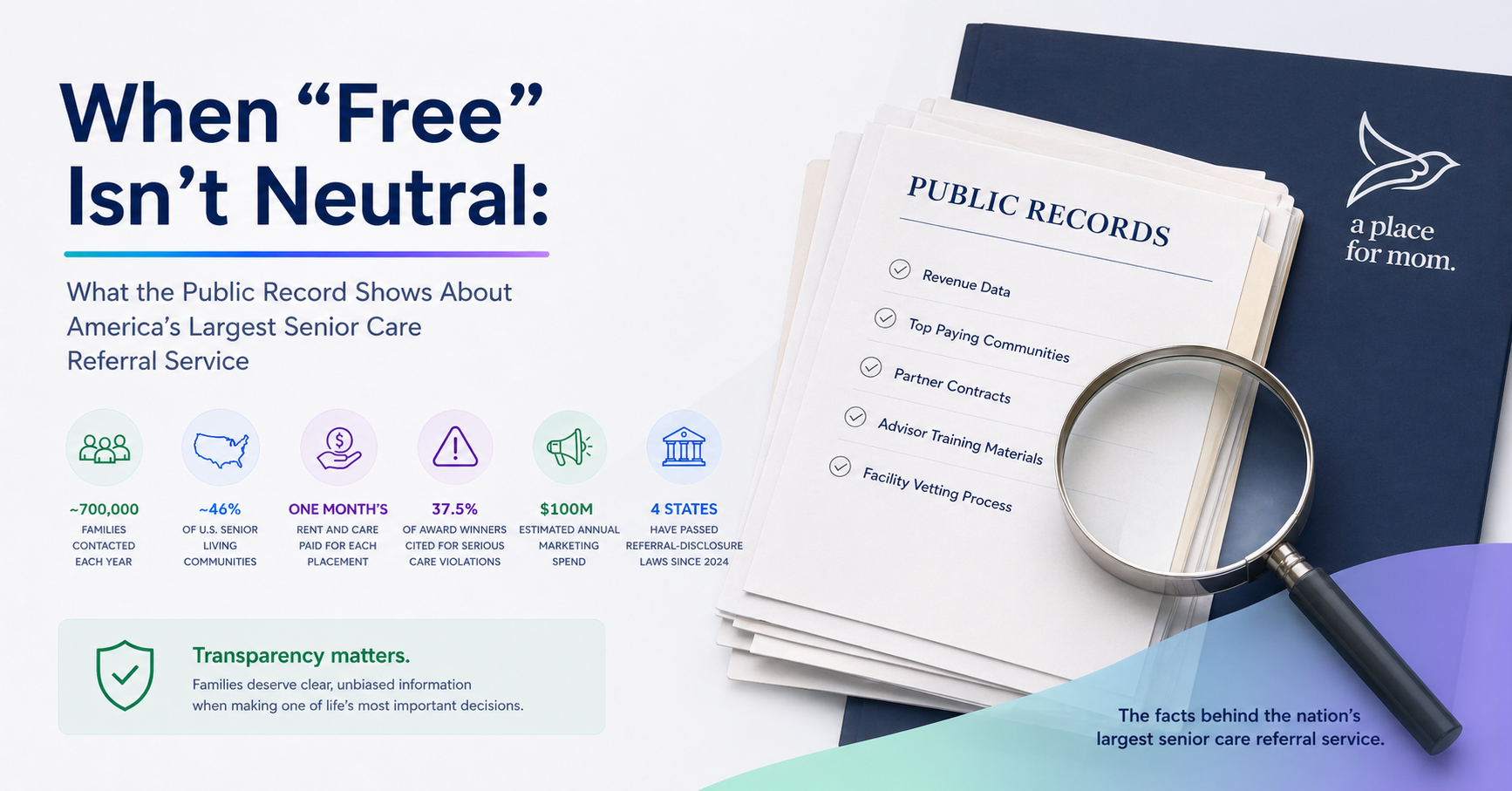
Key takeaways
- The U.S. Senate Special Committee on Aging opened a formal inquiry into A Place for Mom in June 2024, alleging deceptive marketing, an undisclosed pay-to-play referral model, and a pattern of upselling families above their stated budgets.
- A Washington Post analysis published one month earlier found that 37.5% of A Place for Mom's "Best of Senior Living" award winners across 28 states had been cited by state inspectors for serious violations affecting resident care, including falls, bedsores, medication errors, staff misconduct, and incidents involving violence and abuse.
- A Place for Mom's network includes roughly 14,000 to 15,000 communities out of approximately 30,600 senior living communities nationwide. Families using the service see fewer than half of their available options.
- According to the company's own data cited in the Senate letter, 38% of referred families pay monthly rent above their stated budget after a referral. For memory care, that figure rises to 55%.
- The referral-fee model is industry-standard. Caring.com, Seniorly, and other major national directories operate the same commission structure, where the community pays roughly one month's rent and care for each successful placement.
- Washington, Colorado, Arizona, and Maryland have passed laws requiring senior care referral services to disclose their financial relationships with recommended communities. Similar legislation has been considered in Missouri and California.
- Subscription-based directory models, where communities pay a flat monthly listing fee regardless of placements, exist as a structural alternative that removes the per-placement upselling incentive.
Lede
Most families searching for assisted living walk the same path. They Google. They call A Place for Mom. A friendly advisor takes the call, asks a few questions, and sends a list of recommended communities. The advice is "free," the relief is genuine, and the decision feels guided.
What that path obscures is a structural question about who the advisor actually works for. Over the past two years, a public record has accumulated that any family or operator deserves to see before they trust the recommendation.
The Senate Inquiry
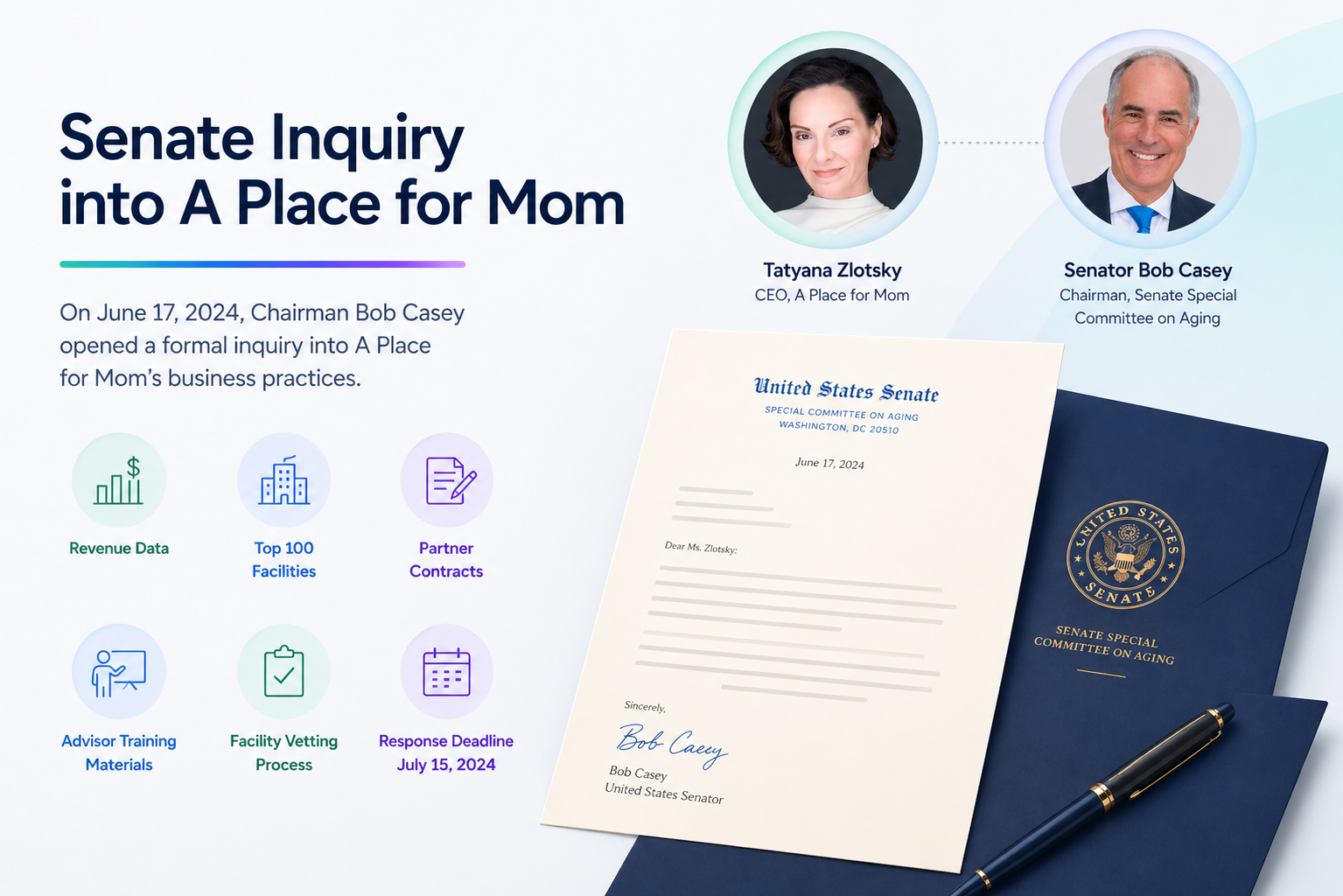
On June 17, 2024, then-U.S. Senator Bob Casey (D-PA), Chairman of the Senate Special Committee on Aging, sent a letter to A Place for Mom CEO Tatyana Zlotsky opening a formal inquiry into the company's business practices. Casey accused the country's largest senior care referral service of misleading older adults and their families by marketing itself as unbiased and no-cost when, in his characterization, the company's recommendations were "not objective, not safe, and not truly free." The committee requested three years of revenue data, the identities of the 100 facilities from which APFM had received the most money, sample partner contracts, advisor training materials, and the company's facility vetting process. The deadline for response was July 15, 2024.
The letter laid out specific allegations grounded in APFM's own marketing materials and recent reporting:
A Place for Mom refers families only to facilities that pay it a commission, leaving roughly half of U.S. assisted living communities outside its recommendation set.
According to the company's own published data cited in the letter, 38% of referred families ended up paying monthly rent above their stated budget. For memory care referrals, that figure rose to 55%.
The company's FAQ language effectively excluded Medicaid-eligible families from receiving referrals.
A former A Place for Mom Chief Marketing Officer had publicly acknowledged the structural fact that referral advisors only present communities willing to pay them.
The implication was straightforward. Families using A Place for Mom were seeing the subset of communities willing to pay A Place for Mom, not the broader market they thought they were searching.
The Reporting That Triggered the Inquiry
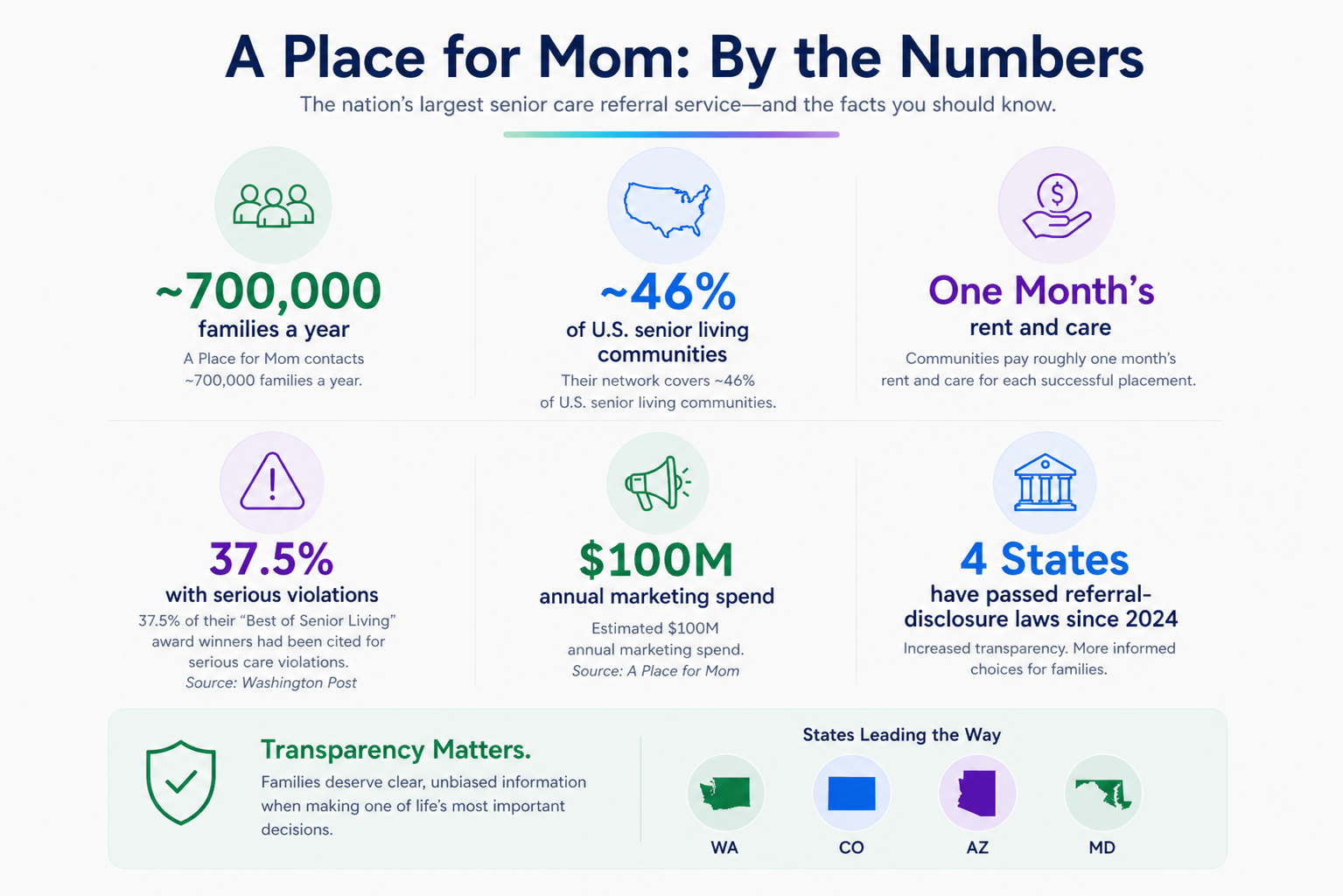
Casey's letter cited an investigation published by The Washington Post on May 16, 2024. Reporters Christopher Rowland, Steven Rich, Todd C. Frankel and Douglas MacMillan compared 863 communities that had received A Place for Mom's "Best of Senior Living" award in 2023 and 2024 to state inspection records across 28 states. They found 324 of those award-winning communities, or 37.5%, had been cited for serious violations affecting resident care.
The cited violations were significant. The Post's reporting documented falls, bedsores, medication errors, understaffing, staff misconduct, and incidents involving violence and sexual abuse. Current and former employees of senior living chains told the Post that reviews underlying the awards were sometimes manipulated, including being solicited from staff members' own friends and family.
One reported example: in 2022, a resident at Inspired Living at Bonita Springs died of heat exhaustion after being left unattended outside on a day when the heat index reached 100.4°F. The following year, the same facility appeared on A Place for Mom's "Best of Senior Living" honor roll based on 2023 consumer reviews.
How the Referral-Fee Model Actually Works
The headline numbers can read like outliers, but the underlying business structure is the standard one across the industry.
A Place for Mom's model, used in some form by every major national senior care referral service, works like this. The family pays nothing. The community pays the referral service a fee equal to roughly the first month's rent of any resident who moves in following a successful referral. Communities that don't pay don't appear in the recommendations. Communities that do pay are the only options the family ever sees.
A Place for Mom's network as of 2024 included roughly 14,000 communities, out of the approximately 30,600 senior living communities in the United States. By the company's own publicly stated reach, families using the service see fewer than half of available options nationwide.
Communities that do pay must price their services to recover the commission. A first-month referral fee is, in effect, a financing cost the community must recover through monthly rent. Casey's letter argued this dynamic explains why nearly 40% of referred families end up paying above their stated budget, and why memory care, where commissions are largest, shows the highest budget overage rate.
The model is not unique to A Place for Mom. Caring.com, Seniorly, and other large national directories all operate variations of the same fee structure. Kate Granigan of the Aging Life Care Association told NBC News that any model where the facility pays the referrer rather than the consumer paying the advisor is structurally "ripe for conflict."
What Happened After the Letter
A Place for Mom's public response was a general statement that the company is dedicated to providing transparent information and continually improving its processes, language the company has used consistently across media inquiries. No substantive public response to Casey's specific questions has been reported.
A formal Senate findings report was never publicly released. Senator Casey lost his 2024 reelection bid, and the Senate Special Committee on Aging is now chaired by Senator Rick Scott (R-FL), with announced priorities focused on prescription drug affordability, financial fraud, and senior wellness. The 2024 letter and its underlying allegations remain part of the documented public record, but no further federal action against A Place for Mom has been publicly announced as of the date of this article.
State legislatures have moved more decisively. Washington, Colorado, Arizona, and Maryland have all passed laws requiring senior care referral services to disclose their financial relationships with recommended facilities. Missouri considered similar legislation in 2025. State-level reporting on that bill noted that A Place for Mom hired seven Jefferson City lobbyists to oppose it. The company's chief legal officer testified that the disclosure requirements would be "an unnecessary regulatory burden" that would confuse families. A St. Louis legislator, Rep. Jo Doll, characterized the company's referral model in committee as effectively selling families' contact information to its paying community customers.
Separately, in 2019, A Place for Mom settled a class-action lawsuit alleging it violated the Telephone Consumer Protection Act through unsolicited calls. The settlement was for $6 million; the company stated at the time that it disagreed with the allegations.
What This Means for Families
The Senate inquiry, the Washington Post reporting, and the state legislation all converge on one point. Families using a referral service have a right to understand its incentive structure before they trust a recommendation.
This doesn't mean every recommendation is wrong, or that local referral advisors aren't genuinely helpful. Many are, particularly small, locally-owned advisor practices where a single advisor knows the regional market, has visited the communities they recommend, and works with the family across multiple months. The structural critique applies to the model, not to every person operating within it.
The questions families should ask any senior care advisor (referral agency, online directory, hospital discharge planner, or anyone else who positions themselves as helping with placement) are the same ones the Senate asked, just at a personal scale:
How are you compensated, and by whom?
Is your recommendation list limited to facilities that pay you?
Do you sell or share my contact information with the facilities you recommend?
What percentage of families do you refer to end up paying more than their stated budget?
Do you exclude Medicaid-eligible families or facilities?
How do you account for state inspection records, complaints, or regulatory violations when making recommendations?
A service that answers those questions clearly is one a family can use with eyes open. The Senate, the Washington Post, and four state legislatures have spent two years pressing for those answers from A Place for Mom.
What This Means for Operators
Senior living operators, particularly smaller and independently-owned communities, have known about the economics of the referral model for years. The first-month commission has long been a cost of doing business with the largest referral platforms, and many operators describe it as a margin pressure they pass through to residents because they have no alternative way to be visible to families searching online.
The question this investigation raises for operators isn't whether the commissions exist. That's well-documented. The question is whether the trade is still worth it as scrutiny grows. State disclosure laws are spreading. Family awareness, post-Washington Post, is higher than it used to be. Commissions tied to placements produce the budget-overage dynamic that families now have language for, and that legislators in four states have already moved to regulate.
There are alternatives. Subscription-based directory models, where communities pay a flat monthly fee for profile listing regardless of whether any specific family moves in, separate visibility from per-placement economics. The flat-fee structure removes the upselling incentive the Senate letter identified. It removes the contact-information-as-product dynamic state legislators have flagged. And it lets families see a wider range of communities than just those willing to pay the largest commissions.
This is the model Zenblis was built on. Communities pay a flat monthly subscription to maintain a verified profile. Families see the full network without their information being sold. Recommendations are based on fit, not commission. Several other operators work on similar structures, including local advisors, independent geriatric care managers, and a handful of newer platforms. We publish our pricing and methodology openly because the public record around the alternative model speaks for itself.
The Bottom Line
A Place for Mom helps hundreds of thousands of families every year, and many of those families are genuinely glad for the help they received. The company is not a scam, and its advisors are not bad people. The structural critique is narrower: any service whose recommendations are restricted to its paying customers, whose advisors are commissioned on placements, and whose award lists have repeatedly included communities cited for serious care violations is producing outcomes that families and regulators now have ample reason to question.
The Senate inquiry did not produce a final report, but it put documented facts on the public record. The Washington Post put inspection data on the public record. Four state legislatures have put disclosure requirements into law. The company's own materials are on the record.
For a family choosing a senior living community, that record is the starting point. Not every recommendation from a referral service is wrong, but every family making this decision deserves to weigh recommendations with full knowledge of who is paying whom.
Frequently Asked Questions
- What was the Senate investigation into A Place for Mom about?
- In June 2024, then-Senator Bob Casey, Chairman of the U.S. Senate Special Committee on Aging, sent a formal letter to A Place for Mom CEO Tatyana Zlotsky opening an inquiry into the company's business practices. The letter accused A Place for Mom of misleading families by marketing itself as unbiased while only referring to commission-paying communities, encouraging upselling above family budgets, and effectively excluding Medicaid-eligible families from referrals. The committee requested three years of revenue data, sample partner contracts, advisor training materials, and the company's facility vetting process.
- How does A Place for Mom make money if it's free for families?
- A Place for Mom is paid by the senior living communities and home care agencies in its network, not by families. When a family A Place for Mom refers chooses to move into a participating community, that community pays A Place for Mom a fee equal to roughly the first month's rent and care. Communities that do not pay A Place for Mom are not included in its recommendations.
- What did the Washington Post find about A Place for Mom?
- A Washington Post investigation published May 16, 2024 reviewed 863 communities recognized by A Place for Mom's "Best of Senior Living" award in 2023 and 2024 across 28 states. The reporters found 324 of those communities, or 37.5%, had been cited by state inspectors for serious violations affecting resident care. The cited violations included falls, bedsores, medication errors, understaffing, staff misconduct, and incidents involving violence and sexual abuse. Current and former employees of senior living chains also told the Post that consumer reviews underlying the awards had been manipulated, including being solicited from staff members' friends and family.
- Did the Senate investigation produce a final report?
- No formal Senate findings report on A Place for Mom was publicly released. Senator Casey lost his 2024 reelection bid, and the Senate Special Committee on Aging is now chaired by Senator Rick Scott (R-FL), with different announced priorities focused on prescription drug affordability, fraud, and senior wellness. The 2024 letter and its underlying allegations remain part of the documented public record, but no further federal action has been publicly announced.
- Does A Place for Mom work with Medicaid-eligible families?
- According to the company's own FAQ language cited in the Senate letter, A Place for Mom's advisors work to ensure that no federally funded family is referred to its network communities. This effectively excludes families relying on Medicaid to cover assisted living costs from receiving referrals through the service.
- Which states require senior care referral services to disclose their financial relationships?
- As of 2025, four states have passed laws requiring senior care referral services to disclose to families that they receive payment from the communities they recommend: Washington, Colorado, Arizona, and Maryland. Similar legislation was considered in Missouri in 2025 and has been pending in California. State-level reporting indicates that A Place for Mom has actively lobbied against these disclosure requirements, including hiring seven Jefferson City lobbyists in Missouri.
- What questions should families ask any senior care referral service before using it?
- Six questions cover the structural concerns identified by the Senate, the Washington Post, and state legislators. How are you compensated, and by whom? Is your recommendation list limited to facilities that pay you? Do you sell or share my contact information with the facilities you recommend? What percentage of families you refer end up paying more than their stated budget? Do you exclude Medicaid-eligible families or facilities? How do you account for state inspection records, complaints, or regulatory violations when making recommendations? A service that answers all six clearly is one a family can use with full information.
- Are there alternatives to commission-based senior care referral services?
- Yes. Subscription-based directory models, where communities pay a flat monthly listing fee regardless of whether any specific family moves in, separate visibility from per-placement economics. Local placement advisors and independent geriatric care managers also serve families directly, sometimes for a flat fee paid by the family rather than a commission paid by the community. Hospital discharge planners and Area Agencies on Aging are additional non-commission resources. The right alternative depends on the family's situation, but the questions to ask are the same regardless of which type of advisor a family chooses.
Sources
- Sen. Bob Casey press release announcing the inquiry, June 18, 2024
- Washington Post investigation, Rowland / Rich / Frankel / MacMillan, May 16, 2024
- McKnight's Senior Living, "Sen. Casey calls out A Place for Mom over 'potentially deceptive business practices,'" June 19, 2024
- NBC News, "Senate probes A Place for Mom, referral service accused of putting seniors at risk," June 18, 2024
- Senior Housing News, "US Senator Probes A Place for Mom, Alleging 'Deceptive' Practices," June 20, 2024
- Senior Housing News, "Washington Post Analysis Links A Place for Mom Reviews, Awards with Care Citations," May 17, 2024
- McKnight's Senior Living, "Senior living referral site accused of using manipulated reviews, listing communities providing substandard care," May 2024
- Missouri Independent, "Missouri bill would require senior-care referral companies to disclose financial ties," April 10, 2025
- U.S. Senate Special Committee on Aging (committee homepage, current chair and priorities)
- Sen. Casey statement on social media announcing the investigation, June 18, 2024