https://zenblis.com/resources/operators-respond-to-bad-state-inspection
After a Nursing Home Inspection: Correct Problems and Communicate Clearly
After an inspection identifies deficiencies, protect residents, confirm the survey agency’s requirements, document corrective work and communicate verified progress. An accepted plan is not proof of restored compliance.
By Derek Belfield - 2026-10-08
- Inspection response
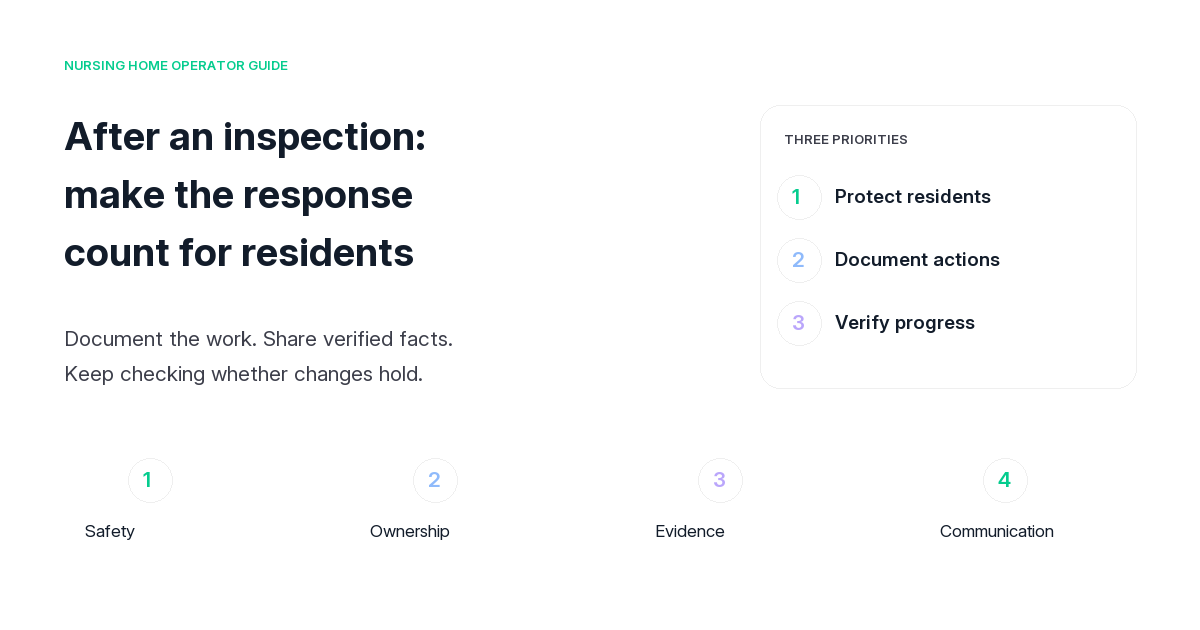
After a nursing home inspection identifies deficiencies, protect residents first. Confirm the required response and deadlines with your survey agency, document corrective action, and give residents and families clear, factual updates. Explain verified changes without minimizing the finding or promising to erase the inspection history.
This guide covers federal requirements for Medicare- and Medicaid-certified nursing homes. State-specific procedures and assisted living rules require separate review. Use your actual notice and survey agency instructions for your facility.
What changed in the 2026 survey process?
CMS’s risk-based survey memo starts the nationwide rollout for eligible nursing homes on September 8, 2026, according to state survey schedules. Eligible facilities receive a more focused review with less onsite time and a smaller team. The requirement for standard recertification surveys at least every 15 months remains. Resident-safety concerns can prompt the traditional survey process.
Address the finding and document the work
Review Form CMS-2567 and the agency’s instructions with your administrator and quality team. CMS Chapter 7, section 7317 identifies five elements of an acceptable plan of correction:
Corrective action for affected residents.
How to identify other residents who could be affected.
Changes intended to prevent recurrence.
Monitoring to determine whether improvements last.
Completion dates acceptable to the state.
The federal guidance generally requires submission within 10 calendar days after receipt of CMS-2567, with exceptions for past noncompliance and scope/severity level A findings. Follow the actual notice and any immediate-jeopardy instructions. An accepted plan is an allegation of compliance. Substantial compliance must be verified before remedies can end.
As a practical management step, assign an accountable owner to each action and keep evidence of results. A training attendance sheet, for example, records attendance; checking staff practice helps show whether the correction is working.
Give residents and families factual updates
Explain what is known, what has changed and when people can expect another update. Complete required notifications and protect resident privacy. A family meeting or marketing statement does not replace the required process.
Brief staff on verified facts and identify a contact for questions. If a correction is still being tested, say so. Keep identifiable resident details out of public responses.
Keep public information accurate
Align public descriptions with the inspection record and documented corrective work. Update leadership, staffing or training information only when it is accurate and supportable. Photographs, testimonials and paid directory subscriptions do not change an inspection finding.
When someone asks about a citation, explain the finding, actions taken and current evidence. Invite honest feedback without pressuring residents or asking for a particular rating. Do not minimize harm or promise a rating or occupancy outcome.
If you believe a finding is inaccurate, ask your compliance adviser about the applicable formal dispute process. Public communication does not replace that process or waive your rights.
Keep checking whether changes work
Maintain a record of actions, owners, monitoring results and agency determinations. Tell people what is complete and what remains unresolved. A written plan or updated profile alone does not show that a problem has been resolved.
Use these four questions to prepare a clear update:
What needs to change?
Who owns the work?
What does the evidence show?
What is still unresolved, and what happens next?
These are communication prompts, not an official CMS plan-of-correction template.
Keep your Zenblis listing current
Zenblis is an independent senior care directory. Families browse for free, and operators can claim their listings for free. Keep editable listing information accurate while preserving the distinction between your updates and the official inspection record.
Subscriptions support operator tools. They do not change search ranking, Bliss Score, editorial coverage or which communities appear. Zenblis takes no referral fees, kickbacks or move-in commissions. A subscription or profile update is not a change to an inspection finding.
Frequently Asked Questions
- What is a plan of correction?
- It explains how the facility will address cited deficiencies. Confirm the required elements, deadline and submission method with the survey agency. An accepted plan does not by itself establish that substantial compliance has been restored.
- Does the 2026 risk-based survey mean fewer inspections?
- No. The CMS memo describes a more focused protocol for eligible nursing homes, with less onsite time and a smaller team. Standard recertification surveys are still required at least every 15 months, and resident-safety concerns can lead to the traditional process.
- Do these federal steps apply to assisted living?
- This guide addresses Medicare- and Medicaid-certified nursing homes. Assisted living requirements vary by state. Check the licensing agency’s current rules and the actual inspection notice rather than applying the federal nursing-home deadline automatically.
- How should we discuss a past citation with prospective families?
- Answer directly, protect resident privacy and distinguish completed actions from work still underway. Explain the official finding and what your monitoring shows. Do not promise that a citation will disappear or that a rating will improve.