https://zenblis.com/resources/nursing-homes-big-beautiful-bill-2026
What the "One Big Beautiful Bill" Means for Nursing Home Care in 2026
The 2025 law delays federal nursing-home staffing rules and reshapes Medicaid. Here's what families paying for skilled nursing care should understand in 2026.
By Derek Belfield - 2026-07-29
- nursing home
What the "One Big Beautiful Bill" Means for Nursing Home Care in 2026
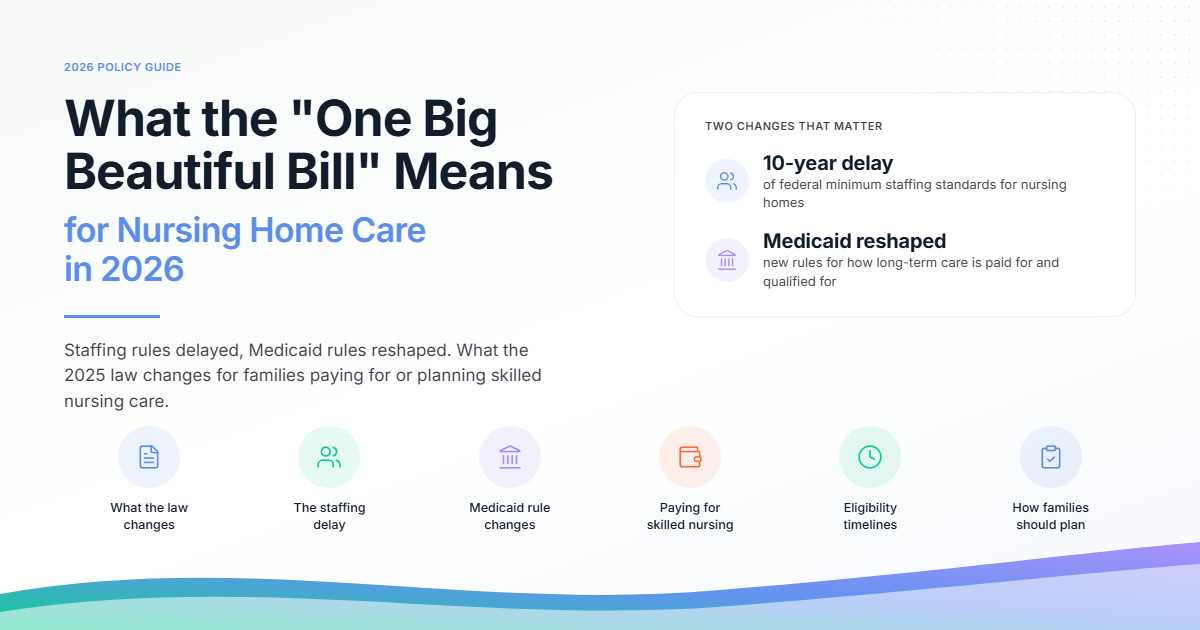
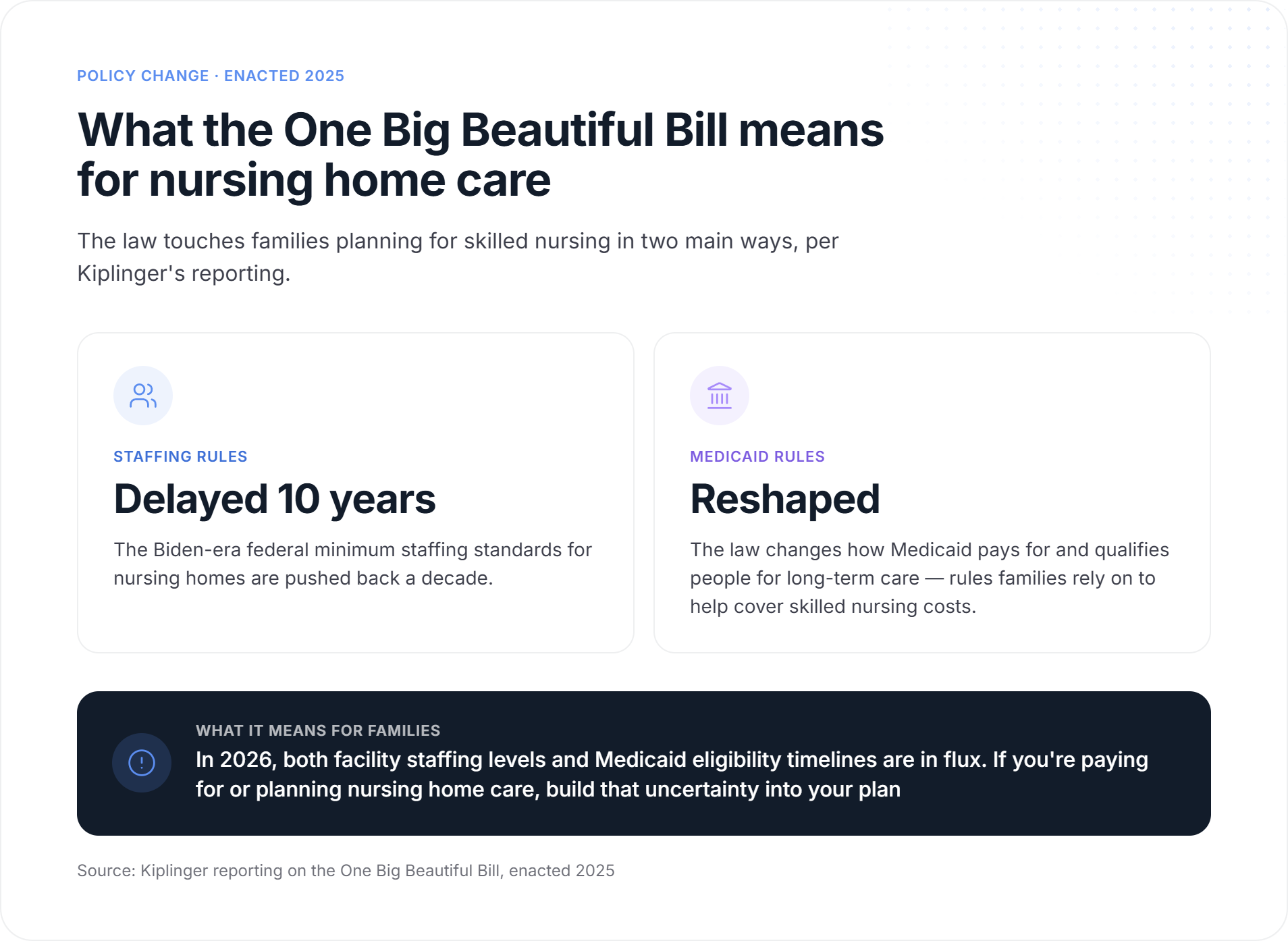
The One Big Beautiful Bill, enacted in 2025, affects nursing homes and Medicaid in two main ways: it delays new federal nursing-home staffing rules and it changes how Medicaid pays for and qualifies people for long-term care. According to reporting by Kiplinger, the law pushes back the Biden-era federal minimum staffing standards for nursing homes by 10 years and reshapes several Medicaid rules that families rely on to help cover skilled nursing costs. For families paying for or planning nursing home care, the practical result is that facility staffing levels and Medicaid eligibility timelines are both in flux in 2026.
Below is a factual, source-attributed summary of the major provisions, along with the concerns advocacy groups have raised. Zenblis is presenting these as reported claims from named sources, not as our own policy position.
The 10-year delay of federal staffing standards
Kiplinger reports that the law delays implementation of the Biden-era federal minimum staffing standards for nursing homes for 10 years. That rule would have required, among other things, a registered nurse (RN) on-site 24 hours a day. With the mandate delayed, there is no new nationwide federal floor for around-the-clock RN coverage in the near term, though existing federal and state requirements still apply. Because staffing rules are on hold, actual staffing levels will continue to vary widely from one facility to the next.
Advocates' warning on understaffing
The executive director of the National Consumer Voice for Quality Long-Term Care has estimated that roughly 13,000 lives could be lost each year due to understaffing. It is important to note that this figure is a projection from an advocacy organization, not an official government estimate, and it reflects that group's assessment of the potential impact of weaker staffing requirements. Zenblis reports it here as an attributed estimate so families can weigh it alongside other information.
Shorter Medicaid retroactive coverage
According to Kiplinger, the law reduces Medicaid retroactive coverage for new beneficiaries from three months to two months. Retroactive coverage can help pay for care received before an application is formally approved. Trimming that window by a month means families have less cushion to have earlier bills covered, which makes timely application more important when a loved one enters skilled nursing care.
The 2028 home-equity cap for Medicaid
Kiplinger reports that, starting in 2028, the home-equity cap for Medicaid long-term-care qualification is set at $1 million with no inflation adjustment. Advocates warn this could force some older adults to sell a home in order to qualify for Medicaid coverage of long-term care. Because the cap is not indexed to inflation, its practical effect could grow over time as home values rise. This provision is scheduled to take effect in 2028, so it does not change qualification rules immediately in 2026.
Pressure on home- and community-based services (HCBS)
The law also places new limits on provider taxes, a financing tool states use to help fund Medicaid. As a result, states may scale back optional Medicaid benefits, including home- and community-based services (HCBS). Justice in Aging warns that reduced HCBS access could increase institutionalization, because fewer seniors would be able to get care outside of a facility. For families weighing at-home or community options versus a nursing home, the availability of these optional benefits may become less predictable depending on the state.
Bottom line
The One Big Beautiful Bill does not change the fundamentals of what a nursing home is, but it pauses stronger federal staffing rules and tightens several Medicaid provisions that families use to afford care. Because the delayed staffing standards mean quality and staffing still vary by facility, families should check a facility's actual staffing and inspection record rather than assume a federal minimum applies. The Medicaid timing changes make earlier planning valuable, and because the rules are technical and still evolving, families should consult an elder-law attorney or benefits counselor for specifics tied to their state and situation. CMS guidance remains the authoritative source for how each provision is ultimately implemented.
How Zenblis helps
Zenblis is a senior-care education platform and provider directory that helps families understand their options and compare providers. On nursing home and skilled nursing profiles, as well as assisted living and at-home care, families can browse and compare provider information for free. Our model is a monthly subscription that senior care facilities pay to maintain their profiles on our platform. That means Zenblis is not a placement agency: we do not take a per-placement commission and we do not sell your information as a lead. Our goal is simply to help families make informed decisions with clear, comparable provider information.
Frequently Asked Questions
- Does the One Big Beautiful Bill eliminate nursing home staffing requirements?
- No. According to Kiplinger, the law delays the Biden-era federal minimum staffing standards for nursing homes for 10 years rather than eliminating staffing rules entirely. Existing federal and state requirements still apply, but the new nationwide floor, including a 24-hour on-site registered nurse, is on hold.
- Where does the estimate of 13,000 lives lost per year come from?
- That estimate comes from the executive director of the National Consumer Voice for Quality Long-Term Care, an advocacy organization. It is a projection tied to concerns about understaffing, not an official government figure, and Zenblis reports it as an attributed estimate.
- How is Medicaid retroactive coverage changing?
- Kiplinger reports that Medicaid retroactive coverage for new beneficiaries is reduced from three months to two months. That shortens the period during which care received before approval can be covered, which is why earlier application and planning matter.
- What is the 2028 home-equity cap for Medicaid?
- According to Kiplinger, starting in 2028 the home-equity cap for Medicaid long-term-care qualification is set at $1 million with no inflation adjustment. Advocates warn this could require some older adults to sell a home to qualify. It takes effect in 2028, so it does not change eligibility in 2026.