https://zenblis.com/resources/memory-care-violence-safety-guide-2026
Violence in Memory Care: What Families Should Know in 2026
Violence in memory care and dementia facilities is more common than most families expect, though fatal cases remain rare. According to a KFF Health News investigation by Jordan Rau published July 20, 2026 (also carried by NPR), resident-on-resident aggression is now the single most frequently cited safety violation in dementia care.
By Derek Belfield - 2026-07-27
- memory care
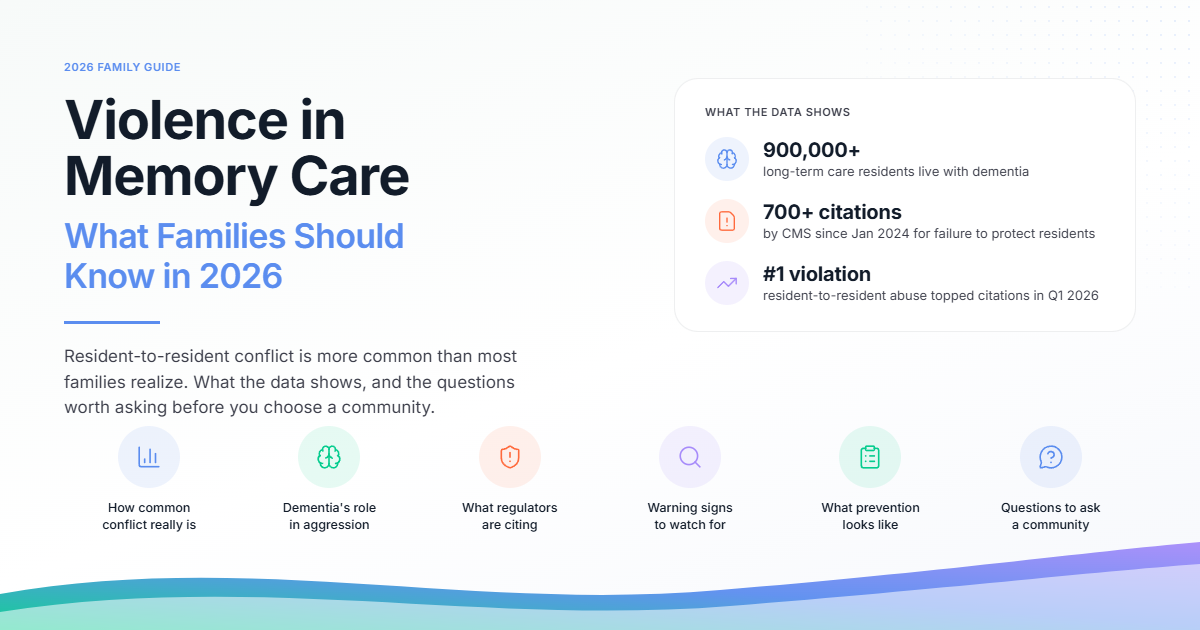
Cornell University research cited by KFF estimated that about 1 in 7 assisted living residents experienced aggression within a single month, and about 1 in 5 nursing home residents experienced altercations monthly. For families choosing memory care, the takeaway is not to panic but to ask the right questions.
How common is resident-on-resident aggression?
The scale of dementia in long-term care helps explain why aggression is so widespread. According to KFF Health News, more than 900,000 of the roughly 2.2 million U.S. long-term care residents have dementia, a condition that can cause confusion, agitation, and impaired impulse control. A separate CDC analysis cited by KFF found that nearly 8% of assisted living residents engaged in physical aggression. Combined with the Cornell figures above, the data suggests that verbal and physical conflict between residents is a routine risk in these settings rather than a rare aberration.
What the federal data shows
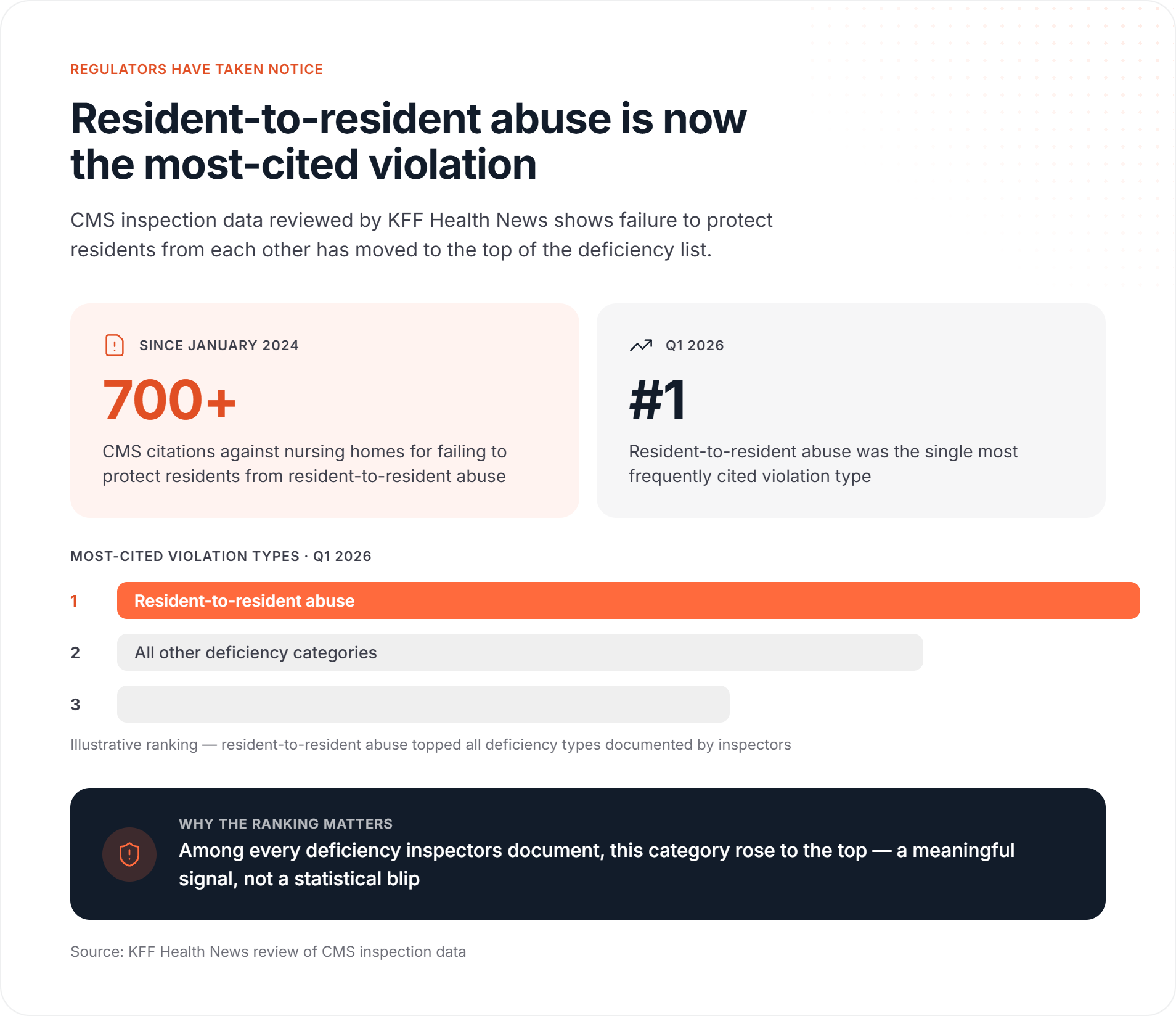
Regulators have taken notice. According to KFF Health News, which reviewed CMS data, the Centers for Medicare & Medicaid Services has cited nursing homes at least 700 times since January 2024 for failing to protect residents from resident-to-resident abuse. In the first quarter of 2026, resident-to-resident abuse was the single most frequently cited violation type. That ranking is a meaningful signal: among all the deficiencies inspectors document, this category rose to the top.
When aggression turns fatal
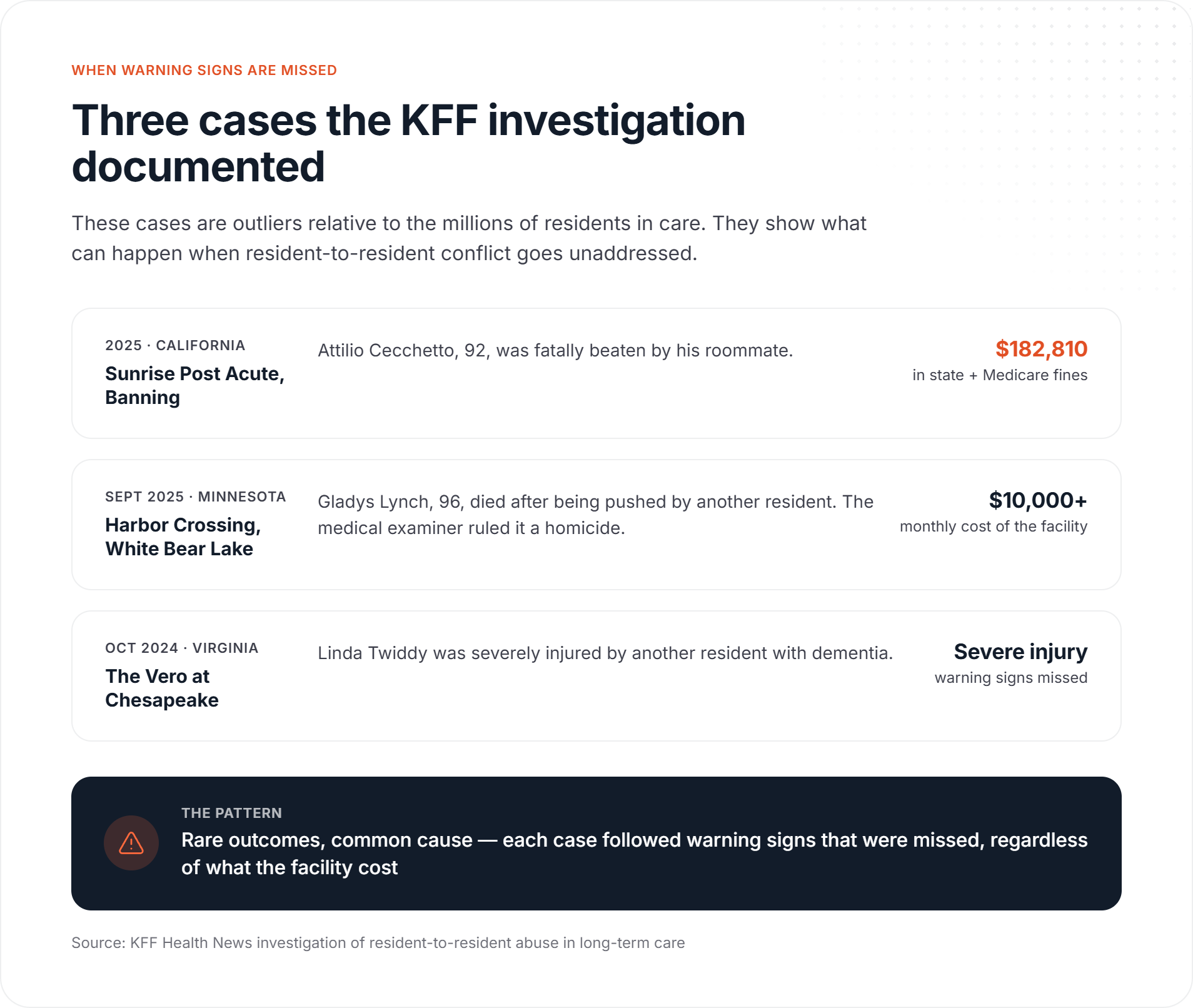
The KFF investigation documented cases where conflict ended in death or serious injury. At Sunrise Post Acute in Banning, California, 92-year-old Attilio Cecchetto was fatally beaten by his roommate in 2025; California fined the facility $120,000 and Medicare issued a separate $62,810 fine. At Harbor Crossing in White Bear Lake, Minnesota, 96-year-old Gladys Lynch died in September 2025 after being pushed by another resident, a death the medical examiner ruled a homicide, even though the facility cost more than $10,000 a month. At The Vero at Chesapeake in Virginia, resident Linda Twiddy was severely injured by another resident with dementia in October 2024. These cases are outliers relative to the millions of residents in care, but they show what can happen when warning signs are missed.
Warning signs are usually there first
Most incidents do not come out of nowhere. Dementia consultant Eilon Caspi told KFF Health News that in the vast majority of incidents there are warning signs in the months, weeks, days, hours, and sometimes seconds beforehand. That matters for families because it means aggression is often preventable when staff are trained to spot escalation early and are present enough to intervene.
What prevention looks like
Experts cited in the investigation point to concrete, learnable practices rather than lockdowns. Effective communities use closer supervision of high-risk residents, room placement near nursing stations, and separation of residents with a known history of conflict. They build personalized care plans that address each resident's individual triggers, and they invest in staff training paired with quick intervention when tensions rise. None of these steps require exotic technology; they require adequate staffing, attention, and a culture that treats resident safety as a daily priority.
Questions to ask a memory care community
- What are your staff-to-resident ratios during the day, at night, and on weekends?
- Do staff receive dementia-specific training in recognizing and de-escalating aggression?
- How do you screen roommate compatibility, and how do you handle a resident who becomes aggressive?
- How do you document incidents, and will you share your incident-reporting history with families?
Bottom line
Resident-on-resident aggression is common in memory care, and as of the first quarter of 2026 it is the most frequently cited safety violation in the sector, according to KFF Health News' review of CMS data. Fatal cases remain rare, and the same experts who documented the problem stress that warning signs usually appear early and that supervision, thoughtful room placement, individualized care plans, and trained staff can prevent most incidents. The strongest move a family can make is to ask pointed questions about staffing, training, and incident reporting before signing anything.
How Zenblis helps
Zenblis is a free education platform and provider directory for families comparing senior care. You can browse and compare memory care, assisted living, and skilled nursing provider profiles at no cost, and use the safety questions above as a checklist during tours. Unlike placement agencies, Zenblis does not take a per-placement commission or sell your information as a lead. Facilities pay Zenblis a flat monthly subscription to maintain their profile, so you can research and compare communities freely.
Frequently Asked Questions
- How common is violence in memory care and dementia facilities?
- It is more common than many families realize. According to Cornell University research cited by KFF Health News, about 1 in 7 assisted living residents experienced aggression within a month, and about 1 in 5 nursing home residents experienced altercations monthly. A CDC analysis cited by KFF found nearly 8% of assisted living residents engaged in physical aggression. Most incidents are verbal or minor rather than fatal.
- Is resident-on-resident abuse a top safety violation?
- Yes. According to KFF Health News' review of CMS data, resident-to-resident abuse was the single most frequently cited violation type in the first quarter of 2026, and CMS has cited nursing homes at least 700 times since January 2024 for failing to protect residents from it.
- Can aggression between residents be prevented?
- Often, yes. Dementia consultant Eilon Caspi told KFF Health News that warning signs usually appear before an incident. Communities can reduce risk through closer supervision of high-risk residents, room placement near nursing stations, separating residents with a history of conflict, personalized care plans that address triggers, and staff training with quick intervention
- What should I ask a memory care community about safety?
- Ask about staff-to-resident ratios across all shifts, whether staff receive dementia-specific training, how the community screens roommate compatibility and responds to aggression, and how incidents are documented and reported to families.