https://zenblis.com/resources/memory-care-cost-2026
Memory Care Costs: How to Compare Written Quotes
Compare memory-care quotes using the same assessed needs, included services, extra fees and confirmed payment sources. Keep one-time costs and pending benefits separate.
By Derek Belfield - 2026-10-09
- Paying for Care
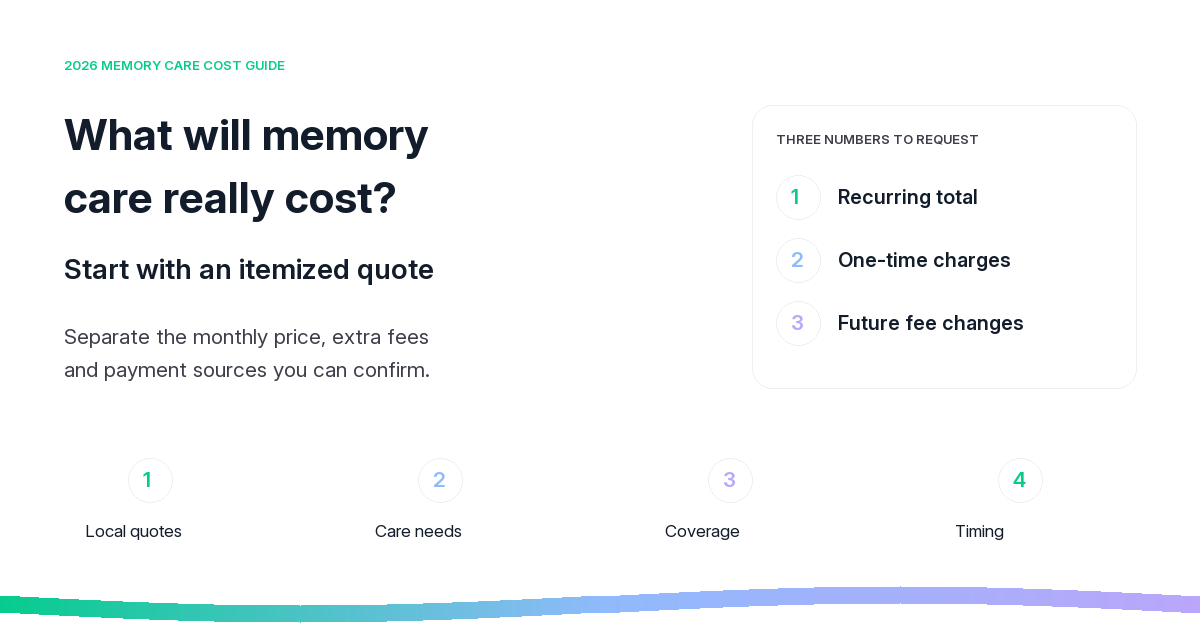
A useful memory-care budget starts with a written quote for the person's assessed needs. Ask what the base rate includes, what costs extra, when fees can change and which payment sources are confirmed. Medicare does not pay for ongoing custodial care, even when a person has dementia.
A national estimate cannot tell you what a particular community will charge your family. Use the same questions with each community so you can compare services and costs on a consistent basis.
Start with the care assessment and written quote
Ask the community to assess the person's current support needs before treating a price as a budget. Request the quote's date, how long it remains valid, what room type it covers and whether care-level charges are included. A base-rate advertisement may describe a different package from the services your family needs.
Ask about dementia-specific staffing, programming, supervision and safety features. A lower total for a different service package is not automatically the better fit. This is a quote-comparison guide, not a clinical assessment or an individual financial recommendation.
Separate the recurring price from other charges
Ask whether the quoted price includes housing, meals, supervision, daily personal assistance, housekeeping and dementia-specific programming. Request separate amounts for care-level charges, supplies, medication assistance and any one-time community fee.
Ask for an all-in monthly estimate at the person's current care level. Find out how reassessments affect the price, what notice the agreement provides for increases, and which services are billed by outside providers. Do not assume that a service is included because another community includes it.
Use the same comparison sheet for every community
Copy these fields into your notes. Mark an unanswered question as “not confirmed,” rather than treating it as zero cost.
Quote and assessment: date, assessed care needs, room type and quote expiration.
Recurring community charges: base rate plus separately quoted care and other required monthly fees. Avoid counting an included service twice.
Outside bills: services or supplies paid separately, their billing frequency and who provides the estimate.
Move-in costs: deposits, one-time charges, refund terms and payment dates.
Changes: reassessment process, fee-change notice and what happens if the community can no longer meet the person's needs.
Confirmed funding: amount, start date, duration, limits and who confirmed it.
Unresolved items: pending applications, estimates and the person responsible for following up.
Compare the recurring total with confirmed monthly resources. Keep one-time costs separate so that a move-in fee does not disappear inside an average. If a benefit is pending, show the budget both without it and with the amount you are asking the program to confirm.
Check payment sources before relying on them
The Alzheimer's Association describes several potential funding sources, including personal assets, insurance and government assistance. Availability depends on the person's circumstances; an application is not an approval.
Income, savings and insurance. Families may use income, savings, investments or home-sale proceeds. If there is a long-term care insurance policy, ask the insurer to confirm the setting and services covered, eligibility triggers, limits and waiting period. Request the confirmation in writing.
Medicare. Ongoing non-medical long-term care is generally not covered. Covered medical services and qualifying skilled-nursing care have separate rules; a dementia diagnosis does not turn residential custodial care into a covered benefit.
Medicaid. Help depends on the state, program, setting and eligibility. States design HCBS waiver services and enrollment limits. Ask the state program and community exactly what is covered, whether a slot is available and what the resident must pay. This guide does not establish eligibility in any state.
Veterans benefits. VA Aid and Attendance can add to a VA pension for qualifying veterans and survivors who meet the requirements. It is not automatic coverage for every veteran. Confirm eligibility and timing with VA or an accredited representative.
Home equity. A reverse mortgage is not a simple way to finance a permanent move. For Home Equity Conversion Mortgages, the CFPB explains that moving out can trigger repayment; protections for a co-borrower or eligible non-borrowing spouse depend on circumstances. Consult a HUD-approved housing counselor before relying on this option.
Revisit the budget when needs change
Keep the quote, agreement and benefit confirmations together. Update the budget when care needs, fees or approved benefits change. Ask the community to explain differences between the original estimate and a new bill before assuming the discrepancy is routine.
Use your shortlist to ask better questions
Browse communities on Zenblis, then request written quotes directly from the communities you are considering. Zenblis is free for families and takes no referral fees, kickbacks or move-in commissions. Community subscriptions support operator tools; they do not change search ranking, Bliss Score, editorial coverage or which communities appear.
Frequently Asked Questions
- Does Medicare pay for memory care?
- Medicare generally does not cover ongoing custodial care. Eligible medical services and qualifying skilled-nursing care have separate coverage rules. Ask the plan about the particular service rather than assuming a dementia diagnosis covers residential care.
- Can Medicaid help pay for memory care?
- Possibly. Eligibility, covered services, providers and available waiver slots vary by state and program. Ask the state Medicaid agency and the community what is covered, what the resident pays and whether a waiting list applies.
- Can I compare communities using the base rate alone?
- No. Ask for itemized quotes at the same assessed care level and room type. Compare included services, recurring extra charges, one-time fees and the conditions that can change the price. Mark unknown charges as not confirmed.