https://zenblis.com/resources/assisted-living-comprehensive-copy-copy
Assisted Living: The Complete Guide (2026)
Assisted living costs a median $5,419–$6,200 per month in 2026. What it includes, who it's for, how pricing really works, and how it's regulated — with sourced data.
By Derek Belfield - 2026-07-28
- assisted living
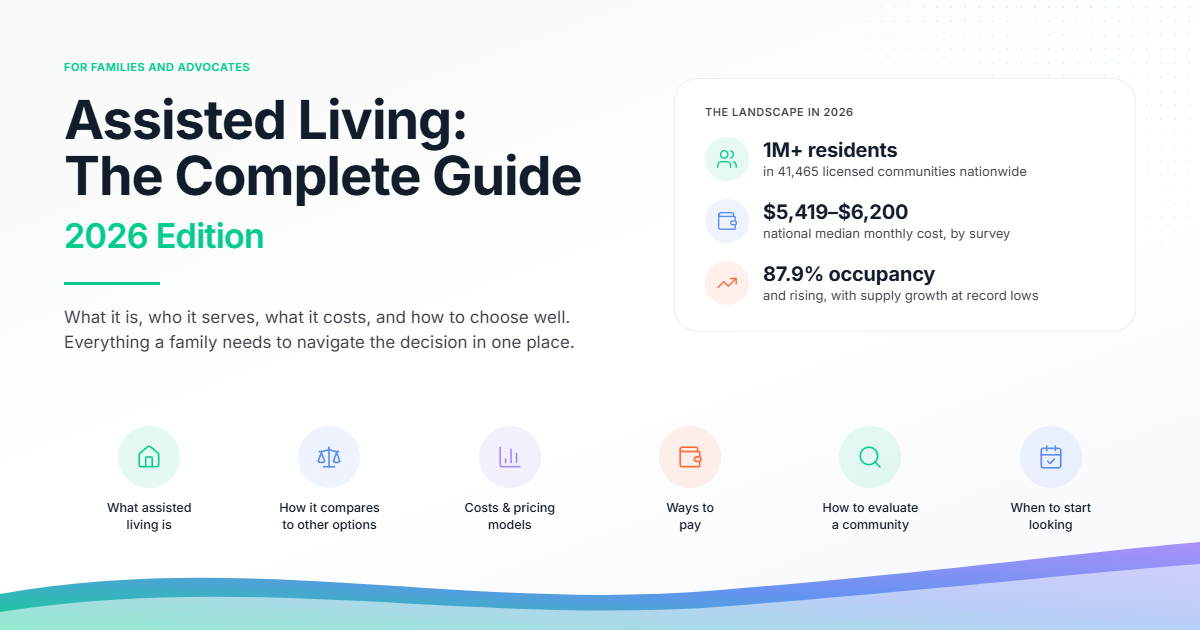
Assisted Living: The Complete Guide (2026)
Assisted living is a licensed residential setting for older adults who need daily help with personal care — bathing, dressing, medication, mobility — but do not need round-the-clock skilled nursing. Residents live in their own apartment or room, receive meals and housekeeping, and get as much or as little hands-on care as their assessment calls for.
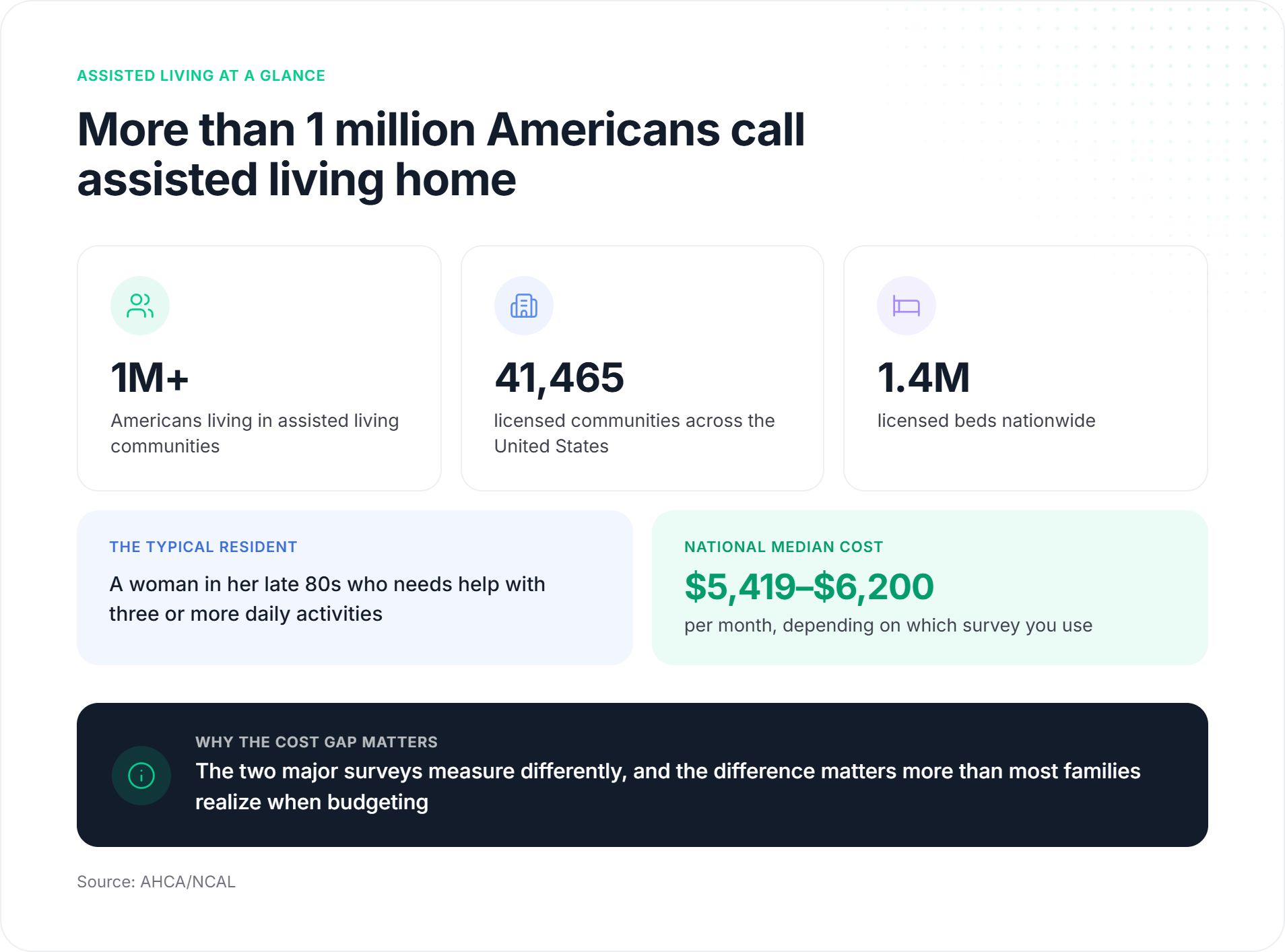
More than 1 million Americans live in roughly 41,465 licensed assisted living communities across the United States, holding about 1.4 million licensed beds (AHCA/NCAL). The typical resident is a woman in her late 80s who needs help with three or more daily activities. The national median cost runs between $5,419 and $6,200 per month depending on which survey you use — a gap we explain below, because it matters more than most families realize.
This guide covers what assisted living actually includes, who it fits, what it costs, how the billing really works, how it's regulated, and how to evaluate a community before you sign anything.
What Is Assisted Living?
Assisted living occupies the middle of the senior care spectrum. It's more support than independent living, less medical intervention than a nursing home.
A resident typically has a private apartment — studio, one-bedroom, sometimes shared — with a lockable door and often a kitchenette. Staff are on site 24 hours a day, but "24-hour staffing" is not the same as "24-hour nursing." In most states, assisted living communities are not required to have a nurse on duty at all times, and the staff providing hands-on help are usually certified aides rather than licensed nurses.
What's typically included in the base rate
A private or semi-private apartment
Three meals a day plus snacks, in a common dining room
Housekeeping and linen service
Scheduled transportation to medical appointments and errands
Activities, social programming, and outings
24-hour staff presence and emergency call systems
Basic maintenance and utilities (often excluding phone and internet)
What's usually billed separately
Personal care itself. This is the most misunderstood part of assisted living pricing. Help with bathing, dressing, toileting, transfers, and mobility is frequently priced on top of the base rent.
Medication management. Often a separate monthly fee, sometimes tiered by number of medications or times per day.
Incontinence care and supplies
A second occupant (typically $800–$1,500/month for a spouse sharing the apartment)
Beauty salon, guest meals, personal laundry
A one-time community fee or entrance fee, commonly equivalent to one month's rent
Assisted Living by the Numbers (2026)
| Criteria | Figure | Source |
|---|---|---|
| Licensed communities in the U.S. | 41,465 | AHCA/NCAL |
| Licensed beds | ~1.4 million | AHCA/NCAL |
| Average community size | 33 beds | AHCA/NCAL |
| Americans living in assisted living | 1,000,000+ | AHCA/NCAL |
| Chain-affiliated communities | 57.3% | AHCA/NCAL |
| Independently owned | 42.7% | AHCA/NCAL |
| Assisted living employees | 512,300 (June 2026) | AHCA/NCAL |
| National median monthly cost | $5,419 or $6,200 (see below) | A Place for Mom / CareScout |
| Occupancy rate, 31 primary markets | 87.9% (Q1 2026) | NIC MAP |
| Residents relying on Medicaid | ~17% | NCHS |
Two caveats worth understanding before you use these numbers.
- These rows count different universes. AHCA/NCAL counts every licensed community in the country, including thousands of six-bed adult care homes. NIC's occupancy figure covers only 31 primary metropolitan markets and skews toward large, professionally managed properties. Dividing 1 million residents by 1.4 million licensed beds does not produce a meaningful occupancy rate, because the two figures aren't drawn from the same population.
- Community counts are not resident counts. AHCA/NCAL reports that 44.5% of assisted living communities are in the West versus 8.2% in the Northeast. The source doesn't label its denominator explicitly but given that western states license large numbers of very small adult care homes, this almost certainly reflects buildings rather than beds or residents — the West does not house five times as many assisted living residents as the Northeast. Whenever you see a regional or state breakdown, check wh
Who Lives in Assisted Living?
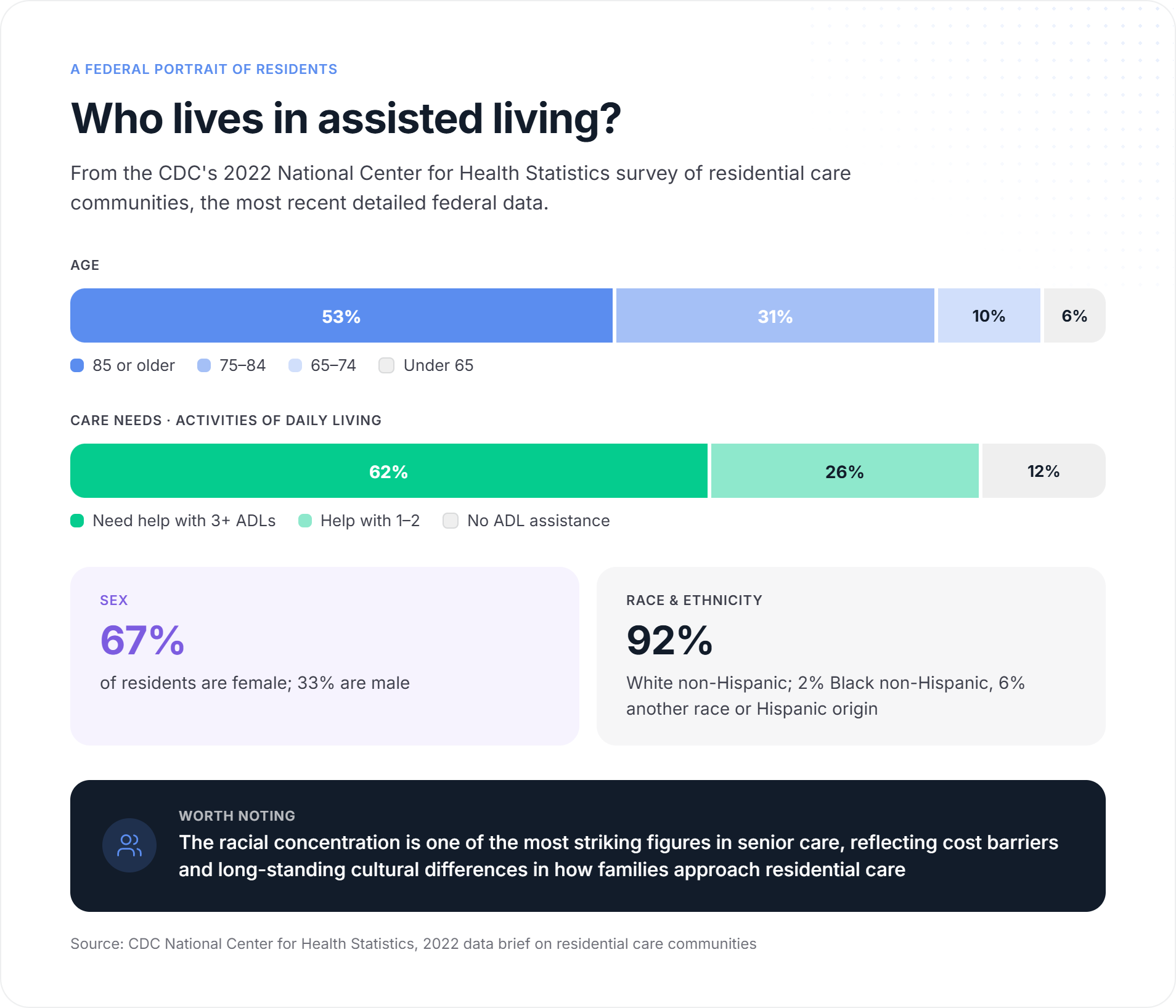
The most reliable federal data comes from the CDC's National Center for Health Statistics, which surveys "residential care communities" — a category that includes assisted living plus similar licensed settings. From the 2022 NCHS data brief, the most recent detailed federal portrait:
Age
53% are 85 or older
31% are 75–84
10% are 65–74
6% are under 65
Sex and race
67% female, 33% male
92% White non-Hispanic, 2% Black non-Hispanic, 6% another race or Hispanic origin
That racial concentration is one of the most striking figures in senior care, and it reflects both cost barriers and long-standing differences in how families across cultures approach residential care.
Care needs
Nearly two-thirds of residents need substantial daily help:
62% need assistance with three or more activities of daily living
26% need help with one or two
12% need no ADL assistance
Broken out by specific task:
ActivityShare needing helpBathing75%Walking71%Dressing60%Transferring57%Toileting51%Eating28%
Health conditions
High blood pressure: 58%
Alzheimer's disease or another dementia: 44%
Heart disease: 33%
Depression: 26%
Arthritis: 18%
Most residents carry multiple diagnoses — 55% have two or three chronic conditions and 18% have four or more.
The dementia figure deserves emphasis. Nearly half of all assisted living residents have some form of cognitive impairment, and many of them live in standard assisted living rather than a dedicated memory care unit. When you tour a community, its capacity to manage cognitive decline is not a niche question — it's a central one.
Assisted Living Compared to Other Options
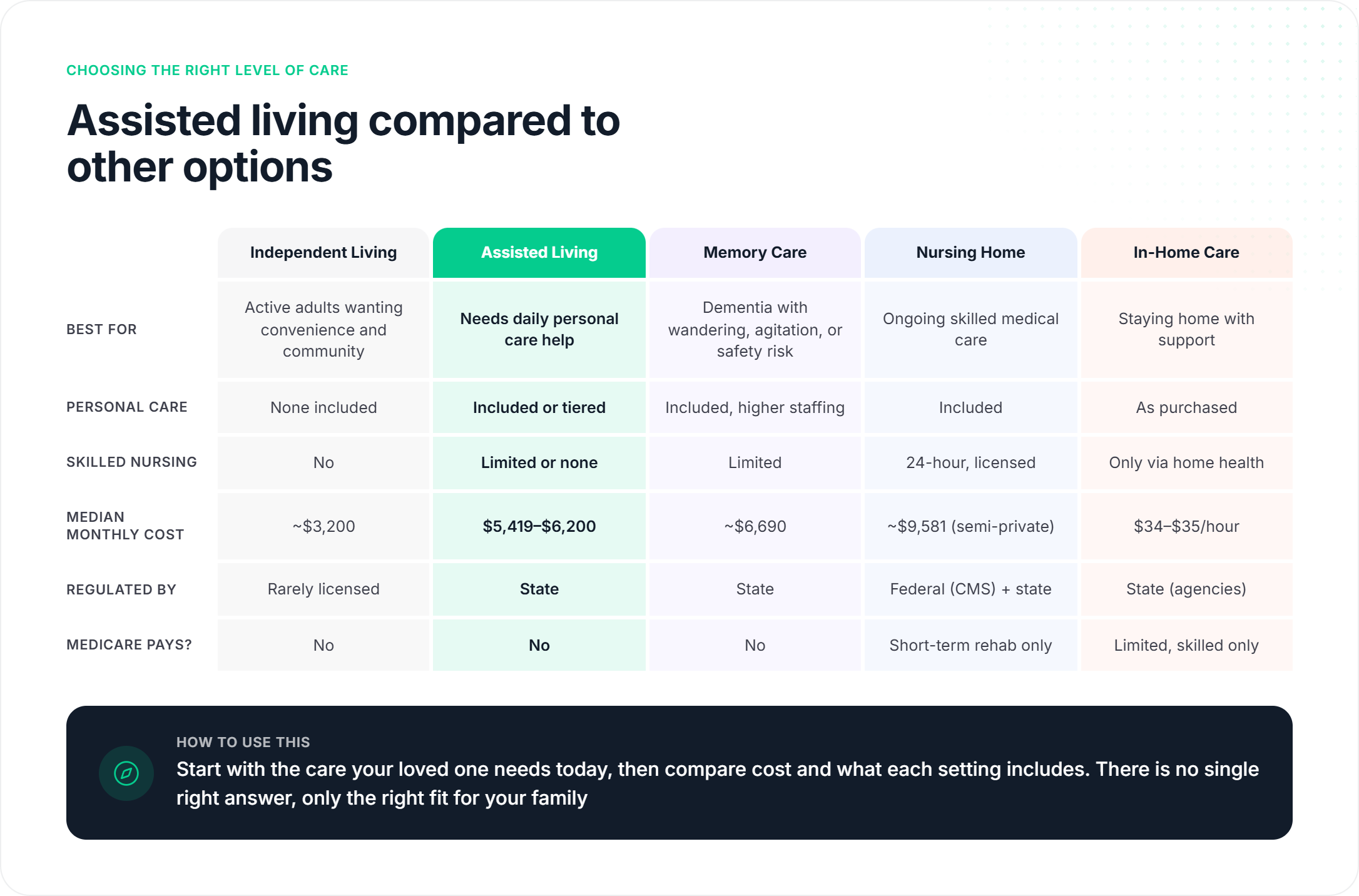
Independent living, assisted living, and memory care medians from A Place for Mom's 2026 cost report, reflecting 2025 move-ins. Nursing home and the upper assisted living figure from the 2025 CareScout Cost of Care Survey, fielded July–November 2025. Home care is $34/hour per A Place for Mom and $35/hour per CareScout. The nursing home monthly figure is derived from CareScout's published rate of $315 per day ($114,975 per year) for comparability — note that CareScout annualizes nursing home care over 365 days and assisted living over 12 months, so its published annual figures are not strictly parallel.
The practical distinction families miss most often: the jump from assisted living to a nursing home is usually driven by a medical event, not a gradual decline. A fall with a fracture, a stroke, or a hospitalization that leaves someone needing two-person transfers can move a resident out of assisted living quickly. Ask every community you tour what specifically would trigger a discharge.
What Assisted Living Costs in 2026
The two numbers, and why they disagree
You will encounter two very different national medians, and understanding the difference will make you a much sharper shopper.
$6,200 per month — the 2025 CareScout Cost of Care Survey (formerly the Genworth survey, running since 2004). CareScout collected more than 25,000 rates directly from providers between July and November 2025, at the metro-area level. Two methodology details matter: the rates describe a one-bedroom unit, and where a provider quotes a range from basic to substantial care, surveyors record the midpoint. The national figure is a median across metro areas, not weighted by population.
$5,419 per month — A Place for Mom's 2026 report, built from amounts actually paid by more than 24,305 people who moved into assisted living during calendar year 2025, including base rent plus care fees where care was provided.
Neither number is wrong, and neither is simply a "list price" versus a "real price." The roughly $780 gap reflects several things at once: different unit types, different treatment of care levels, different sample composition, and different geographic weighting. Anyone who tells you the difference proves you can negotiate $780 off your quote is over-reading the data.
What the two do agree on is direction. Assisted living rates rose 4.4% (A Place for Mom) to 5% (CareScout) year over year. For comparison, CPI-U ran 3.5% for the twelve months ending June 2026 — so senior living costs are outpacing general inflation, though by roughly a point rather than dramatically. A Place for Mom, which is the only one of the two that tracks independent living, put that segment's increase at about 1.75%, meaning the rising cost is concentrated in care rather than housing.
What actually drives the price
Local labor markets. Staffing is the dominant cost in senior care. Wage rates in your metro area explain more of the price than the building's finishes.
Level of care. Two residents in identical apartments can pay bills that differ by $2,000 or more.
Apartment size and type. A shared room can cost 20–40% less than a private one-bedroom.
Real estate. Land and construction costs flow through to rent.
Newness and amenities. A community built in 2023 with a bistro and a therapy pool prices differently than a 1990s building — sometimes without a difference in care quality.
How Assisted Living Pricing Actually Works
This is the section most guides skip, and it's where families get surprised. The monthly quote you receive on a tour is rarely the number you'll pay in year two.
A note on the figures below: unlike costs and demographics, assisted living fee structures are not systematically tracked or published by anyone — no federal agency, no industry survey, no state. The dollar ranges here reflect widely observed industry practice rather than a measured dataset, and individual communities vary well outside them. Treat them as orientation for what to ask about, not as benchmarks to hold a community to.

The costs to ask about before you sign
- Community fee / entrance fee. A one-time charge, commonly around one month's rent, usually non-refundable.
- Care level reassessment. How often is the resident reassessed, and who decides? Can the level increase without family consent?
- Annual rate increases. What was the increase each of the last three years? Get the actual history, not a policy statement. This single question is the highest-value one on any tour.
- Second person fee for a spouse or partner.
- Medication management, and how it's priced.
- Discharge terms. How much notice must you give? How much must they give? What triggers an involuntary discharge?
The questions worth putting in writing
Ask for the resident agreement in advance and read the sections on rate increases, level-of-care changes, and discharge before you tour a second community. A community that won't share the agreement before a deposit is telling you something.
How Families Pay for Assisted Living
Medicare does not cover assisted living
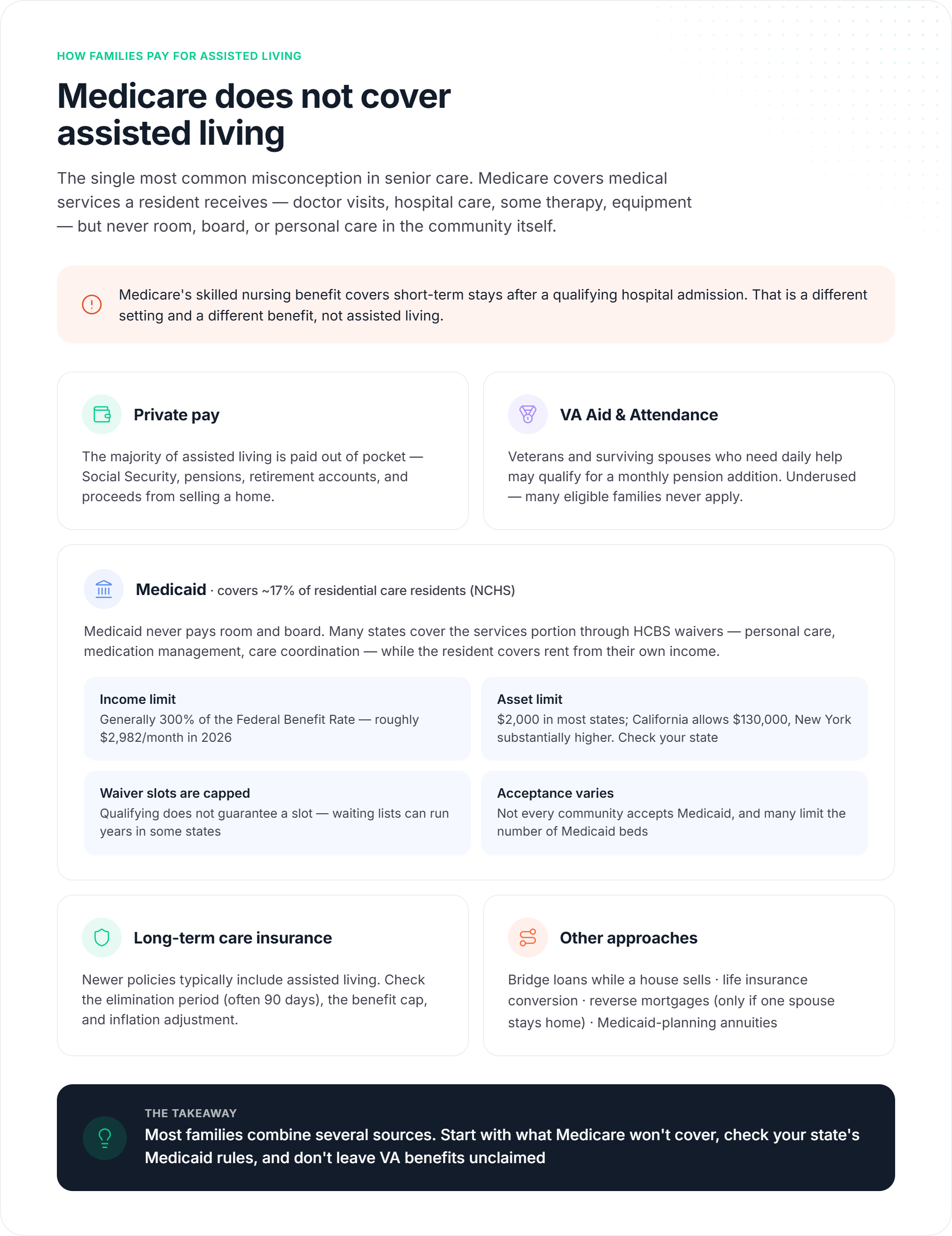
This is the single most common misconception in senior care. Medicare does not pay for room, board, or personal care in an assisted living community. It covers medical services a resident receives — doctor visits, hospital care, some therapy, durable medical equipment — but not the cost of living there. Medicare covers short-term skilled nursing facility stays after a qualifying hospital admission, which is a different setting and a different benefit.
Private pay
The majority of assisted living is paid out of pocket, typically from some combination of Social Security, pensions, retirement accounts, and proceeds from selling a home.
Medicaid
About 17% of residential care residents are Medicaid beneficiaries (NCHS), but the coverage is narrower than families expect.
Medicaid does not pay room and board in assisted living. What many states do is cover the services portion through Home and Community-Based Services (HCBS) waivers — personal care, medication management, care coordination — while the resident covers rent from their own income, often capped near the SSI rate.
Key constraints:
Income limit is generally capped at 300% of the Federal Benefit Rate — roughly $2,982/month in 2026 for an individual.
Asset limit is $2,000 in most states, with the primary residence and certain assets exempt. A few states are far more generous — California's limit is $130,000 for an individual as of January 1, 2026, and New York's is also substantially higher. Check your own state before assuming you're ineligible.
Functional eligibility requires an assessment showing you need the level of care the waiver funds.
Waivers are capped. Unlike nursing home Medicaid, which is an entitlement, HCBS waiver slots are limited. Qualifying does not guarantee a slot — waiting lists are common and can run years in some states.
Not every community accepts Medicaid, and those that do often limit the number of Medicaid beds.
VA benefits
Veterans and surviving spouses who need help with daily activities may qualify for Aid and Attendance, a monthly addition to a VA pension that can be applied to assisted living. It's underused — many eligible families never apply.
Long-term care insurance
Policies vary enormously. Older policies may cover nursing homes only; newer ones typically include assisted living. Check the elimination period (the waiting time before benefits start, often 90 days), the daily or monthly benefit cap, and whether benefits are inflation-adjusted.
Other approaches
Bridge loans to cover the gap while a house sells
Life insurance conversion or accelerated death benefits
Reverse mortgages, though only if one spouse remains in the home
Annuities structured for Medicaid planning
How Assisted Living Is Regulated
There is no federal licensing standard for assisted living. Unlike nursing homes, which CMS certifies, inspects, and rates on a public five-star scale, assisted living is licensed and inspected by each state individually.
The practical consequences:
Terminology differs by state. What one state calls "assisted living" another licenses as a residential care facility, personal care home, adult care home, or community residence. The same building could carry different license types depending on where it sits.
Standards differ by state. Staffing minimums, required caregiver training hours, medication administration rules, and admission and retention criteria are all set at the state level and vary widely. Some states specify staff-to-resident ratios; others require only "sufficient staff." The rules are also a moving target: NCAL's annual Assisted Living State Regulatory Review found that 18 states and the District of Columbia modified assisted living regulations during 2025 alone, and comparable counts in prior years have ranged from 17 to 29. Whatever your state required when a relative moved in may not be what it requires now.
Inspection practices differ by state. Most states conduct periodic unannounced surveys and investigate complaints, but frequency, depth, and — critically — whether reports are published online all vary. There is no national database of assisted living inspection results the way there is for nursing homes.
Some federal rules do apply. Labor and safety law reaches every community, and any community receiving Medicaid HCBS funding must comply with the CMS Home and Community-Based Services Settings Rule, which requires resident privacy, choice, and community access.
What to look up before you tour
Find your state's assisted living licensing agency — usually within the department of health, human services, or aging.
Search the community's license status and inspection history. Many states publish survey results online; some require a records request.
Contact your long-term care ombudsman, a free state advocate who can tell you about complaint patterns at specific communities.
Ask the community directly for its most recent survey results. They should have them.
Signs It May Be Time to Consider Assisted Living
- Safety. Falls, wandering, leaving the stove on, driving incidents, or an inability to respond in an emergency.
- Personal care. Declining hygiene, wearing the same clothes repeatedly, unexplained weight loss, an empty or spoiled refrigerator.
- Medication. Missed doses, doubled doses, or a pill organizer that's clearly not being used correctly.
- Household. Mail and bills piling up, utilities shut off, home falling into disrepair.
- Isolation. Withdrawal from friends, hobbies, or activities they used to value.
- Caregiver strain. The family caregiver's health, work, or relationships are visibly deteriorating. This one counts as much as the others.
Evaluating a Community
Before you visit
- Verify license status and inspection history with the state
- Read reviews across multiple sources, looking for patterns rather than individual complaints
- Confirm the community accepts your payment source, especially if Medicaid may eventually be needed
- Request the residency agreement and the full fee schedule
During the visit
Go at mealtime. You'll see food quality, dining room atmosphere, and how staff interact with residents who need help eating — all at once.
Watch staff. Do they greet residents by name? Do they knock before entering? Are call lights answered promptly? How many caregivers do you actually see on the floor?
Ask about turnover. High staff turnover is the strongest predictor of inconsistent care. Ask directly what the turnover rate was last year and how long the executive director and director of nursing have been in their roles.
Talk to residents and families, not just the tour guide.
Visit twice — once scheduled, once unannounced, ideally on a weekend or evening when staffing is thinnest.
Questions that reveal the most
What is your caregiver-to-resident ratio during the day, evening, and overnight?
Is a licensed nurse on site, and during what hours?
How do you handle a resident whose needs increase — and what would cause you to ask them to leave?
What were your rate increases each of the last three years?
How many residents live here now, and what's your current occupancy?
What happens if a resident falls at 3 a.m.?
Availability Is Tightening
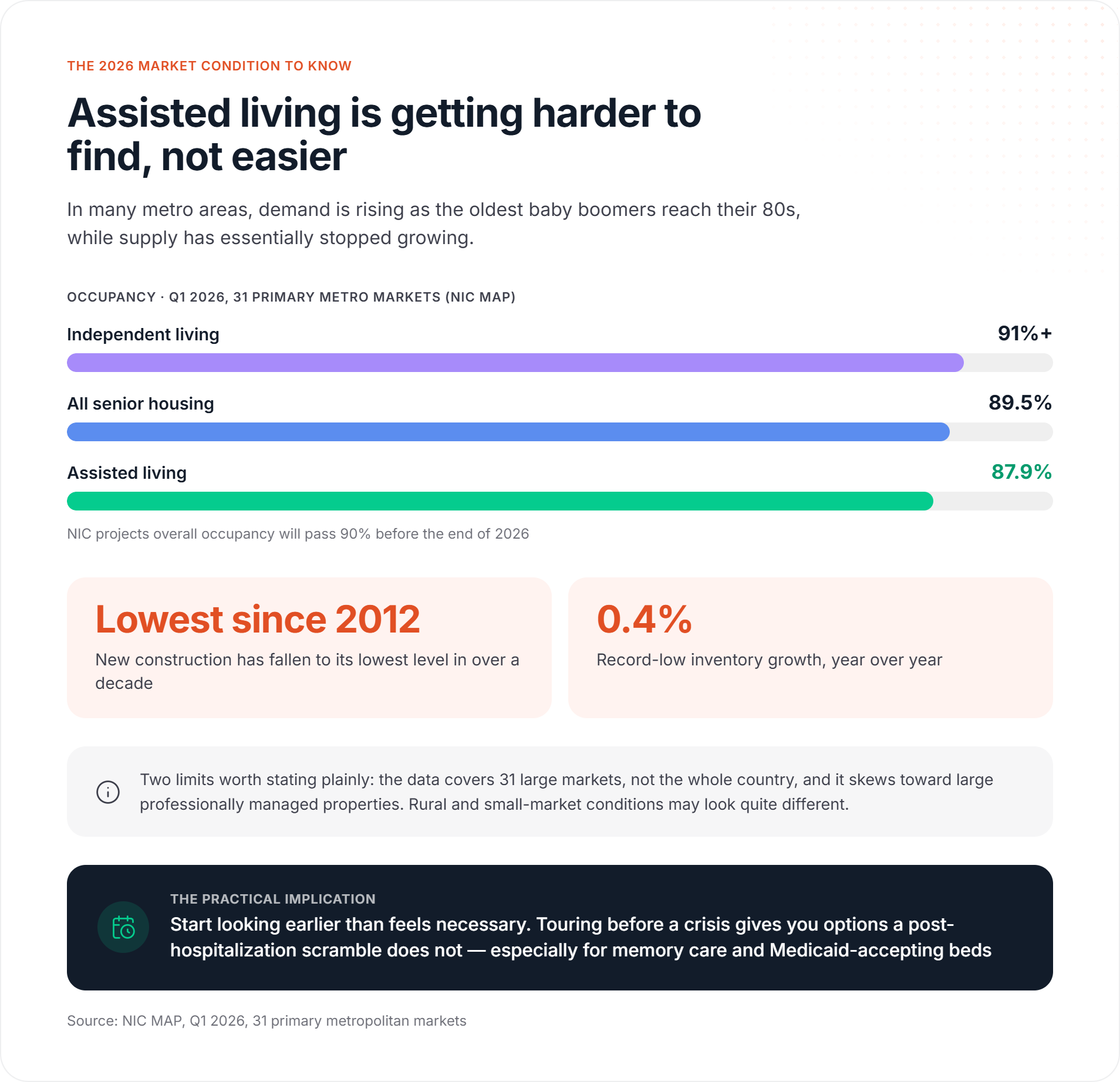
One market condition worth knowing in 2026: in many metro areas, assisted living is getting harder to find, not easier.
Across the 31 primary metropolitan markets NIC MAP tracks, senior housing occupancy reached 89.5% in Q1 2026, with assisted living specifically at 87.9% and independent living above 91% (NIC). At the same time, new construction fell to its lowest level since 2012, and inventory growth hit a record low of 0.4% year over year.
Two limits on that data are worth stating plainly. It covers 31 large markets, not the whole country, and it skews toward large professionally managed properties rather than the small licensed care homes that make up much of the national supply. Rural and small-market conditions may look quite different.
Within those markets, though, the trend is clear: demand is rising as the oldest baby boomers reach their 80s while supply has essentially stopped growing, and NIC projects occupancy will pass 90% before the end of the year. Where that's happening, families face fewer open units and longer waits — particularly for memory care and for Medicaid-accepting beds.
The practical implication: start looking earlier than feels necessary. Touring communities before a crisis gives you options that a post-hospitalization scramble does not.
Frequently Asked Questions
- How much does assisted living cost per month?
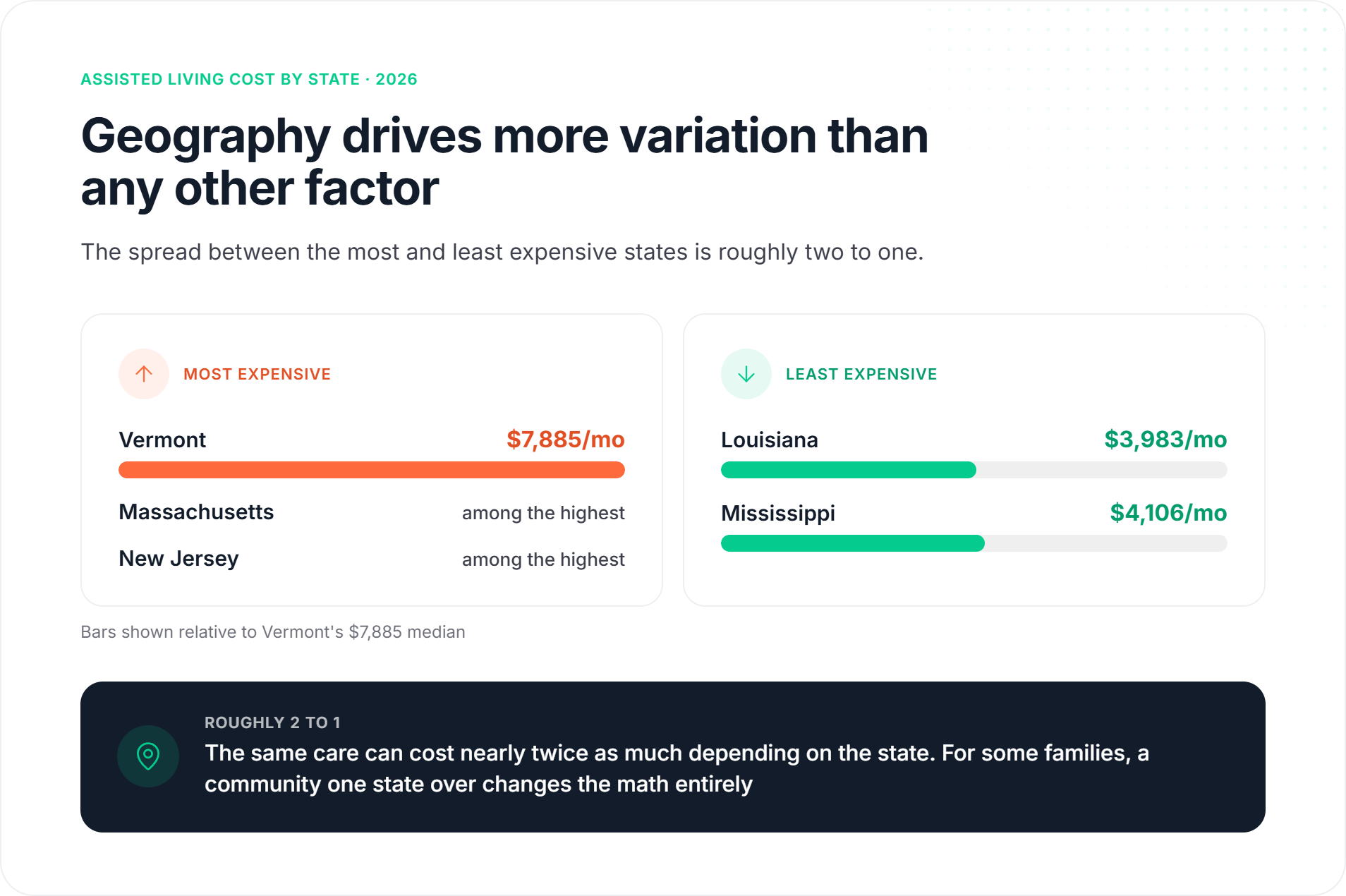
- The national median is between $5,419 and $6,200 per month in 2026, depending on the source. A Place for Mom reports $5,419 based on amounts paid by residents who moved in during 2025 through its referral network; CareScout reports $6,200 based on one-bedroom rates surveyed from providers across metro areas. The two use different unit types, samples, and weighting, which is why they differ. State medians range from about $3,983 in Louisiana to $7,885 in Vermont.
- Does Medicare pay for assisted living?
- No. Medicare does not cover room, board, or personal care in assisted living. It covers medical services a resident receives and short-term skilled nursing facility stays following a qualifying hospital admission, which is a different setting.
- Does Medicaid pay for assisted living?
- Partially, in most states. Medicaid does not pay room and board, but many states cover personal care services through HCBS waivers. Roughly 17% of residential care residents are Medicaid beneficiaries. Waiver slots are limited and waiting lists are common.
- What's the difference between assisted living and a nursing home?
- Assisted living provides help with daily activities in a residential setting and is regulated by states. Nursing homes provide 24-hour skilled nursing care, are federally certified and inspected by CMS, and cost significantly more — a median $315 per day, or $114,975 per year, for a semi-private room in the 2025 CareScout survey.
- How long do people stay in assisted living?
- It varies widely by health status. Many residents move on either to memory care or skilled nursing as needs increase, often triggered by a medical event such as a fall or hospitalization rather than gradual decline.
- Can someone with dementia live in assisted living?
- Often, yes. About 44% of residential care residents have Alzheimer's disease or another dementia, and many live in standard assisted living. Whether a specific community can serve a specific person depends on state retention rules and the community's staffing and security — ask directly about wandering, sundowning, and behavioral symptoms.
- What is included in the monthly fee?
- Typically the apartment, meals, housekeeping, transportation, activities, and 24-hour staff presence. Personal care is often billed separately through care levels, and medication management, incontinence care, and a second occupant usually carry additional fees.
- Is assisted living regulated?
- Yes, but by states rather than the federal government. Each state sets its own licensing standards, staffing requirements, training rules, and inspection schedules. There is no national inspection database or star rating for assisted living the way there is for nursing homes.
- How do I check a community's inspection history?
- Contact your state's assisted living licensing agency — usually housed in the health, human services, or aging department. Many states publish survey results online. Your local long-term care ombudsman can also share complaint history.
- Is assisted living getting harder to find?
- In many metro areas, yes. Across the 31 primary markets NIC MAP tracks, assisted living occupancy reached 87.9% in Q1 2026 while inventory growth fell to a record low of 0.4%, with construction at its lowest level since 2012. That data covers large markets and larger properties, so conditions in rural areas and among small care homes may differ.
Sources
- AHCA/NCAL, Assisted Living Facts and Figures
- CDC/NCHS, Residential Care Community Resident Characteristics: United States, 2022 (Data Brief 506)
- CareScout 2025 Cost of Care Survey
- A Place for Mom, 2026 Costs of Long-Term Care and Senior Living
- NIC MAP, senior housing occupancy Q1 2026
- National Council on Aging, Medicaid and assisted living
- NCAL, Assisted Living State Regulatory Review (2026 edition)
- CMS Informational Bulletin, December 9, 2025
- Bureau of Labor Statistics, CPI-U